
Displaying items by tag: theatre review
No Dogs’ Delivers an Unfamiliar Earnest
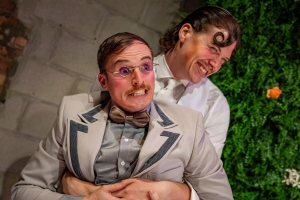
Oscar Wilde’s The Importance of Being Earnest is one of the greatest farces ever written. His wordplay caricatured high society, and clever pay-offs are hilarious when executed properly. The play was first performed on February 14, 1895 (Valentine's Day). The premiere took place at the historic St James's Theatre in London. Wilde famously subtitled the work “A Trivial Comedy for Serious People,” a reminder that its brilliance lies in treating absurdity with absolute sincerity. Unfortunately, No Dogs in the Kitchen Theatre Company’s recent production, directed by Genevieve Corkery, misses the mark when bringing this beloved play to the stage.
For those unfamiliar, the classic comedy follows two high-society bachelors, Jack Worthing and Algernon Moncrieff, who invent secret personas to escape the boredom of everyday life. Trouble arises, however, when Jack (going by the name of “Ernest”) proposes to Gwendolen, who is intent on only marrying a man with that specific name. Matters are complicated further when the carefree, mischievous Algernon also dons the moniker “Ernest” to woo Jack’s ward, Cecily, who shares the exact same romantic obsession with the name. To find happiness, the lovers must quickly untangle a web of ridiculous misunderstandings and mistaken identities. The true brilliance of Wilde’s script lies in its wordplay and sharp societal satire, taking the audience on a wild, hysterical ride where the utterly absurd is treated with the utmost importance.
Founded in 2023, No Dogs in the Kitchen is still a young company, and a certain learning curve is both natural and expected as they continue shaping their artistic identity. Their past work has already shown a clear interest in bold, unconventional staging, often embracing heightened physicality and playful absurdism. That adventurous spirit is a defining part of their aesthetic, and it’s evident the ensemble values experimentation and a willingness to push familiar texts in unexpected directions. While this production didn’t always find harmony between those impulses and Wilde’s finely tuned verbal wit, the company’s enthusiasm, imaginative framework, growing technical confidence, and emerging vision suggest they have the tools to grow into a distinctive and compelling presence within Chicago’s storefront theatre scene.
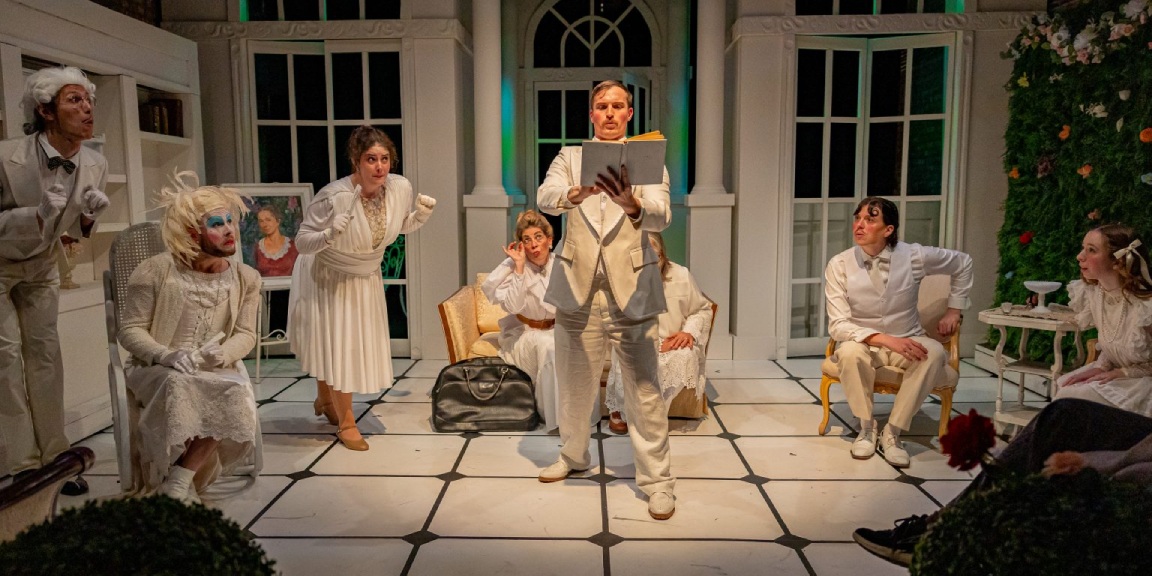
The cast of No Dogs in the Kitchen’s “The Importance of Being Earnest” at Facility Theatre.Photo: Alex Albrecht
That said, where this production struggles is in its apparent distrust of the script, adding jumbled and superfluous elements that only serve to undercut the humor it tries so hard to generate. It is as if the creative team didn't believe the script was funny enough on its own, choosing instead to pile on unnecessary subtext that needlessly deviated from - and was unsupported by - Wilde’s text.
This staging regularly undermines its own comedic timing with added, cartoonish sound effects that reduce wit to silly gags. From boinging springs to breaking plates, it felt as if someone was trying to use every button on a soundboard. Furthermore, a heavy hand of physical humor frequently distracts from the brilliant dialogue. During several monologues, cast members distracted the audience with routines like fighting on a sofa. Another oddity occurred in the final act when multiple cast members broke the fourth wall to deliver lines - a trick they hadn't used up until that point. It’s unclear why there was such distrust in the source material, and why a surplus of additions was believed to be the solution.
The performances also suffered from this same directive, often relying on over-the-top delivery. Mitch Karmis, who played two different butlers, mugged for the audience and utilized an almost cartoon-like physicality. David Lovejoy portrayed Lady Bracknell as a Mommie Dearest caricature instead of the formidable, sophisticated society matriarch who delivers scathing lines with dry, icy wit. The performance moved between widely contrasting vocal registers, creating an uneven tone that often felt out of step with Lady Bracknell’s traditionally controlled presence. It was also unclear why, in the final act, Lady Bracknell suddenly transformed into a flirtatious aggressor who growled at Jack and threw herself at the butler. Another odd decision was to have Dr. Chasuble played by Sara Corkery in a rubber race mask.
Amidst these choices, there was a bright spot in Garret Weigel’s Jack. For the most part, Weigel found the right balance between inventive character choices and a respect for the script. Jack could easily be played as a boring straight-man when up against the whimsical Algernon, but Weigel added a distinct flair to his interpretation without straying too far from the original play.
It is genuinely unfortunate that the production chose to deviate so drastically from the text. When done faithfully, The Importance of Being Earnest is a true theatrical gem. While there were moments that elicited genuine laughter, they occurred when the text was allowed to speak for itself, rather than being buried under extraneous gags.
While this hyper-stylized, over-the-top version might appeal to theatergoers seeking a radical, alternative spin on a classic, those looking for a faithful, witty adaptation of Wilde’s masterpiece will likely find this production is not the one.
The Importance of Being Earnest runs through July 26th at Facility Theatre. For more information and/or tickets, visit https://nodogsinthekitchen.org/.
keerah - Lost Between Myth and Reality
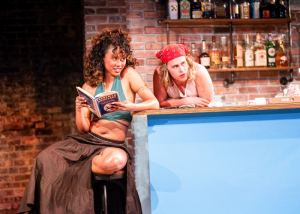
Definition Theatre's Amplify New Play Program exists to elevate emerging voices, and Netta Walker's keerah certainly arrives with ambition. Loosely inspired by the mythological lovers Orpheus and Eurydice, the play explores race, identity, love, and memory through the relationship between Ciara and Cormac. While the production benefits from strong performances and excellent design work, the script ultimately struggles to transform its compelling ideas into equally compelling drama.
The cast features Netta Walker as Ciara, Cat Christmas as Lucy, Beck Nolan as Cormac, and Jacob Coggeshall as Finn. Under the direction of McKenzie Chinn, the actors work tirelessly to bring depth and authenticity to the material. Walker and Nolan, in particular, share a natural chemistry that anchors the evening. Their relationship serves as a constant reminder of the play's potential. Even when the script falters, both actors remain committed to finding emotional truth in their characters.
The first act unfolds as something of a meandering exploration of youthful angst and attraction. While it establishes the emotional stakes, it often feels unfocused. The second act finds greater urgency but also becomes increasingly forced, pushing emotional revelations rather than allowing them to emerge organically. Although Walker draws inspiration from the story of Orpheus and Eurydice, these characters never achieve the mythic resonance suggested by that source material. In fact, despite the strong acting, Ciara and Cormac never fully emerge as people who exist beyond the play's thematic framework.
The central relationship also bears the weight of a nearly two-hour running time. Scene after scene dissects emotional wounds without revealing enough new dimensions to sustain the audience's investment. The result is a play that feels longer than it is, with the stakes remaining surprisingly low considering the intensity with which they are discussed.
More problematic is the play's handling of race and identity. At one point Cormac declares, "I'm not white, I'm Irish," a statement that hints at a potentially fascinating conversation about ethnicity and cultural identity. Unfortunately, the play never meaningfully explores the implications of that claim. Even more troubling is a scene in which Ciara opens a bottle of Hennessy and mutters a racial slur. Rather than illuminating character or advancing the narrative, the moment feels gratuitous and awkwardly inserted for shock value.
Fortunately, the production's design elements are consistently strong. Scenic Designer Isa Noe creates realistic environments that are immediately recognizable and lived-in. The restaurant where the women work, the city streets, and the bedroom scenes all feel authentic. Garrett Bell's lighting design beautifully supports the shifting moods of the play, while Costume Designer Janelle Smith outfits the characters in clothing that feels both realistic and specific. Sound Designer Aaron Harris Woodstein further enriches the atmosphere.
One leaves keerah admiring the effort more than the result. Definition Theatre has repeatedly demonstrated its ability to produce work of the highest caliber, and its commitment to developing new plays remains invaluable. While keerah contains moments of promise and is bolstered by a talented cast and creative team, it remains a work still searching for the emotional and thematic clarity that would allow its ideas to truly resonate.
Somewhat Recommended
When: Through June 28
Where: Definition Theatre @1160 E. 55th Street Chicago
Running Time 2 hours with a 15-minute intermission
Tickets: Start at $25
312-469-0390
https://www.definitiontheatre.org/shows/keerah
This review is proudly shared with our friends at www.TheatreInChicago.com.





Latest Articles
-
 Identity Performing Arts' Fifth Anniversary Gala: Movement That Keeps Becoming
Written by Wesley DavidFive years is an important milestone for any arts organization, but for a contemporary dance company it also marks an artistic coming of age. Identity Performing Arts celebrated its fifth anniversary at the Edlis Neeson Theater at the Museum of…
Identity Performing Arts' Fifth Anniversary Gala: Movement That Keeps Becoming
Written by Wesley DavidFive years is an important milestone for any arts organization, but for a contemporary dance company it also marks an artistic coming of age. Identity Performing Arts celebrated its fifth anniversary at the Edlis Neeson Theater at the Museum of… -
 Overshadowed Theatrical Productions Brings Beloved Holiday Classic It’s a Wonderful Life to the Stage
Written by Buzz Center StageThis holiday season, Overshadowed Theatrical Productions is thrilled to present the timeless holiday classic, It’s a Wonderful Life, live on stage. As Frank Capra’s legendary film celebrates its 80th anniversary, this stage adaptation offers the perfect way for families and…
Overshadowed Theatrical Productions Brings Beloved Holiday Classic It’s a Wonderful Life to the Stage
Written by Buzz Center StageThis holiday season, Overshadowed Theatrical Productions is thrilled to present the timeless holiday classic, It’s a Wonderful Life, live on stage. As Frank Capra’s legendary film celebrates its 80th anniversary, this stage adaptation offers the perfect way for families and… -
 Dance Theatre of Harlem fills Auditorium Theatre with fire and funk
Written by Susan LiebermanProjecting a vibe that felt more homecoming party than ballet presentation, Dance Theatre of Harlem returned to Chicago on October 17th after a 10-year absence. The Auditorium Theatre audience took a while to assemble itself largely because people were having…
Dance Theatre of Harlem fills Auditorium Theatre with fire and funk
Written by Susan LiebermanProjecting a vibe that felt more homecoming party than ballet presentation, Dance Theatre of Harlem returned to Chicago on October 17th after a 10-year absence. The Auditorium Theatre audience took a while to assemble itself largely because people were having… -
 “A Strange Loop” Lets the Intrusive Thoughts Win at Raven Theatre in partnership with About Face Theatre
Written by John AccroccoA musical, but it’s just the voices in your head. Sounds just crazy enough to win the 2020 Pulitzer for Drama. “A Strange Loop” by Michael R. Jackson finally makes its Chicago premiere at Raven Theatre in a co-production with…
“A Strange Loop” Lets the Intrusive Thoughts Win at Raven Theatre in partnership with About Face Theatre
Written by John AccroccoA musical, but it’s just the voices in your head. Sounds just crazy enough to win the 2020 Pulitzer for Drama. “A Strange Loop” by Michael R. Jackson finally makes its Chicago premiere at Raven Theatre in a co-production with…
Does your theatre company want to connect with Buzz Center Stage or would you like to reach out and say "hello"? Message us through facebook or shoot us an email at This email address is being protected from spambots. You need JavaScript enabled to view it..
*This disclaimer informs readers that the views, thoughts, and opinions expressed in the text belong solely to the author, and not necessarily to Buzz Center Stage. Buzz Center Stage is a non-profit, volunteer-based platform that enables, and encourages, staff members to post their own honest thoughts on a particular production.