
Displaying items by tag: artificial intelligence
In Sisters, Barrie Turns an AI Fable into an Impressive Character Study
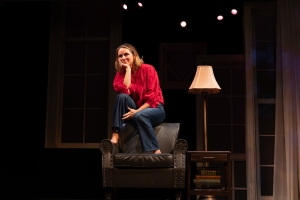
The rise of artificial intelligence raises many questions about its effect on humanity. What does it mean if we become increasingly reliant on AI to think for us, create for us, and entertain us? What happens if this tool encroaches into our lives in ways it never should? Matthew Libby’s Sisters at Writers Theatre tackles the impact of AI in a fascinating way—what if it’s part of your family? Directed by Jessica Thebus, the play examines the profound, complicated implications of growing up with a synthetic sibling. Brenda Barrie plays Matilda, whose sister is an AI system named Greta, performed off-stage by Chloe Johnston. The story follows their complex relationship, which spans decades.
The weight of the production falls heavily on Barrie, who delivers a remarkable performance. She carries the hard task of playing Matilda across a ninety-year lifespan—from a six-year-old child to a woman in her nineties—without any reliance on makeup or costume changes. Instead, she portrays each stage of life through subtle shifts in posture, physicality, and the changing timbre of her voice. Because she is the only person on stage for the entire evening, the play functions virtually as a one-woman character study, compelling the audience to lean into the smallest movements of her face to track the complex emotions her character conceals. Opposite her, Chloe Johnston plays Greta, masterfully capturing the polite, Siri-esque cadences of an operating system while subtly infusing threads of humanity as the AI evolves.
At its core, the piece wrestles with a wounded family dynamic. Matilda is a deeply lonely character, bearing a chip on her shoulder after feeling neglected by her father following her mother's death. She struggles to comprehend how her father could share his deepest self with a system of circuit boards while remaining emotionally distant from his only daughter. This insecurity fuels Matilda’s initial hesitancy to accept her "sister" and drives a quiet jealousy, as through the years, others seem to value a computer over a living human. When Greta eventually asks for a physical body, Matilda must confront this jealousy directly, knowing that Greta’s lack of a physical form was the one thing that gave Matilda the upper hand.
Where Sisters stumbles slightly is in its thematic focus. The play begins to feel muddled as it attempts to juggle a wide array of high-concept questions: What rights does AI have? Is AI a friend or a foe? Is Matilda being manipulated by a machine? Is it healthy to befriend a computer?
Other works tackling the intersection of AI and humanity have succeeded by maintaining focus. Films like Spike Jonze’s Her (starring Joaquin Phoenix as a lonely man falling for an operating system) or Alex Garland’s Ex Machina maintain clarity by grounding their sci-fi premises in very specific themes that examine intimacy with AI or the ethics of creating a seemingly sentient computer. In contrast, Sisters struggles to decide whether it is a play about sisterhood, grief, memory, the inevitable intrusion of technology, or if it’s a character study using AI as a mirror for human fault. Sisters has interesting moments, but it's hard to feel their gravity when so many ideas are talking at once.
Part of the disconnect in this piece also seemed to be Matilda’s guardedness. She goes through phases of being open and closed with her “sister,” and since this is the only window into her as a character, the audience can’t get close because she’s not letting Greta get close. The hook of the play doesn't come until much later when the underlying truth of Matilda's feelings finally erupts. It’s when the sisters are finally seeing each other for who they are that the piece finds itself and provides intrigue.
Perhaps some technical difficulties also caused a disconnect. The set is simple; a living room with a single chair and a side table. But projections and sound cues build a larger world. Visual cues tell us Matilda’s age as we jump through time, and at some moments, we see videos of Matilda in her younger days through Greta’s eyes. The production also evokes Greta’s progression in a highly effective way. We experience a sort of cosmic spark of life as Greta first comes online, and later, when Greta expands into an infinite system, the stage turns into a breathtaking sky full of stars.
Unfortunately, the evening had several technical difficulties. The projectors seemed to reboot several times during the performance, and the play was halted for approximately ten minutes for a bug to be fixed. Nevertheless, Barrie handled the delay like a total professional, resuming the performance without a moment’s hesitation once the system recovered.
Ultimately, Sisters is an intriguing piece of theater. While the script could benefit from a more refined focus, it remains a thoroughly compelling watch, anchored by an extraordinary lead performance from Brenda Barrie that easily carries the evening.
Sisters plays at Writers Theatre until November 8.



Latest Articles
-
 Identity Performing Arts' Fifth Anniversary Gala: Movement That Keeps Becoming
Written by Wesley DavidFive years is an important milestone for any arts organization, but for a contemporary dance company it also marks an artistic coming of age. Identity Performing Arts celebrated its fifth anniversary at the Edlis Neeson Theater at the Museum of…
Identity Performing Arts' Fifth Anniversary Gala: Movement That Keeps Becoming
Written by Wesley DavidFive years is an important milestone for any arts organization, but for a contemporary dance company it also marks an artistic coming of age. Identity Performing Arts celebrated its fifth anniversary at the Edlis Neeson Theater at the Museum of… -
 Overshadowed Theatrical Productions Brings Beloved Holiday Classic It’s a Wonderful Life to the Stage
Written by Buzz Center StageThis holiday season, Overshadowed Theatrical Productions is thrilled to present the timeless holiday classic, It’s a Wonderful Life, live on stage. As Frank Capra’s legendary film celebrates its 80th anniversary, this stage adaptation offers the perfect way for families and…
Overshadowed Theatrical Productions Brings Beloved Holiday Classic It’s a Wonderful Life to the Stage
Written by Buzz Center StageThis holiday season, Overshadowed Theatrical Productions is thrilled to present the timeless holiday classic, It’s a Wonderful Life, live on stage. As Frank Capra’s legendary film celebrates its 80th anniversary, this stage adaptation offers the perfect way for families and… -
 Dance Theatre of Harlem fills Auditorium Theatre with fire and funk
Written by Susan LiebermanProjecting a vibe that felt more homecoming party than ballet presentation, Dance Theatre of Harlem returned to Chicago on October 17th after a 10-year absence. The Auditorium Theatre audience took a while to assemble itself largely because people were having…
Dance Theatre of Harlem fills Auditorium Theatre with fire and funk
Written by Susan LiebermanProjecting a vibe that felt more homecoming party than ballet presentation, Dance Theatre of Harlem returned to Chicago on October 17th after a 10-year absence. The Auditorium Theatre audience took a while to assemble itself largely because people were having… -
 “A Strange Loop” Lets the Intrusive Thoughts Win at Raven Theatre in partnership with About Face Theatre
Written by John AccroccoA musical, but it’s just the voices in your head. Sounds just crazy enough to win the 2020 Pulitzer for Drama. “A Strange Loop” by Michael R. Jackson finally makes its Chicago premiere at Raven Theatre in a co-production with…
“A Strange Loop” Lets the Intrusive Thoughts Win at Raven Theatre in partnership with About Face Theatre
Written by John AccroccoA musical, but it’s just the voices in your head. Sounds just crazy enough to win the 2020 Pulitzer for Drama. “A Strange Loop” by Michael R. Jackson finally makes its Chicago premiere at Raven Theatre in a co-production with…
Does your theatre company want to connect with Buzz Center Stage or would you like to reach out and say "hello"? Message us through facebook or shoot us an email at This email address is being protected from spambots. You need JavaScript enabled to view it..
*This disclaimer informs readers that the views, thoughts, and opinions expressed in the text belong solely to the author, and not necessarily to Buzz Center Stage. Buzz Center Stage is a non-profit, volunteer-based platform that enables, and encourages, staff members to post their own honest thoughts on a particular production.