
Displaying items by tag: Facility Theatre
The 37th annual Rhinoceros Theater Festival through October 26 at Six Chicago venues
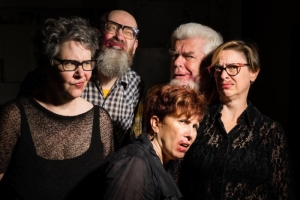
Curious Theatre Branch, with co-producers Chicago Danztheater Ensemble, Chicago Dramatists and Labyrinth Club, are pleased to announce the 37th annual Rhinoceros Theater Festival, September 20 - October 26 at four venues across Chicago. The month-long festival of shows will kick off with a special “afternoon tea” edition of the Full Moon Vaudeville, this concert launches the festival on Sunday, Sept. 20 at 3 p.m. at Facility Theatre, 1138 N. California Ave., headlined by art/folk/cabaret act The Crooked Mouth and other special guests.
Throughout its nearly four decades, Rhinofest has endeavored to welcome as many participants as possible, both as artists and as audience members. To that end, artists pay no fee to apply or to produce their works at Rhinofest and all tickets are offered at pay-what-you-can pricing, with a $25 suggested price. Tickets and details for all upcoming shows will be available Sunday, Sept. 6 at Rhinofest.com.
Since its inception in 1989, as a single weekend of shows in the Wicker Park neighborhood, this unique and mutable fringe festival has expanded and contracted to fit the time and has become the longest running Fringe Festival in Chicago. Festival events will take place at four venues this year: Facility Theatre, 1138 N. California Ave. in Humboldt Park; Chicago Dramatists, 798 N. Aberdeen in River West, Labyrinth Arts Club, 3658 N. Pulaski Rd. in the Irving Park neighborhood and Chicago Danztheatre Ensemble, 1650 W. Foster Ave.
The 37th Rhinofest will feature mostly original work from Chicago artists and companies, including new work from The Fat Theater Project, the 10th anniversary of Ira Murfin’s An Interview, a new work by Jessica Wright Buha, new work from Drinking and Writing Theater, and, of course, an evening of short works by The Curious Theatre Branch, Rhinofest’s host. New to the Festival in 2026 are partnerships with Chicago Danztheater, a beautiful space in Andersonville, featuring movement-based work and a creativity workshop called Maps, Guides & Legends: a generative writing and interdisciplinary art-making workshop on Saturday, Oct. 24 at 10 a.m. - 2 p.m.
This year's festival will feature plays, music and performances from more than 35 companies and solo artists. Among the highlights are:
The Full Moon Vaudeville
Facility Theater, 1138 N. California Ave.
Sunday, Sept. 20 at 3 p.m.
The annual bacchanalia headlined by art/folk/cabaret act The Crooked Mouth
includes a variety of acts to inaugurate the festival featuring cool things as yet unknown and a rare afternoon teatime show.
Make Out the Words
by The Curious Theatre Branch
Chicago Dramatists, 1105 W. Chicago Ave.
Saturday, Oct. 3 at 9 p.m., Sunday, Oct. 4 at 5 p.m., Saturday, Oct. 10 at 7 p.m., Sunday, Oct. 18 at 5 p.m., Friday, Oct. 23 at 7 p.m.
Make Out the Words: two new short plays inspired by the unproduced writing of the late Matt Rieger, by Curious ensemble members Charlotte Lastra and Chris Bower. The show also features a performance of Rieger's own text by Beau O'Reilly.
A strange encounter on a train leaves an aimless woman desperate for answers, and a flood with no explanation leaves a couple with a basement full of ruined Moby Dicks.
Drinking and Writing Theater: Miersten Wolf
Labyrinth Arts Club, 3658 N. Pulaski Rd.
Thursdays: Sept. 24, Oct. 1, Oct. 8, Oct. 15 and Oct. 22 at 7 p.m.
In this 70-minute musical, three stories are interwoven with 10 original songs. The stories include the truthful biographical information of the writer, the history of Chicago's problem/solution with its waste and, lastly, a fictional story of a crib keeper on Lake Michigan who dreams of a mysterious woman named Miersten Wolf.
Works in Progress
By Jeff Glassman, Mark Enslin and Susan Parenti
Chicago Dramatists, 1105 W. Chicago Ave.
Saturday, Oct. 3 at 7 p.m. and Sunday, Oct. 4 at 3 p.m.
Works in progress include Radish is My Teacher by Jeff Glassman, a collection of scripts for puppets by Susan Parenti and a libretto by Mark Enslin about a stranded international volunteer incarcerated firefighter. Both Susan Parenti & Jeff Glassman have had new works produced here in Chicago and around the country over the last decade.
The Metamorphosis aka The Adult Show/I'm a Bug!!! aka the Kids Show
By Jessica Wright Buha
Chicago Dramatists, 1105 W. Chicago Ave.
Sundays: Oct. 4, Oct. 11, Oct. 18 and Oct. 25 at 11 a.m.
This staged reading presents TWO works-in-progress that will happen at the same time (in two separate rooms).
The Metamorphosis aka The Adult Show, is a five-actor immersive show based on Franz Kafka's “The Metamorphosis.”
I'm a Bug!!!! aka the Kids Show, is a two-actor/teaching artist show for kids based on Franz Kafka's “The Metamorphosis.” This second piece will also serve as child care for audience members going to see The Metamorphosis.
Shaking the Beckett:
The Magic of Lady M. and A Needless & Wasteful Requirement
By Fat Theater Company
Chicago Danztheatre Ensemble, 1650 W. Foster Ave.
Friday, Oct. 9 and Saturday, Oct. 10 at 9 p.m.
These two one acts are both subjective and satirical interpretations of the works of two theatrical masters: William Shakespeare and Samuel Beckett. The Magic of Lady M. by Laura Scruggs reimagines the tragedy of “Macbeth” as a feminist political satire in a style akin to John Waters or “Ru Paul's Drag Race.” A Needless & Wasteful Requirement by Robert MacCrae follows two actresses awaiting the performance rights to produce Waiting for Godot, which becomes an existential absurd comedy in the vein of Beckett himself.
An Interview
By Ira Murfin
Sunday, Oct. 18 at 4 p.m. at Labyrinth Arts Club, 3658 N. Pulaski Rd.
Saturday, Oct. 24 at 9 p.m. at Chicago Danztheatre Ensemble, 1650 W. Foster Ave.
An Interview is an ongoing series of encounters between rotating pairs of participants, who meet across a table in front of an audience to first revisit an interview conducted during the previous installment and now to conduct a new, unrehearsed conversation. Every performance is specific, unique and unrepeatable, while each encounter is connected to all the others by the format and sequence that carries through the project’s 10-year history.
Special Event: Maps, Guides & Legends
Led by Sherry Antonini and Jenny Magnus
Chicago Danztheatre Ensemble, 1650 W. Foster Ave.
Saturday, Oct. 24 from 10 a.m. - 2 p.m.
Maps, Guides & Legends is a generative writing and interdisciplinary art-making workshop. A writing and creativity day based on the idea that doing is learning, and experiments and games are an explosive way to try new things. Antonini and Magnus have been teaching together for 30 years, from the incredible Interdisciplinary Arts Department at Columbia College Chicago back in the day to writing classes at The School of the Art Institute and everything in between. This duo knows how to have fun and get ideas rolling. Anyone can get ready to begin, begin again or find a way through the middle of a project. Open to writers and interdisciplinary artists at all levels, this workshop will point to new project routes, productive detours and discoveries of what can be found along unpaved roads.
About the Rhinoceros Theater Festival
The event that became the Rhinoceros Theater Festival began in 1988 as an offshoot of the Bucktown Arts Fest and in its first year featured just two days of performances, including work by Curious Theatre Branch co-founders Jenny Magnus and Beau O'Reilly. Curious went on to produce the Rhino across many neighborhoods and venues over the years, with events variously taking place in Wicker Park/Bucktown, Rogers Park, Andersonville and Avondale; at spaces including the Lunar Cabaret and Full Moon Café, the Neo-Futurarium, the Society for New Things, The Garage, The Firehouse, Remains Theatre and Prop Thtr. In the mid-2000s, Rhinofest settled at Prop Thtr in Avondale as its long-term base and Prop and Curious co-produced the festival among a shifting group of curators for many years. Following the closure of Prop's Elston Ave. space in 2020 and a year off during the height of the pandemic, Rhinofest now returns to its expanded form, producing shows by more than 50 artists at multiple venues.
No Dogs’ Delivers an Unfamiliar Earnest
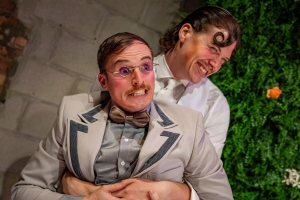
Oscar Wilde’s The Importance of Being Earnest is one of the greatest farces ever written. His wordplay caricatured high society, and clever pay-offs are hilarious when executed properly. The play was first performed on February 14, 1895 (Valentine's Day). The premiere took place at the historic St James's Theatre in London. Wilde famously subtitled the work “A Trivial Comedy for Serious People,” a reminder that its brilliance lies in treating absurdity with absolute sincerity. Unfortunately, No Dogs in the Kitchen Theatre Company’s recent production, directed by Genevieve Corkery, misses the mark when bringing this beloved play to the stage.
For those unfamiliar, the classic comedy follows two high-society bachelors, Jack Worthing and Algernon Moncrieff, who invent secret personas to escape the boredom of everyday life. Trouble arises, however, when Jack (going by the name of “Ernest”) proposes to Gwendolen, who is intent on only marrying a man with that specific name. Matters are complicated further when the carefree, mischievous Algernon also dons the moniker “Ernest” to woo Jack’s ward, Cecily, who shares the exact same romantic obsession with the name. To find happiness, the lovers must quickly untangle a web of ridiculous misunderstandings and mistaken identities. The true brilliance of Wilde’s script lies in its wordplay and sharp societal satire, taking the audience on a wild, hysterical ride where the utterly absurd is treated with the utmost importance.
Founded in 2023, No Dogs in the Kitchen is still a young company, and a certain learning curve is both natural and expected as they continue shaping their artistic identity. Their past work has already shown a clear interest in bold, unconventional staging, often embracing heightened physicality and playful absurdism. That adventurous spirit is a defining part of their aesthetic, and it’s evident the ensemble values experimentation and a willingness to push familiar texts in unexpected directions. While this production didn’t always find harmony between those impulses and Wilde’s finely tuned verbal wit, the company’s enthusiasm, imaginative framework, growing technical confidence, and emerging vision suggest they have the tools to grow into a distinctive and compelling presence within Chicago’s storefront theatre scene.
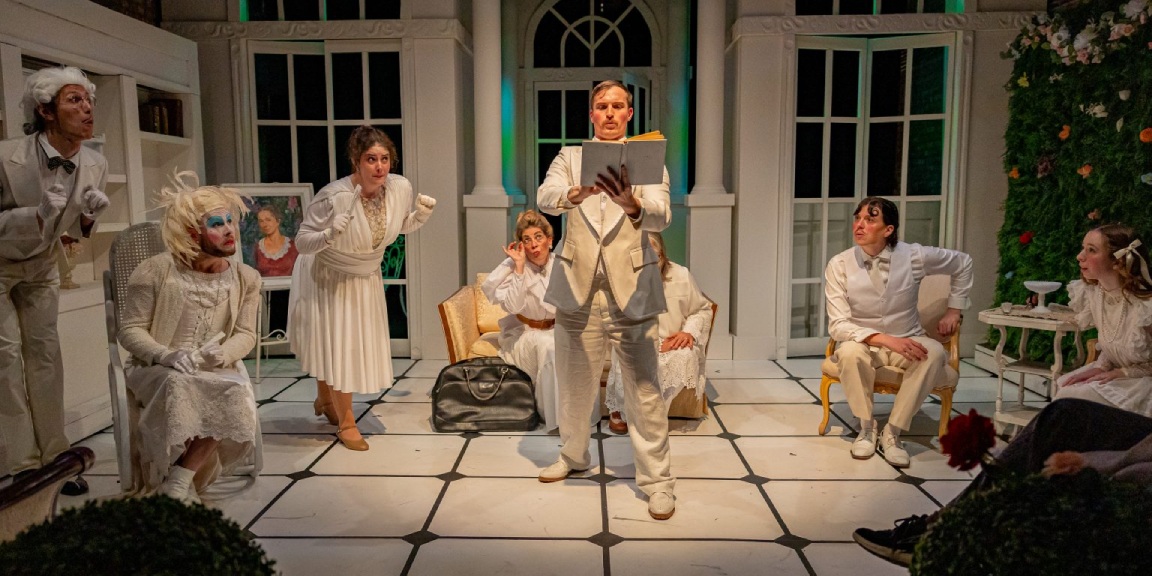
The cast of No Dogs in the Kitchen’s “The Importance of Being Earnest” at Facility Theatre.Photo: Alex Albrecht
That said, where this production struggles is in its apparent distrust of the script, adding jumbled and superfluous elements that only serve to undercut the humor it tries so hard to generate. It is as if the creative team didn't believe the script was funny enough on its own, choosing instead to pile on unnecessary subtext that needlessly deviated from - and was unsupported by - Wilde’s text.
This staging regularly undermines its own comedic timing with added, cartoonish sound effects that reduce wit to silly gags. From boinging springs to breaking plates, it felt as if someone was trying to use every button on a soundboard. Furthermore, a heavy hand of physical humor frequently distracts from the brilliant dialogue. During several monologues, cast members distracted the audience with routines like fighting on a sofa. Another oddity occurred in the final act when multiple cast members broke the fourth wall to deliver lines - a trick they hadn't used up until that point. It’s unclear why there was such distrust in the source material, and why a surplus of additions was believed to be the solution.
The performances also suffered from this same directive, often relying on over-the-top delivery. Mitch Karmis, who played two different butlers, mugged for the audience and utilized an almost cartoon-like physicality. David Lovejoy portrayed Lady Bracknell as a Mommie Dearest caricature instead of the formidable, sophisticated society matriarch who delivers scathing lines with dry, icy wit. The performance moved between widely contrasting vocal registers, creating an uneven tone that often felt out of step with Lady Bracknell’s traditionally controlled presence. It was also unclear why, in the final act, Lady Bracknell suddenly transformed into a flirtatious aggressor who growled at Jack and threw herself at the butler. Another odd decision was to have Dr. Chasuble played by Sara Corkery in a rubber race mask.
Amidst these choices, there was a bright spot in Garret Weigel’s Jack. For the most part, Weigel found the right balance between inventive character choices and a respect for the script. Jack could easily be played as a boring straight-man when up against the whimsical Algernon, but Weigel added a distinct flair to his interpretation without straying too far from the original play.
It is genuinely unfortunate that the production chose to deviate so drastically from the text. When done faithfully, The Importance of Being Earnest is a true theatrical gem. While there were moments that elicited genuine laughter, they occurred when the text was allowed to speak for itself, rather than being buried under extraneous gags.
While this hyper-stylized, over-the-top version might appeal to theatergoers seeking a radical, alternative spin on a classic, those looking for a faithful, witty adaptation of Wilde’s masterpiece will likely find this production is not the one.
The Importance of Being Earnest runs through July 26th at Facility Theatre. For more information and/or tickets, visit https://nodogsinthekitchen.org/.
Experimental Theater Grottesco and Fay|Glassman Duo Bring New Approach to Stage Narrative in 'Action at a Distance'

Santa Fe-based Theater Grottesco's new show, produced with Fay|Glassman Duo of Urbana, IL, is having its Chicago premiere at the Facility Theater on California near Division, brings a new approach to the performance and script design. The one-hour “Action at a Distance. . .in 2025” consists of six different plays, all performed simultaneously by the troupe of four actors. Devised by Lisa Fay and Jeff Glassman, “Action at a Distance” is probably unlike anything you will have experienced; it was for me.
The plays involved are these:
1. A family with a crying child frantically prepares to evacuate their home in advance of a hurricane.
2. An international human rights lawyer flees her international arms-dealing partner.
3. A filmmaker interviews a doctor who volunteered at the Occupy Wall Street tent camp in 2011.
4. A union local hosts an address by a revolutionary Venezuelan union leader.
5. An artist prepares a gallery installation of the UN negotiator's office for the 1948 Palestine Mandate, just before the negotiator’s assassination by the Stern Gang.
6. A financial mogul is unnerved by a rock, with a photo attached, smashing his window.
Each of these descriptors, provided by Fay|Glassman, suggest provocative and even enticing drama. They are not, however, played in a sequence of say, six 10-minute plays performed consecutively. Instead, all six are performed at once. Perhaps to ease the audience into what is without question a jarring experience, the performance begins with a clearly identifiable scene from the fifth play in the series.
In this one, the Artist (Apollo Garcia Orellana) is arranging the installation of the UN negotiator’s desk. A kaffiyeh scarf on a coat rack cues us to the scene as the Artist types words that would have appeared in the typewriter moments before the negotiator was assassinated. The Artist is carefully arranging the negotiator's books, sets his chair at the angle it occupied, while another character, perhaps his spouse (Elizabeth Glass), nibbling on a sandwich, nitpicks at his work and intimates the futility of the project as a whole.
“You’re doing a whole installation about Palestine and you’ll never get another grant,” the spouse declares, to which the Artist retorts, “It’s genocide.” He encourages her to find something to occupy herself, as she devilishly rearranges the gloves on the desk each time the Artist places them just so - a subtle skirmish between the two.
Soon enough two new actors enter the scene, and we can determine we are witnessing play number three, the camera-toting Documentarian (Danielle Louise Reddick) interviewing the Volunteer Doctor (John Flax) about his time in the 2011 Occupy Wall Street demonstrations. The characters offer exposition by self-description. If I recall accurately, the Artist is still upstage, doing some stage business from his scene, while the Documentarian and Doctor deliver their lines stage front. “When did you first get involved in Occupy Wall Street,” the Documentarian queries. The Doctor later reveals, “My mother told me that racism was the best way to control white people.”
That scene dissolves as Reddick now becomes an adult trying to comfort and distract an unseen child as her family prepares to evacuate before a hurricane. A suitcase is rolled into the action and the rest of the company joins a flurry of angst-ridden preparation flavored with recrimination and peremptory orders as they all prepare to flee.
Soon Reddick introduces an unseen speaker to an unseen audience. “Everyone, this is Dr. Lenzo, from Venezuela,” and we know the address by a revolutionary Venezuelan union leader has commenced - the fourth of the plays. And so on until all six plays are in motion on stage.
Striking lines jump out from the individual plays, and at times all the players are involved in a scene in which the dialog has meaning for all of them. “Would you take that out in the hall please?” On the whole, “Action at a Distance. . .in 2025” has no obvious meaning, and seems like a jumble of vaguely related utterances that finally give way to a single, diminishing spotlight on a one actor, and then darkness.
It was only in the discussion with the cast and the co-creator of the script, Jeff Glassman, that some light was shed on what the viewers had witnessed We learned that half the play is partly unscripted, and that the occasions in which an actor is playing to an invisible person are called “manifested absences.” Glassman declares that never happens in theater, though that is patently incorrect, and the one-sided phone conversation is a familiar example.

The six plays run largely independent of each other, except for two occasions when the action of all of them converge. Garcia Orellana holds up a color coded timeline, explaining, “There are two places where we all land on the same page.” This timeline reflects the acting and directorial planning to keep the action straight.
The effect, regardless of the intellectual construct behind it, seems Dada-esque. Though in some respects the show is engaging, it wasn’t particularly enjoyable or satisfying for me.
An over-arching theme for the stories is one of failure, Glassman says.“It points at the fact that there are many failures around us that are compounded. There’s no excuse for it.” Viewing “Action at a Distance . . .in 2025” requires real effort from an audience member, and certainly the activation of their imagination. “In order to get out of that [failure],” Glassman says, “we have to use imagination.”
As to the style and structure of the show, Glassman poses a question. “Why is theater about one person going through life?” In other words, why is it about a protagonist encountering obstacles and reaching some kind of resolution, along a linear timeline? Why not dispense with timeline, and allow multiple themes to be expressed simultaneously on stage in a play?
“Dance, music, have done that,” Glassman says. Why not theater?
Here's why. Music is purely aural, dance is visual and aural. Humans can hear and see multiple themes running simultaneously and register them in a wide panorama of experience that affects us non-verbally. Plays use words. The words don’t have meaning when they aren’t delivered in a reasonably sequential manner. They just become a word salad. We come away with very little.
Theater Grottesco describes this as “immersing audiences in a constantly shifting mosaic of interactions and emotions,” and “much like the bustle of a crowded airport, ‘Action at a Distance’ captures the unpredictability within human connections.” Somehow, I think sitting in the concourse of Terminal 1 is more enjoyable than this Facility Theater show.
Perhaps Glassman’s approach would have validity if it were used for a single play, not six of them at once. For me, it was an interesting thought experiment, and it will be intriguing to see if anything comes from any quarter of the theater world, in the development of this approach. “Action at a Distance” runs through November 16, 2025 with performances at 3 pm and 8 pm.



Latest Articles
-
 “A Strange Loop” Lets the Intrusive Thoughts Win at Raven Theatre in partnership with About Face Theatre
Written by John AccroccoA musical, but it’s just the voices in your head. Sounds just crazy enough to win the 2020 Pulitzer for Drama. “A Strange Loop” by Michael R. Jackson finally makes its Chicago premiere at Raven Theatre in a co-production with…
“A Strange Loop” Lets the Intrusive Thoughts Win at Raven Theatre in partnership with About Face Theatre
Written by John AccroccoA musical, but it’s just the voices in your head. Sounds just crazy enough to win the 2020 Pulitzer for Drama. “A Strange Loop” by Michael R. Jackson finally makes its Chicago premiere at Raven Theatre in a co-production with… -
 Announcing Goodman's 22nd New Stages 2026 Festival Line-Up
Written by Buzz Center StageFrom a "Kung Fu rom-com" to a witchy new musical, The Goodman's popular New Stages Festival in its 22nd year continues to offer a first glimpse at the latest works by a handful of the hottest contemporary playwrights. This year's four-play…
Announcing Goodman's 22nd New Stages 2026 Festival Line-Up
Written by Buzz Center StageFrom a "Kung Fu rom-com" to a witchy new musical, The Goodman's popular New Stages Festival in its 22nd year continues to offer a first glimpse at the latest works by a handful of the hottest contemporary playwrights. This year's four-play… -
Chicago Danztheatre Ensemble Announces 2026-2027 Season
Written by Buzz Center StageChicago Danztheatre Ensemble (CDE) is pleased to announce its 2026 - 2027 season. CDE will open this artistic season with Copestic Vibrations: A Music Festival, Friday, Nov. 13 and Saturday, Nov. 14, followed by a fully staged production of For…
-
Eos Theatre Company Announces Second Production with The Thin Place
Written by Buzz Center StageEos Theatre Company is pleased to announce their second production with Lucas Hnath's horror play The Thin Place, directed by JC Clementz (Steppenwolf's Director of Casting and Artistic Operations), playing February 5 - 28, 2027 in Bramble Arts Loft's Beatrice Theater, 5545 N…
Does your theatre company want to connect with Buzz Center Stage or would you like to reach out and say "hello"? Message us through facebook or shoot us an email at This email address is being protected from spambots. You need JavaScript enabled to view it..
*This disclaimer informs readers that the views, thoughts, and opinions expressed in the text belong solely to the author, and not necessarily to Buzz Center Stage. Buzz Center Stage is a non-profit, volunteer-based platform that enables, and encourages, staff members to post their own honest thoughts on a particular production.