
Displaying items by tag: classic musical
A Thoughtful Evolution of Her Own Making: Overshadowed Theatrical Productions’ My Fair Lady
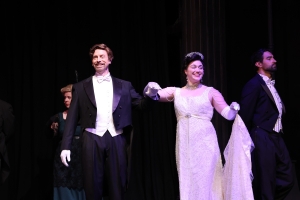
Overshadowed Theatre Productions brings fresh energy to one of musical theatre’s most enduring classics, offering a spirited and thoughtful take on My Fair Lady. This production leans into the story’s sharp contrasts - class and aspiration, control and independence - and invites audiences to see Eliza Doolittle’s transformation with new clarity. It’s a familiar tale, but Overshadowed’s staging makes it feel newly engaged and unexpectedly resonant.
Taking place in 1912, Edwardian London, My Fair Lady is the story of Eliza Doolittle (Kimberly Nicolosi), a resilient young woman who sells flowers for tuppence and whose Cockney accent marks her as invisible to the upper-class Londoners who pass her by. When she crosses paths with Henry Higgins (John Hacker), a brilliant but insufferably arrogant linguist, he boasts that he can remake her into someone society will accept - someone who can pass as a duchess at an embassy ball. What begins as a bet between scholars becomes a transformation that neither fully anticipates.
As Eliza endures Higgins’ relentless drills and dismissive temperament, she begins to outgrow the very mold he tries to force her into. Her ascent exposes the absurdity of class performance, the fragility of male ego, and the uncomfortable truth that respectability often demands erasing the people who need it most. By the time Eliza steps into high society, she is no longer Higgins’ creation but her own person - one who refuses to be spoken for, spoken over, or spoken down to.
The musical’s enduring tension lies in the question it never answers neatly: whether transformation is liberation or simply another form of confinement. My Fair Lady may dazzle with its elegance, but its heart beats in Eliza’s insistence that dignity is not something granted by others - it’s something claimed.
Lerner and Loewe’s My Fair Lady entered the musical theatre canon in 1956, following its development in 1955–56 and a Broadway premiere led by Julie Andrews and Rex Harrison. The story later reached an even wider audience with the 1964 film adaptation, starring Audrey Hepburn as Eliza and Rex Harrison reprising his stage role as Higgins, released on October 21, 1964.
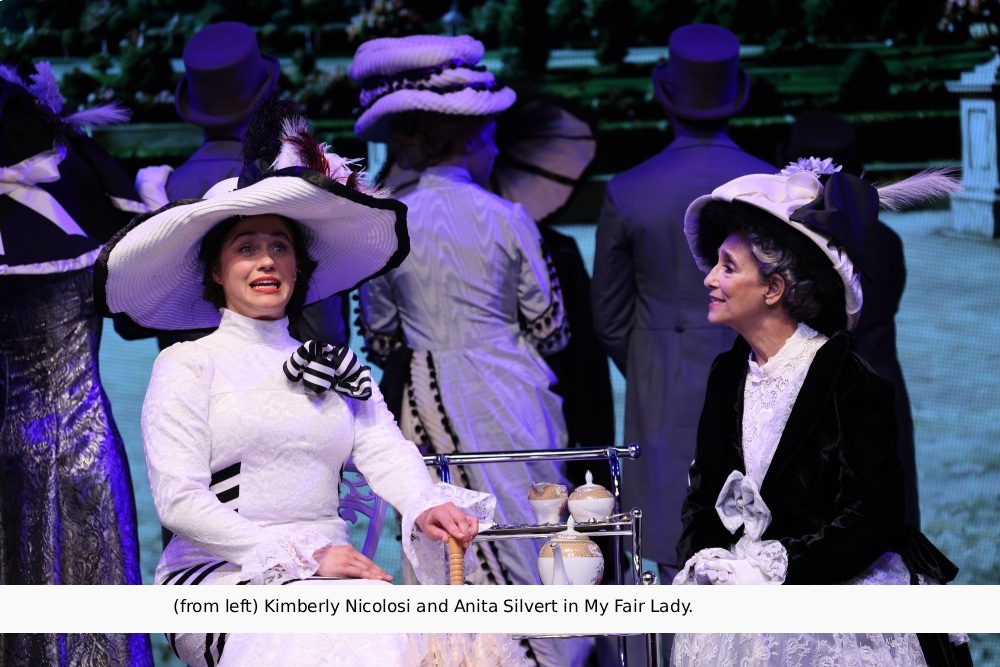
Overshadowed’s current production of this defining musical is anchored by Kimberly Nicolosi, whose Eliza Doolittle grows with steady assurance and a clear emotional arc that makes her transformation feel genuinely earned. Nicolosi is an absolute whirlwind of conviction, with vocals that match her intensity beat for beat, and a charm that makes her Eliza impossible to resist. Opposite her, John Hacker offers a thoughtfully restrained Henry Higgins, capturing both the character’s intellectual rigidity and the subtle shifts that reveal his dependence on Eliza, and his performance brings a compelling, understated complexity to the role. They shape the show’s strongest and most engaging dynamic. Surrounding them, Glen Lindemann brings gentle dignity to Colonel Pickering, while Madeline Frederick’s composed Mrs. Pierce adds welcome stability to Higgins’ household. Brad Holloman provides lively humor as Alfred P. Doolittle, and the Eynsford-Hill family - Sharon Lindemann as Mrs. Eynsford-Hill and Aren Dawson as Freddy - adds a touch of sweetness and refinement. Anita Silvert’s poised Mrs. Higgins offers a calm counterbalance to her son’s bluster, and she delivers a few of the play’s most pointed one-liners with crisp, knowing precision. Under Reba Hervas’ direction, the ensemble works together with easy cohesion, and Hervas guides the production with a steady, confident hand that keeps the storytelling clear, warm, and consistently engaging.
Though wrapped in Edwardian charm, My Fair Lady carries a clear feminist undercurrent, rooted in Eliza’s fight for self-determination. Her journey is not simply one of refinement but of agency - choosing to reshape her life, challenge the limitations imposed by class and gender, and ultimately assert her independence from Higgins’ control. The production highlights how her transformation belongs to her alone, not to the men who presume to mold her, allowing the story’s critique of patriarchal entitlement and its celebration of female autonomy to resonate beneath the musical’s elegance.
The production’s musical backbone shines through beloved highlights such as “Wouldn’t It Be Loverly,” “The Rain in Spain,” “I Could Have Danced All Night,” and “On the Street Where You Live,” each handled with care under Karen Archbold’s attentive music direction. The staging moves with an easy flow thanks to Katy Smith’s well-shaped choreography, which keeps the transitions light and the ensemble well-coordinated. These elements honor the classic craftsmanship of Alan Jay Lerner, who penned the book and lyrics, and Frederick Loewe, whose score remains one of musical theatre’s most enduring treasures.
The set design stands out as one of the production’s most impressive achievements, delivering a level of polish that will surprise audiences unfamiliar with Overshadowed’s work. Thoughtfully constructed and visually cohesive, it creates an environment that supports the storytelling without ever overwhelming it. This marks the first production by the company to utilize a massive video board, and its use is highly successful - enhancing the world of the play with vivid, effective projections that expand each location with striking clarity. The video board works in concert with well-crafted props and scenic pieces that are seamlessly brought in when needed, creating transitions that feel both fluid and purposeful. The scenic and projection work by Yohannan Lee adds depth and atmosphere, giving each setting a sense of place and intention. Complementing the world onstage, Megan Wilburn’s costume design brings the period to life with authenticity, from the tailored silhouettes to the women’s elaborate Edwardian picture hats, which add a flourish of social detail and visual charm. All of these design choices elevate the production with a craftsmanship that feels both ambitious and warmly inviting.

(from left) - Al Gorr, Brad Holloman and Tony Lopez in My Fair Lady.
Stepping back from the production itself, Overshadowed Theatre reveals a company with a purpose that complements the kind of storytelling seen on their stage. I was struck by how deeply rooted their mission is in creating a welcoming, family-friendly space where storytelling and community go hand in hand. Their history reflects a commitment to mentorship and faith-centered values, with an emphasis on giving young performers a place to grow while offering audiences productions that uplift rather than overwhelm. Overshadowed cultivates an environment built on encouragement, accessibility, and shared experience. The company resides within Jubilee Bible Church in Medinah, IL, and the theatre is fully ADA accessible, with vast and easy parking, spacious corridors, and plentiful concessions that make the audience experience comfortable from the moment you arrive.
Audiences can also look forward to a whimsical shift in tone as the company prepares to stage A Midsummer Night’s Dream, bringing Shakespeare’s mischievous magic, tangled romances, and fairy-filled forest to life. Following that, their upcoming season offers a wide range of titles: Flame of Fire (Sep 18–Oct 10, 2026), an original play written and directed by Artistic Director Reba Hervas. Based on the true 1956 story of Operation Auca, the production recounts the lives of missionaries Jim Elliot, Nate Saint, Pete Fleming, Ed McCully, and Roger Youderian, who were killed while attempting peaceful contact with the isolated Huaorani tribe in Ecuador. The play also explores the extraordinary aftermath, as their wives chose to return to the jungle to forgive the tribe and continue living among them. The season continues with It’s a Wonderful Life (Nov 27–Dec 19, 2026), James and the Giant Peach (Jan 22–Feb 6, 2027), The Stranger by Agatha Christie (Mar 12–20 and Apr 1–10, 2027), and Titanic the Musical (July 9–31, 2027). It’s an ambitious slate that blends classic storytelling, family favorites, and dramatic intrigue, promising a season with something for every kind of theatre-goer.
Overshadowed Theatre’s My Fair Lady emerges as a thoughtful production with a clear point of view, delivered with care both onstage and behind the scenes.
Recommended.
For more show information and tickets, visit https://www.overshadowed.org/.
A Quietly Ravishing Night: Marriott’s A Little Night Music
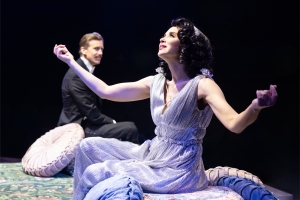
Marriott Theatre’s in‑the‑round intimacy turns A Little Night Music - which premiered on Broadway in 1973 and later became a 1977 film - into a quietly seductive swirl of glances, secrets, and second chances, the kind of production where the waltz feels like its own character. Under the soft glow of perpetual twilight, Sondheim’s lovers and liars circle one another with equal parts longing and restraint, and the space itself heightens every stolen look and half‑spoken truth. It’s a show built on emotional undercurrents, and Marriott’s staging lets those currents ripple right through the audience.
Stephen Sondheim’s A Little Night Music unfolds like a slow-turning dance that keeps tightening its circle, drawing its characters closer to the truths they’ve been avoiding. Set in a turn‑of‑the‑century Sweden where manners are crisp but desires run hot, the story follows lawyer Fredrik Egerman, a man trying to convince himself he’s content. He’s recently married Anne, a porcelain‑delicate young bride who’s still clinging to her innocence, while his son Henrik broods in the corner, nursing both a cello and an unspoken crush.
Everything tilts when Fredrik reconnects with Desiree Armfeldt, the actress he once loved and never quite got over. Desiree, ever the pragmatist, is juggling her own complications - namely Count Carl‑Magnus Malcolm, a swaggering dragoon whose jealousy burns hotter than his intellect. When Desiree attempts to untangle her romantic knots, she invites everyone to her mother’s country estate for a “quiet weekend,” which of course becomes anything but.
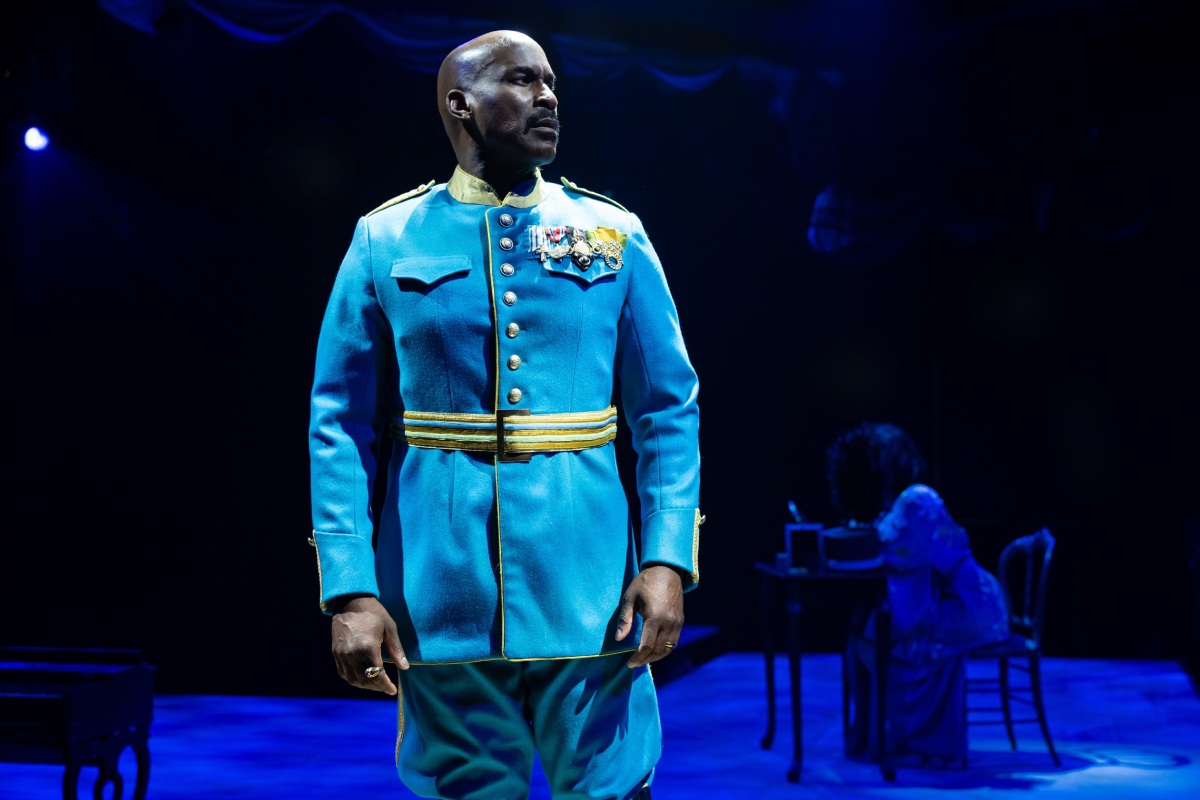
Alan H. Green in Marriott Theatre's A Little Night Music.
What follows is a weekend of mismatched couples, misread signals, and emotional truths finally spoken aloud. Under the glow of the perpetual Nordic twilight, partners shift, illusions crack, and the characters discover that love - in all its foolishness and ache - is rarely tidy but often exactly what they need. By the time the final waltz resolves, hearts have realigned, old wounds have softened, and the night has delivered its promised wisdom.
Sondheim’s score remains the production’s quiet spellbinder - a latticework of turning phrases, reprises, and melodic ironies that reveal as much about the characters as the book does. Songs like “Now,” “Soon,” and “Later” braid together with clockwork precision, exposing the emotional stalemates everyone is too polite to name, while “A Weekend in the Country” bursts with layered wit and rising chaos. And when the music finally slows into the aching simplicity of “Send in the Clowns,” the entire evening seems to exhale. Marriott’s staging lets these songs land not as showpieces but as confessions, each one circling closer to the truths the characters have been dancing around all night.
Under Nick Bowling’s beautifully calibrated direction, A Little Night Music moves with a clarity, elegance, and emotional intelligence that allows every waltz, glance, and confession to land with quiet precision.
Marriott’s production finds its center of gravity in Alexandra Silber, whose Desirée Armfeldt glows with the practiced sparkle of an actress slightly past her prime who knows exactly how she’s perceived and used by the married men who adore her - and the bruised vulnerability of someone who’s finally tired of the performance. Silber calibrates every beat with care: the sly asides, the brittle composure, the ache that flickers just beneath the surface. When she reaches “Send in the Clowns,” it doesn’t arrive as a grand gesture but as something far more intimate - a truth about the “bread crumbing” type of love she’s accepted as a traveling working actress that she’s been circling and battling for years. Opposite her, Andrew Samonsky gives Fredrik Egerman a beautifully worn‑in charm, the kind of man who hides his longing behind polite smiles and a touch of self‑mockery. His Fredrik isn’t a fool; he’s a man quietly unraveling, caught between the mature love he’s built and the young carefree one he still imagines he can achieve with his much younger bride. Samonsky’s performance is both sensual and frustratingly narcissistic. One example of this is when Fredrik apologizes to Desiree - as he leaves her heartbroken yet again - for confessing the tempting truth that her very presence is his safe haven… even though he has no intention of ever being saved by her.
I absolutely adored every delicate moment between lovers, friends, and husbands and wives in this gracefully performed piece, which reveals how men and women are still, even now, navigating the ever‑shifting moods of the partners in their lives in order to sustain lasting relationships.
Alan H. Green makes a vivid impression as Count Carl‑Magnus Malcolm, swaggering through the role with puffed‑up bravado and razor‑sharp comic instinct. Veronica Garza matches him effortlessly as Charlotte, her barbed wit and impeccable comedic timing turning bitterness into something unexpectedly funny and deeply human. Addie Morales gives Anne a shimmering, anxious innocence that feels grounded, while Eldon Warner‑Soriano lets Henrik’s turmoil simmer until it finally breaks open into something raw and affecting.
The singing voices of every single member of this talented and attractive cast are of true opera quality, and paired with the astoundingly modern, lyrical poetry of Sondheim’s evergreen script, I found myself leaning in to catch every word from their lips like a bee sipping nectar from flowers. Across the board, the vocals are rich, expressive, and beautifully attuned to the intricacies of Sondheim’s score.
From there, Carmen Roman anchors the evening with a magnetic, unhurried authority as Madame Armfeldt, delivering Sondheim’s sharpest observations with the cool precision of someone who has cataloged every shade of heartbreak and delicious, luxurious romance from men of great standing throughout her long life. She brings down the house with superbly dry one‑liners like, “Don’t serve them the best champagne - I’m saving that for my funeral!”
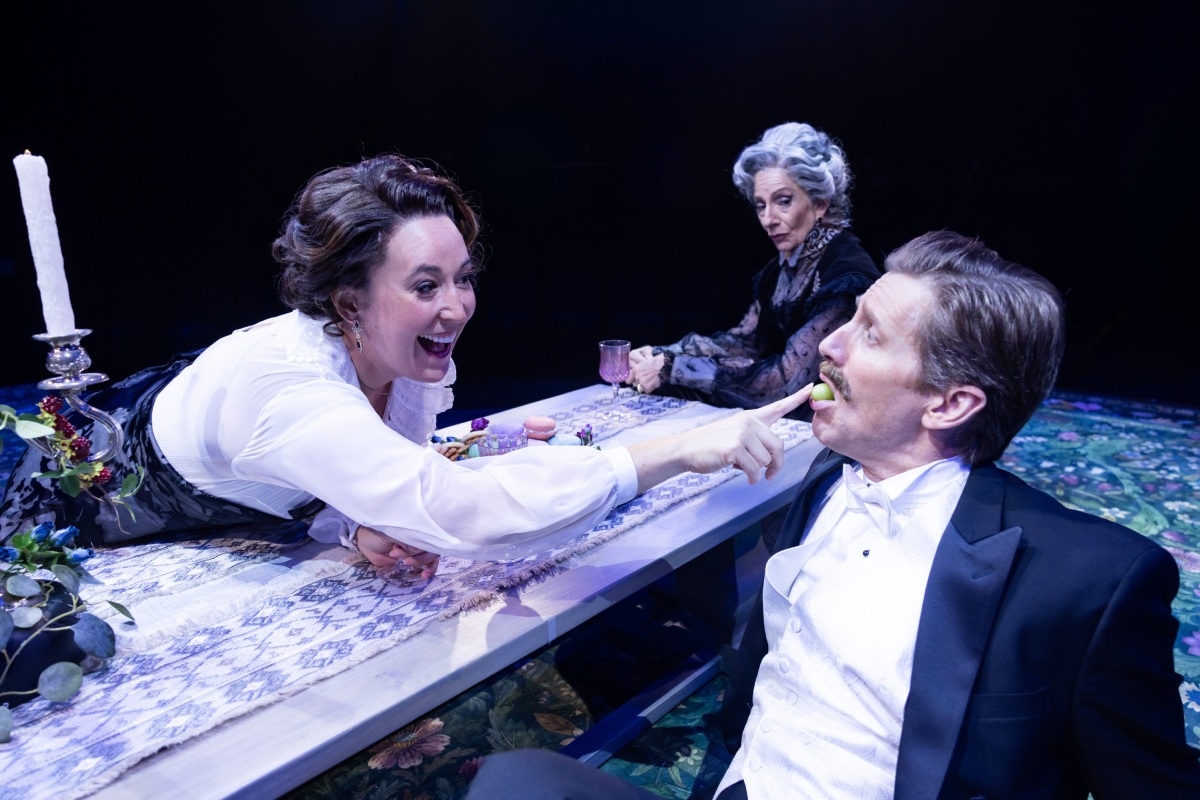
Veronica Garza, Andrew Samonsky and Carmen Roman (rear) in A Little Night Music at Marriott Theatre. Photos by Justin Barbin.
Madison Uphoff brings Petra a bold, earthy vitality - a reminder that desire belongs to everyone, not just the elegantly miserable. Together, this ensemble moves through Sondheim’s bittersweet waltz with nuance, confidence, and a clear understanding of the emotional architecture beneath the score.
Scenic Designer Regina García shapes the evening with a clean, elegant visual world that proves how little is needed to conjure an entire emotional landscape. The stage remains mostly bare - a chaise lounge here, a writing desk there - yet the details she chooses carry real poetic weight: a graceful two‑person swing drifting down from the rafters like a shared memory, a balmy moon casting its soft glow across the space, and strands of hanging lights and flowing ribbon that give the in‑the‑round theatre the feeling of a summer night suspended in time.
Associate Choreographer Katie Johannigman threads movement through this environment with a light, intuitive touch, while under Brad Haak’s baton, Sondheim’s score unfurls with clarity and warmth. Sally Dolembo’s costumes superbly wrap the production in period elegance. Dolembo’s designs resemble modern ballet costumes and express the unique sensuality and sexuality of both the male and female characters in a most tasteful and expressive way that makes your eye want to follow their every move especially the graceful way they make love to one another. The delicate, mostly pastel costumes emote a subtle erotic beauty without overwhelming each character’s emotional and comedic shifts as the night deepens and the whirl tightens its hold.
Marriott Theatre’s A Little Night Music unfolds on the perfectly intimate size of their theatre in the round stage, and the production’s emotional reach is anything but small. What emerges over the course of the evening is a circling dance of sensual longing, unrequited love and unexpected grace - a reminder of how Sondheim’s work can pierce straight through the heart when handled with this level of care. By the time the final notes fade and the lovers step back into the soft glow of twilight, the production has delivered something quietly luminous: a story about desire and forgiveness told with wit, tenderness, and a deep understanding of the ways men and women walk the tightrope of love and pride, playing love like a game of egos until they realize true love is the one thing they truly cannot live without.
Highly recommended.
For tickets and/pr more show information, click here.





Latest Articles
-
 “A Strange Loop” Lets the Intrusive Thoughts Win at Raven Theatre in partnership with About Face Theatre
Written by John AccroccoA musical, but it’s just the voices in your head. Sounds just crazy enough to win the 2020 Pulitzer for Drama. “A Strange Loop” by Michael R. Jackson finally makes its Chicago premiere at Raven Theatre in a co-production with…
“A Strange Loop” Lets the Intrusive Thoughts Win at Raven Theatre in partnership with About Face Theatre
Written by John AccroccoA musical, but it’s just the voices in your head. Sounds just crazy enough to win the 2020 Pulitzer for Drama. “A Strange Loop” by Michael R. Jackson finally makes its Chicago premiere at Raven Theatre in a co-production with… -
 Announcing Goodman's 22nd New Stages 2026 Festival Line-Up
Written by Buzz Center StageFrom a "Kung Fu rom-com" to a witchy new musical, The Goodman's popular New Stages Festival in its 22nd year continues to offer a first glimpse at the latest works by a handful of the hottest contemporary playwrights. This year's four-play…
Announcing Goodman's 22nd New Stages 2026 Festival Line-Up
Written by Buzz Center StageFrom a "Kung Fu rom-com" to a witchy new musical, The Goodman's popular New Stages Festival in its 22nd year continues to offer a first glimpse at the latest works by a handful of the hottest contemporary playwrights. This year's four-play… -
Chicago Danztheatre Ensemble Announces 2026-2027 Season
Written by Buzz Center StageChicago Danztheatre Ensemble (CDE) is pleased to announce its 2026 - 2027 season. CDE will open this artistic season with Copestic Vibrations: A Music Festival, Friday, Nov. 13 and Saturday, Nov. 14, followed by a fully staged production of For…
-
Eos Theatre Company Announces Second Production with The Thin Place
Written by Buzz Center StageEos Theatre Company is pleased to announce their second production with Lucas Hnath's horror play The Thin Place, directed by JC Clementz (Steppenwolf's Director of Casting and Artistic Operations), playing February 5 - 28, 2027 in Bramble Arts Loft's Beatrice Theater, 5545 N…


Does your theatre company want to connect with Buzz Center Stage or would you like to reach out and say "hello"? Message us through facebook or shoot us an email at This email address is being protected from spambots. You need JavaScript enabled to view it..
*This disclaimer informs readers that the views, thoughts, and opinions expressed in the text belong solely to the author, and not necessarily to Buzz Center Stage. Buzz Center Stage is a non-profit, volunteer-based platform that enables, and encourages, staff members to post their own honest thoughts on a particular production.