
Displaying items by tag: My Fair Lady
A Thoughtful Evolution of Her Own Making: Overshadowed Theatrical Productions’ My Fair Lady
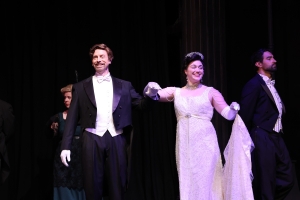
Overshadowed Theatre Productions brings fresh energy to one of musical theatre’s most enduring classics, offering a spirited and thoughtful take on My Fair Lady. This production leans into the story’s sharp contrasts - class and aspiration, control and independence - and invites audiences to see Eliza Doolittle’s transformation with new clarity. It’s a familiar tale, but Overshadowed’s staging makes it feel newly engaged and unexpectedly resonant.
Taking place in 1912, Edwardian London, My Fair Lady is the story of Eliza Doolittle (Kimberly Nicolosi), a resilient young woman who sells flowers for tuppence and whose Cockney accent marks her as invisible to the upper-class Londoners who pass her by. When she crosses paths with Henry Higgins (John Hacker), a brilliant but insufferably arrogant linguist, he boasts that he can remake her into someone society will accept - someone who can pass as a duchess at an embassy ball. What begins as a bet between scholars becomes a transformation that neither fully anticipates.
As Eliza endures Higgins’ relentless drills and dismissive temperament, she begins to outgrow the very mold he tries to force her into. Her ascent exposes the absurdity of class performance, the fragility of male ego, and the uncomfortable truth that respectability often demands erasing the people who need it most. By the time Eliza steps into high society, she is no longer Higgins’ creation but her own person - one who refuses to be spoken for, spoken over, or spoken down to.
The musical’s enduring tension lies in the question it never answers neatly: whether transformation is liberation or simply another form of confinement. My Fair Lady may dazzle with its elegance, but its heart beats in Eliza’s insistence that dignity is not something granted by others - it’s something claimed.
Lerner and Loewe’s My Fair Lady entered the musical theatre canon in 1956, following its development in 1955–56 and a Broadway premiere led by Julie Andrews and Rex Harrison. The story later reached an even wider audience with the 1964 film adaptation, starring Audrey Hepburn as Eliza and Rex Harrison reprising his stage role as Higgins, released on October 21, 1964.
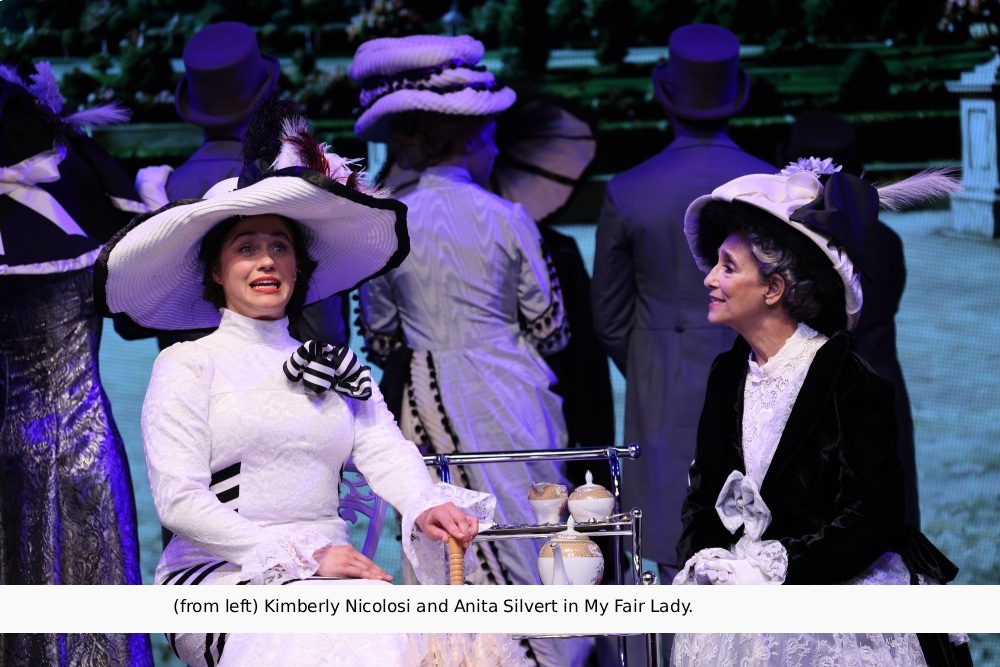
Overshadowed’s current production of this defining musical is anchored by Kimberly Nicolosi, whose Eliza Doolittle grows with steady assurance and a clear emotional arc that makes her transformation feel genuinely earned. Nicolosi is an absolute whirlwind of conviction, with vocals that match her intensity beat for beat, and a charm that makes her Eliza impossible to resist. Opposite her, John Hacker offers a thoughtfully restrained Henry Higgins, capturing both the character’s intellectual rigidity and the subtle shifts that reveal his dependence on Eliza, and his performance brings a compelling, understated complexity to the role. They shape the show’s strongest and most engaging dynamic. Surrounding them, Glen Lindemann brings gentle dignity to Colonel Pickering, while Madeline Frederick’s composed Mrs. Pierce adds welcome stability to Higgins’ household. Brad Holloman provides lively humor as Alfred P. Doolittle, and the Eynsford-Hill family - Sharon Lindemann as Mrs. Eynsford-Hill and Aren Dawson as Freddy - adds a touch of sweetness and refinement. Anita Silvert’s poised Mrs. Higgins offers a calm counterbalance to her son’s bluster, and she delivers a few of the play’s most pointed one-liners with crisp, knowing precision. Under Reba Hervas’ direction, the ensemble works together with easy cohesion, and Hervas guides the production with a steady, confident hand that keeps the storytelling clear, warm, and consistently engaging.
Though wrapped in Edwardian charm, My Fair Lady carries a clear feminist undercurrent, rooted in Eliza’s fight for self-determination. Her journey is not simply one of refinement but of agency - choosing to reshape her life, challenge the limitations imposed by class and gender, and ultimately assert her independence from Higgins’ control. The production highlights how her transformation belongs to her alone, not to the men who presume to mold her, allowing the story’s critique of patriarchal entitlement and its celebration of female autonomy to resonate beneath the musical’s elegance.
The production’s musical backbone shines through beloved highlights such as “Wouldn’t It Be Loverly,” “The Rain in Spain,” “I Could Have Danced All Night,” and “On the Street Where You Live,” each handled with care under Karen Archbold’s attentive music direction. The staging moves with an easy flow thanks to Katy Smith’s well-shaped choreography, which keeps the transitions light and the ensemble well-coordinated. These elements honor the classic craftsmanship of Alan Jay Lerner, who penned the book and lyrics, and Frederick Loewe, whose score remains one of musical theatre’s most enduring treasures.
The set design stands out as one of the production’s most impressive achievements, delivering a level of polish that will surprise audiences unfamiliar with Overshadowed’s work. Thoughtfully constructed and visually cohesive, it creates an environment that supports the storytelling without ever overwhelming it. This marks the first production by the company to utilize a massive video board, and its use is highly successful - enhancing the world of the play with vivid, effective projections that expand each location with striking clarity. The video board works in concert with well-crafted props and scenic pieces that are seamlessly brought in when needed, creating transitions that feel both fluid and purposeful. The scenic and projection work by Yohannan Lee adds depth and atmosphere, giving each setting a sense of place and intention. Complementing the world onstage, Megan Wilburn’s costume design brings the period to life with authenticity, from the tailored silhouettes to the women’s elaborate Edwardian picture hats, which add a flourish of social detail and visual charm. All of these design choices elevate the production with a craftsmanship that feels both ambitious and warmly inviting.
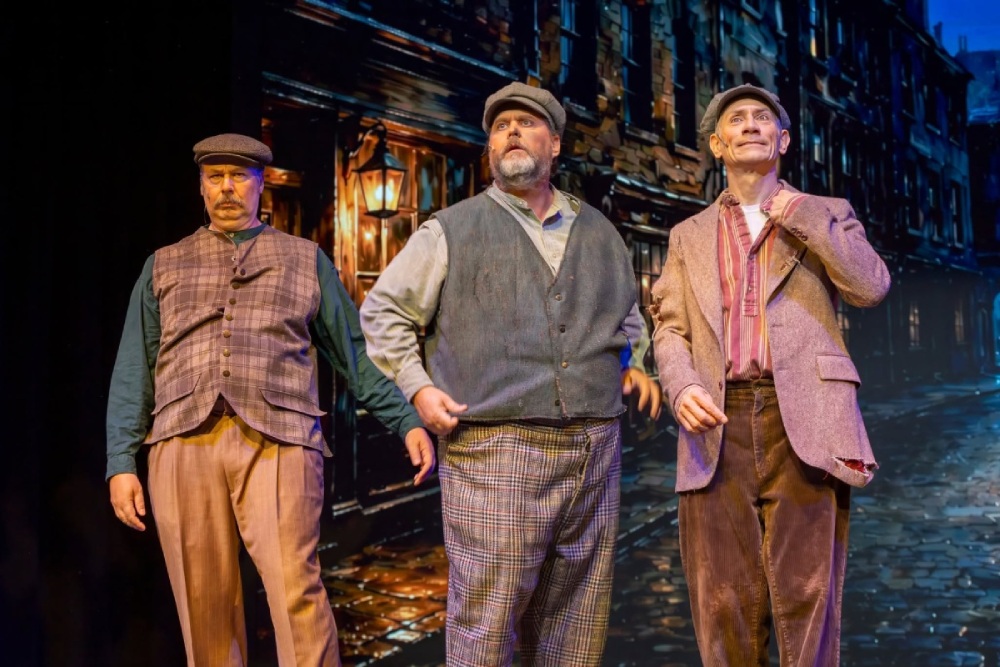
(from left) - Al Gorr, Brad Holloman and Tony Lopez in My Fair Lady.
Stepping back from the production itself, Overshadowed Theatre reveals a company with a purpose that complements the kind of storytelling seen on their stage. I was struck by how deeply rooted their mission is in creating a welcoming, family-friendly space where storytelling and community go hand in hand. Their history reflects a commitment to mentorship and faith-centered values, with an emphasis on giving young performers a place to grow while offering audiences productions that uplift rather than overwhelm. Overshadowed cultivates an environment built on encouragement, accessibility, and shared experience. The company resides within Jubilee Bible Church in Medinah, IL, and the theatre is fully ADA accessible, with vast and easy parking, spacious corridors, and plentiful concessions that make the audience experience comfortable from the moment you arrive.
Audiences can also look forward to a whimsical shift in tone as the company prepares to stage A Midsummer Night’s Dream, bringing Shakespeare’s mischievous magic, tangled romances, and fairy-filled forest to life. Following that, their upcoming season offers a wide range of titles: Flame of Fire (Sep 18–Oct 10, 2026), an original play written and directed by Artistic Director Reba Hervas. Based on the true 1956 story of Operation Auca, the production recounts the lives of missionaries Jim Elliot, Nate Saint, Pete Fleming, Ed McCully, and Roger Youderian, who were killed while attempting peaceful contact with the isolated Huaorani tribe in Ecuador. The play also explores the extraordinary aftermath, as their wives chose to return to the jungle to forgive the tribe and continue living among them. The season continues with It’s a Wonderful Life (Nov 27–Dec 19, 2026), James and the Giant Peach (Jan 22–Feb 6, 2027), The Stranger by Agatha Christie (Mar 12–20 and Apr 1–10, 2027), and Titanic the Musical (July 9–31, 2027). It’s an ambitious slate that blends classic storytelling, family favorites, and dramatic intrigue, promising a season with something for every kind of theatre-goer.
Overshadowed Theatre’s My Fair Lady emerges as a thoughtful production with a clear point of view, delivered with care both onstage and behind the scenes.
Recommended.
For more show information and tickets, visit https://www.overshadowed.org/.
REVIEW: MY FAIR LADY IS STILL LOVERLY

You’d think that a 1956 musical about a man who doesn’t like women all that much and the woman who lets him refine and control her wouldn’t hold up in 2022 (especially in light of the recent Roe v. Wade reversal which gives women far less control over their bodies and lives), but surprisingly for that very reason, it does.
Lerner and Lowe’s classic stage musical My Fair Lady — based on the 1913 George Bernard Shaw play Pygmalion — tells the story of Eliza Doolittle, a young flower seller with a thick Cockney accent that all but requires subtitles, and Henry Higgins, an exacting phonetics scholar obsessed with the English language and its various dialects. When he proposes that he could make coarse, street urchin Eliza passable as a duchess within six months, Eliza is intrigued. She shows up at his home asking for speech lessons so she can learn to speak “more genteel” and get hired at a proper flower shop. Thus begins the fraught relationship between Eliza and Henry, their days filled with vowel exercises and an inordinate amount of yelling.

Laird Mackintoshas Professor Henry Higgins andShereen Ahmedas Eliza Doolittle in The LincolnCenter Theater Production of Lerner & Loewe’s My Fair Lady
This 2022 tour of the 2018 Broadway revival features a well-rounded cast, a fantastic orchestra, and gorgeous, lush sets and costumes. Shereen Ahmed in the title role is beautiful, endearing, and sympathetic as Eliza; she’s easy to root for. And she’s done an impressive job mastering Eliza’s uncouth Cockney as well as her polished English accent that first breaks through in the song “The Rain in Spain Stays Mainly in the Plain”. Her counterpart Henry Higgins, played by Laird Mackintosh, is often infuriating with his condescension but reveals enough vulnerability to show he’s capable of being changed by Eliza as much as she is by him.
If you’ve never seen My Fair Lady onstage or the 1964 film starring Audrey Hepburn, you’re still likely to recognize one or two of its songs. “On the Street Where You Live” has been ubiquitously covered, and “I Could Have Danced All Night” is easily the musical’s most recognizable song. Other notable numbers include “Wouldn’t It Be Loverly”, “Get Me to the Church on Time”, and “I’ve Grown Accustomed to Her Face”. There really isn’t a bad song in the show.
Throughout the production, there’s some subtle birdcage imagery: First, we see that one of Eliza’s few prized possessions is an empty birdcage, and second, the elaborate set for a ballroom scene where Eliza first makes her debut as a high-society lady showcases outlines of peacocks outside of empty birdcages. As Henry suggests at the start of the story, Eliza’s lower-class dialect has held her back in life, trapped her where she is. She’s a woman of wit, charm, beauty, and street smarts, but 1913 London society can’t look past her unpolished appearance or hear past her unrefined, loose-voweled accent. Learning to speak “properly” sets her free, opening her up to worlds she never would have been allowed into before.

Kevin Pariseauas Colonel Pickering,Laird Mackintoshas Professor Henry Higgins andShereenAhmedas Eliza Doolittle in The Lincoln Center Theater Production of Lerner & Loewe’s My Fair Lady
Though Henry’s lessons enrich Eliza’s life, his treatment of her, especially in the first half of the show, is undeniably harsh. In fact, he seems to have a problem with women as a whole. In one of his songs, “I’m an Ordinary Man”, he rants about women’s fickleness and sentimentality, repeating the line, “I will never let a woman in my life”. I wasn’t sure how audiences would react to this song or the character of Henry Higgins in 2022.
But as I said, My Fair Lady surprisingly holds up. Because we view the story through a different lens now. In the 50s, they likely laughed with the man and his exasperation with an insufferable woman, and in 2022, we laugh at the man’s outdated ideals — not to mention the woman’s exasperation with the insufferable man.
My Fair Lady is playing at the Cadillac Palace Theatre at 151 W Randolph St. through July 10, 2022. Tickets are available at BroadwayInChicago.com or by entering the daily ticket lottery.
Lyric Opera's My Fair Lady an Overall Enjoyable Experience

The Lyric Opera continues its Broadway at Lyric series, with the fifth installment in the series - My Fair Lady which opened on Saturday to a full house. The musical is based on the play Pygmalion by George Bernard Shaw and inspired by the Greek myth of Pygmalion, a sculptor who falls in love with his creation. The play and the musical translate this myth into the story of Henry Higgins and his “project” Eliza Doolittle. Eliza is a Cockney flower girl who has a run in with Higgins, a professor of phonetics, and Colonel Pickering, a fellow linguist in front of the Royal Opera House where Higgins brags that in six months he could turn Eliza into a lady by teaching her to speak proper English. Eliza takes him up on that challenge, and urged on by Pickering, they begin their lessons. Over time, Eliza’s speech improves and with some elegant new clothes she almost passes her first test at the Ascot Racecourse, and reaches her prime as the Embassy Ball where she fascinates the crowd and is asked to dance by the Crown Prince. Throughout their time together, Eliza starts to have feelings for Henry, but even after her spectacular showing at the ball, he barely gives her the time of day, focusing instead on how great of a job he did. Only after Eliza leaves, does he start to realize he may have actually developed feelings for her as well, thus falling for his “creation”.
As expected, the production is a massive one, worthy of the Lyric Opera, boasting a cast of 56 singers, dancers and actors. This allows for some excellent ensemble pieces which take over the stage with energy. Choreographer Lynne Page took on this large cast with enthusiasm, creating interesting, playful and engaging choreography which is the highlight of the show. One of the most impressive numbers is by far “Get Me to the Church on Time”. Donald Maxwell as Alfred P. Doolittle, Eliza’s father, was excellent creating a loud and boisterous, yet endearing, character that leads this scene which is executed with precision and gusto.
The set design has its ups and downs. The Covent Garden tenement scenes are backed by a flat white on white backdrop and is only brought into a third dimension with the addition of some (also white) columns. While the large cast helps to liven up the Covent Garden setting during numbers like “With a Little Bit of Luck”, it leaves some colors and dimension to be desired. Higgins study on the other hand, while also based in shades of ivory, creates more on an interesting backdrop to indoor scenes, making use of the desk, chairs and various phonographs, as well as rows and rows of bookshelves and a second story to add dimension to the scenes set here.
Lisa O’Hare as Eliza is excellent and brings the role to life with her powerful voice and commanding stage presence. Her transformation throughout the show is believable and she carries the audience into the unexpected challenges that she faced as a result of her makeover. Richard E. Grant plays Henry Higgins opposite Eliza. While he perfectly captures the immaturity and poor manners of the ridiculously intelligent character, the role is played too over the top, with exaggerated movements that seem to flail around the stage at times. Nicolas Le Prevost as Colonel Pickering provides some good counter balances to Higgins and Bryce Pinkham as Freddy, Eliza’s enamored suitor, really shines in “On the Street Where You Live”.
Overall the production is strong, and has a huge presence, more due to its tremendous cast and elegant, colorful and sparkly costumes designed by Anthony Powell (which makes the scene at the Ball a joy to watch!) than the set or staging itself. With some exceptional performances bringing to life some very iconic songs, the good far outweighs the bad in this production of Lerner and Loewe’s My Fair Lady, directed by Olivier Fredj. My Fair Lady is running at the Lyric Opera through May 21st. For tickets and more show information visit https://www.lyricopera.org/.



Latest Articles
-
 “A Strange Loop” Lets the Intrusive Thoughts Win at Raven Theatre in partnership with About Face Theatre
Written by John AccroccoA musical, but it’s just the voices in your head. Sounds just crazy enough to win the 2020 Pulitzer for Drama. “A Strange Loop” by Michael R. Jackson finally makes its Chicago premiere at Raven Theatre in a co-production with…
“A Strange Loop” Lets the Intrusive Thoughts Win at Raven Theatre in partnership with About Face Theatre
Written by John AccroccoA musical, but it’s just the voices in your head. Sounds just crazy enough to win the 2020 Pulitzer for Drama. “A Strange Loop” by Michael R. Jackson finally makes its Chicago premiere at Raven Theatre in a co-production with… -
 Announcing Goodman's 22nd New Stages 2026 Festival Line-Up
Written by Buzz Center StageFrom a "Kung Fu rom-com" to a witchy new musical, The Goodman's popular New Stages Festival in its 22nd year continues to offer a first glimpse at the latest works by a handful of the hottest contemporary playwrights. This year's four-play…
Announcing Goodman's 22nd New Stages 2026 Festival Line-Up
Written by Buzz Center StageFrom a "Kung Fu rom-com" to a witchy new musical, The Goodman's popular New Stages Festival in its 22nd year continues to offer a first glimpse at the latest works by a handful of the hottest contemporary playwrights. This year's four-play… -
Chicago Danztheatre Ensemble Announces 2026-2027 Season
Written by Buzz Center StageChicago Danztheatre Ensemble (CDE) is pleased to announce its 2026 - 2027 season. CDE will open this artistic season with Copestic Vibrations: A Music Festival, Friday, Nov. 13 and Saturday, Nov. 14, followed by a fully staged production of For…
-
Eos Theatre Company Announces Second Production with The Thin Place
Written by Buzz Center StageEos Theatre Company is pleased to announce their second production with Lucas Hnath's horror play The Thin Place, directed by JC Clementz (Steppenwolf's Director of Casting and Artistic Operations), playing February 5 - 28, 2027 in Bramble Arts Loft's Beatrice Theater, 5545 N…


Does your theatre company want to connect with Buzz Center Stage or would you like to reach out and say "hello"? Message us through facebook or shoot us an email at This email address is being protected from spambots. You need JavaScript enabled to view it..
*This disclaimer informs readers that the views, thoughts, and opinions expressed in the text belong solely to the author, and not necessarily to Buzz Center Stage. Buzz Center Stage is a non-profit, volunteer-based platform that enables, and encourages, staff members to post their own honest thoughts on a particular production.