
Displaying items by tag: Isabel Lee Roden
‘Anatomy of a Suicide’ Is Hard to Watch, But Not Because of the Subject

Perhaps surprisingly, Anatomy of a Suicide is not an overwhelmingly emotionally gripping play, nor is it horrifying. Instead, it vividly portrays the slow drip of suffering for Carol, a woman in the grip of depression, living always with suicidal tendencies. It also presents the impact of an intergenerational transference of Carol’s condition on her daughter and granddaughter. Written by British playwright Alice Birch and ably directed by Alex Mallory, it features Tatiana Pavela in the role of Carol, Taigé Lauren as her young adult daughter Anna, and Isabel Lee Roden as her granddaughter Bonnie.
Anatomy of a Suicide is hard to watch because of the design Birch has chosen for it. The central stories of these three women are performed simultaneously for two hours with one fifteen minute intermission. These focal storylines are in three different time frames, years apart. And some characters carry their roles between the timeframes. In other words, it is difficult to follow. A number of actors play multiple roles as numerous ancillary characters, adding to the challenge.
The program is helpful, but audience members are given just a barcode then told to silence their phones, so there is nothing to guide us as we watch. As a consequence, it is only by reading the program afterward, then studying the Wikipedia page for the play, that I could understand more of the details of what I witnessed.
Still, the broad lines of Anatomy of a Suicide on stage are clear enough to appreciate the heart of the story. All three actors are stunning in their roles. Pavela as Carol, whose life revealed, we are told spans the time frame of 1967-1985, registers the emotions that accompany what we now recognize as post-partum depression. We see every nuance of her internal strife as she struggles to meet societal expectations as homemaker and mother in that window of time when expectations of a woman’s place were unquestioned.
For those of us around then, it is an accurate portrayal of the menial roles women were expected to play in family life. And it puts in the spotlight how that period militated against women having an inner life, especially one that ran counter to the foreordained narrative line. Those who were depressed by childrearing or housekeeping bore the brunt of social opprobrium. And if their condition persisted, they might be subjected to brutal mental illness treatments, including shock therapy.
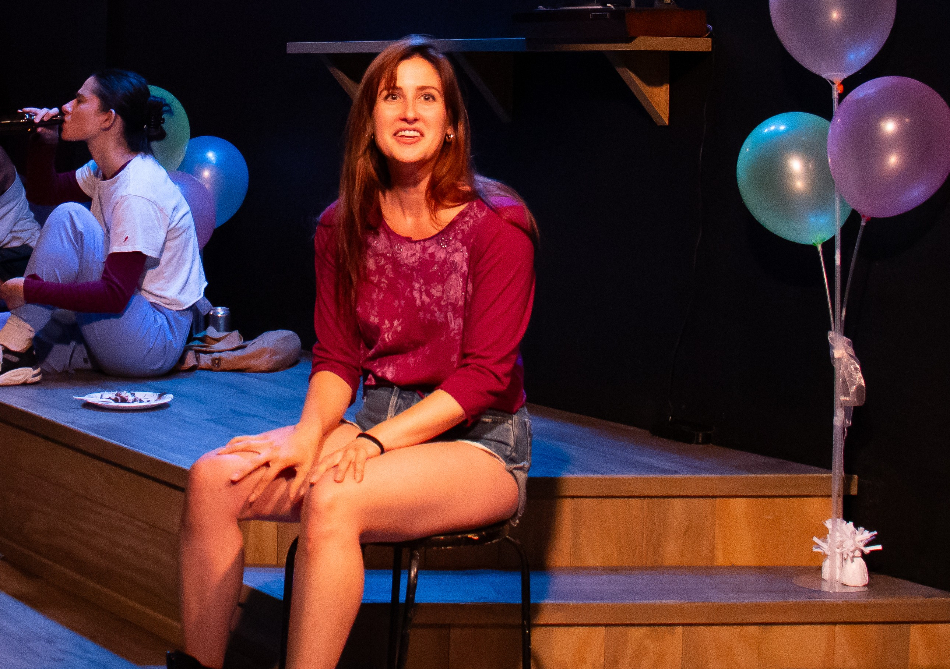
Isabel Lee Roden (left) as Bonnie and Taigé Lauren as Anna in Anatomy of a Suicide.
When we first see Anna, Carol’s daughter, portrayed in the window of 1994-1999 and in her twenties, she is being retrieved by her father, John (Josh Razavi) from a hospital where she was placed following a drug binge. The juxtaposition of these two characters, though in separate unconnected scenes, suggests a link between her mother Carol’s condition and Anna’s drug dependency. Anna emerges from her situation, finds her true love Jamie (Raúl Alonso) marries, and eventually bears a daughter, Bonnie.
We gather the pregnancy and birth are triggering emotionally for Anna. But most of her timeline on stage seems happy. She is a vibrant person. Her wedding day is full of joy; her father embraces her. Taigé Lauren's performance is full, rich and vibrant and it is a pleasure to see her on stage. Another actor, Laila Malak, plays a youthful version of Anna, and it seems that later, during Malak's tenure on stage, she and her father are nearby during a picnic at the moment of Carol’s suicide. This happens later in the play’s sequence, and explains retroactively why Carol was not at Anna’s wedding.
We meet Carol’s granddaughter, Bonnie, who seems to be on the spectrum of some neurodivergent condition. Isabel Lee Roden reflects an inertness in Bonnie, her lack of affect in engaging others. But in climactic moments, Roden leaps from reticence to full-throated dramatic presentation, a great performance that bides its time in deference to the character, but is always there.
To my mind, this is an actor’s play, one for theater professionals, but not something the average ticket buyer would want to see. The play is also burdened with a difficult to market title - Anatomy of a Murder or Anatomy of a Fall have worked, but Anatomy of a Suicide is an unlikely draw. With just 32 seats in the theater, I’m guessing co-producers JunkHeart and The Metal Shop Performance Lab do not have high expectations for revenue. Anatomy of a Suicide runs through August 30, 2026 at Redtwist Theatre in Chicago.
'Shakespeare’s R & J' adapted from 'Romeo and Juliet' by William Shakespeare at Pride Arts Center

Shakespeare’s R & J is another demonstration of just how brilliant William Shakespeare truly was, is, and ever will be. Romeo & Juliet has captivated audiences since the 16th century. The story of the star-crossed lovers is universal, appealing to audiences from all walks of life, and stanzas from the work (e.g. ‘star-crossed lovers’) have become recognizable as allegories. Chicago’s abundant theatrical venues have given us myriad reworkings of Romeo & Juliet, proving over and over that the Bard’s works are endlessly adaptable.
But you’re not here to be sold on Shakespeare as a playwright, right? You already had that. What I’m here to say is that, though we’ve all seen many variations of Romeo & Juliet, Joe Calarco’s Shakespeare’s R & J presented the old chestnut with a twist I personally hadn’t seen before; a twist that director Amber Mandley further bent into a singular new production.
All Shakespeare’s work was, of course, originally played by all-male casts: male actors playing both male and female roles. Adaptations of his works have been stage with extensive diversity of gender-bending (it’s a wonder MAGA’s not yet banned his work!); I’ve seen many variations that were truly brilliant. Romeo & Juliet provides abundant material for presentation as an exegesis of gender, race, ethnicity, religion, politics … a wealth of lenses through which to view this enduring, universal and endlessly adaptable story.
Calarco’s Shakespeare’s R & J was originally envisioned with an all-male cast, set in an exclusive boys’ prep school, and PrideArts’ Artistic Director Jay Españo initially planned to produce it thus. However, various adjustments and scheduling conflicts resulted in PrideArts’ Managing Director Amber Mandley taking the director’s chair, and she was eager to bring more female roles to PrideArts’ stage, and she situated Shakespeare’s R & J in a Catholic girls’ school, with adolescent girl characters. Co-Assistant Directors Elissa Wolf and Magdiel Carmona brought further depths of cultural diversity and familiarity into the directorial discernment.
The four girls are designated only as Student 1 (Madelyn Strasma), Student 2 (Luz Espinoza), Student 3 (Hannah Eisendrath) and Student 4 (Isabel Lee Roden). Their individuality was further obscured by Costume Designer Shawn Quinlan dressing them in matching school uniforms: skimpy pink pleated skirts, spit-shined black patent oxfords, pink vests and jumpers under pink cardigans and blazers, though each differentiated herself (as they do) with a slightly different vest etc. It wasn’t necessary though – the 4 actresses each created their own unique and indelible impression!
Nga Sze Chan had a helluva lot of props to keep track of, all of them oft-used: a blanket is transformed from a bed to a bridal veil; a length of red silk represents a honeymoon suite or an exsanguination, and a cane is deployed to run Mercutio through – said skewering nicely choreographed by James Napoleon Stone. Shakespeare’s R & J relied heavily on Lighting Designer August Tiemeyer to set the mood and spotlight particular events; both he and Sound Designer Valerio Torretta Gardner were well-supported by Lead Electrician Aidan Lynn Smith. And Stage Manager Elijah McTiernan managed to keep everyone and everything coherent and harmonious.
Luz Espinoza was a cuddlesome, ardent little Juliet – maybe a bit of a slapper, but delightfully so. Romeo as played by Madelyn Strasma was far less convincing a lover – or maybe there simply wasn’t sufficiently torrid chemistry between them. It didn’t seem to be an actual shortcoming for either the actors or Intimacy Director Grace Goodyear, they simply didn’t ignite one another. All the actors had to be agile and sprightly as they cavorted and wrestled, gamboled and dueled, but Isabel Lee Roden’s vivacity and marvelous comedic bearing were exceptional – this was their debut with PrideArts and they’re definitely a keeper! Hannah Eisendrath came across as a ringleader, the mastermind and instigator of the group’s revelry, and she carried this sense of dominance across all the roles she played, from Lady Capulet to Mercutio.
Shakespeare’s R & J is about breaking rules – after all, that’s what teenagers do, right? Forbidding anything at all – a book; a curfew; a lover – guarantees that adolescents will flock to it. In Shakespeare’s R & J we watch these four girls become caught up in the Montague – Capulet antipathy to enact their rebellion against the austerity of a convent school.
I do wish that theme had been fleshed out more. Romeo & Juliet was presented beautifully, the acting by all four of the cast excellent. It ain’t easy to deliver iambic pentameter fluently, and Madelyn Strasma, Luz Espinoza, Hannah Eisendrath and Isabel Lee Roden all performed superbly. I just wish Mandley, Carmona and Wolf had contrived to show us a deeper look at Students 1, 2, 3, and 4: four girls navigating the perils of adolescence within the suffocating strictures of a private Catholic girls’ school; four Students with enough acumen and moxie to defy the rules through the medium of a fifteenth-century Harlequin romance. Four girls who, through embodying people dead for four millennia, begin to perceive and explore their own developing bodies and greedy, voracious little minds; four girls becoming women vicariously through women who never lived, yet who live within every woman and man … such a rich vein to mine there!
Yet I walked out without a full understanding of why these four Students chose to flout the rules by reading a banned book, or why they chose Romeo & Juliet, of all the banned books (un)available. I’m not clear on just why Students 1, 2, 3, and 4 decided to enact the play rather than simply read it, and what impact this reenactment had on their developing minds, emotions, and sexuality … though certainly none of them appeared to be squicked by kissing their classmate(s)!
So, though PrideArts’ production of Shakespeare’s R&J was excellent, it was also basically unsatisfying. But I’m an optimist … I look forward to seeing what Jay Españo and Amber Mandley will bring to PrideArts’ next season!
Shakespeare’s R&J plays at PrideArts’ Theatre through March 24




Latest Articles
-
 “A Strange Loop” Lets the Intrusive Thoughts Win at Raven Theatre in partnership with About Face Theatre
Written by John AccroccoA musical, but it’s just the voices in your head. Sounds just crazy enough to win the 2020 Pulitzer for Drama. “A Strange Loop” by Michael R. Jackson finally makes its Chicago premiere at Raven Theatre in a co-production with…
“A Strange Loop” Lets the Intrusive Thoughts Win at Raven Theatre in partnership with About Face Theatre
Written by John AccroccoA musical, but it’s just the voices in your head. Sounds just crazy enough to win the 2020 Pulitzer for Drama. “A Strange Loop” by Michael R. Jackson finally makes its Chicago premiere at Raven Theatre in a co-production with… -
 Announcing Goodman's 22nd New Stages 2026 Festival Line-Up
Written by Buzz Center StageFrom a "Kung Fu rom-com" to a witchy new musical, The Goodman's popular New Stages Festival in its 22nd year continues to offer a first glimpse at the latest works by a handful of the hottest contemporary playwrights. This year's four-play…
Announcing Goodman's 22nd New Stages 2026 Festival Line-Up
Written by Buzz Center StageFrom a "Kung Fu rom-com" to a witchy new musical, The Goodman's popular New Stages Festival in its 22nd year continues to offer a first glimpse at the latest works by a handful of the hottest contemporary playwrights. This year's four-play… -
Chicago Danztheatre Ensemble Announces 2026-2027 Season
Written by Buzz Center StageChicago Danztheatre Ensemble (CDE) is pleased to announce its 2026 - 2027 season. CDE will open this artistic season with Copestic Vibrations: A Music Festival, Friday, Nov. 13 and Saturday, Nov. 14, followed by a fully staged production of For…
-
Eos Theatre Company Announces Second Production with The Thin Place
Written by Buzz Center StageEos Theatre Company is pleased to announce their second production with Lucas Hnath's horror play The Thin Place, directed by JC Clementz (Steppenwolf's Director of Casting and Artistic Operations), playing February 5 - 28, 2027 in Bramble Arts Loft's Beatrice Theater, 5545 N…


Does your theatre company want to connect with Buzz Center Stage or would you like to reach out and say "hello"? Message us through facebook or shoot us an email at This email address is being protected from spambots. You need JavaScript enabled to view it..
*This disclaimer informs readers that the views, thoughts, and opinions expressed in the text belong solely to the author, and not necessarily to Buzz Center Stage. Buzz Center Stage is a non-profit, volunteer-based platform that enables, and encourages, staff members to post their own honest thoughts on a particular production.