
Displaying items by tag: Greenhouse Theatre Center
Gwydion Theatre Delivers More than a Satire in Lynn Nottage’s Por’ Knockers
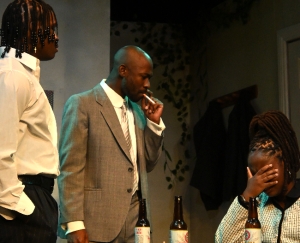
Lynn Nottage is a skilled playwright, and prolific especially considering the high quality of her works: Pulitzer winners Ruined and Sweat. Or the remarkable By the Way, Meet Vera Stark, a kind of All About Eve with the starlet’s Black maid in the Eve role. And then Intimate Apparel, which won wide and very deserved praise. While her scripts vary widely in storyline, they are loaded with very real, authentic characters.
So getting a chance to see an early Nottage work—Gwydion Theatre’s production of Por’ Knockers (1995)—has an especial appeal. It is Nottage’s second play, and it had a turbulent life after premiering Off Broadway in New York at The Vineyard Theatre. Then it went to London. After its London run was cut short, Nottage told The Guardian, “I still remember an audience member ripping up their programme into tiny shreds and throwing it like confetti, saying: ‘I am cancelling my subscription to the theatre!’”
It’s not that the play is bad. In fact it is very good. It was the subject that caused problems: five activists of the imaginary People's Diasporatic Party blow up an FBI building to protest the treatment of African-Americans in the U.S. The play centers on the tension and anxiety within that band of conspirators before and after their destructive venture.
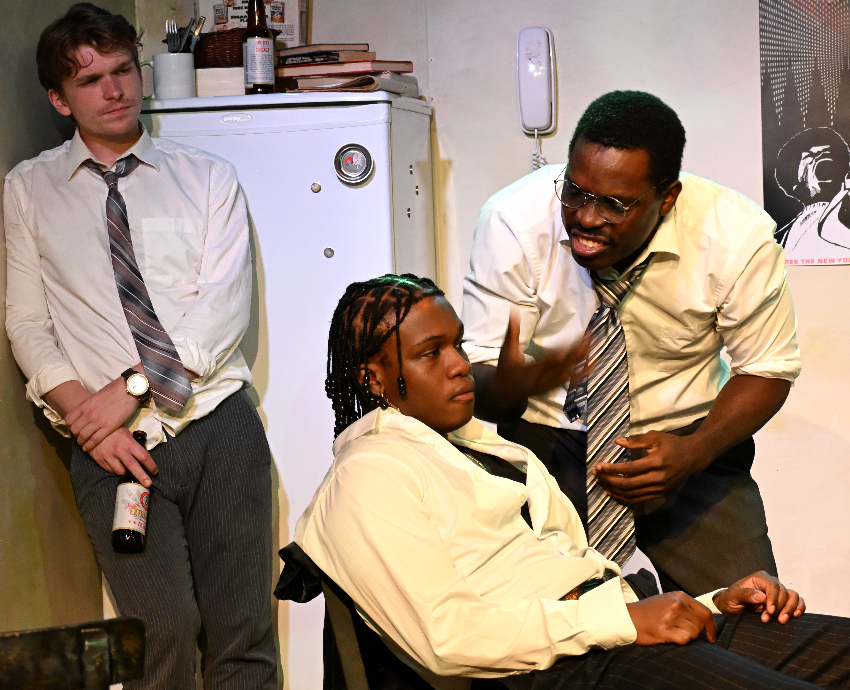
Grayson Kennedy (l-r), Joseph Percy and Dontaye Albert.
Por’ Knockers (the name refers to Guyanese gold panners) was having a successful and well-received run in London until Timothy McVeigh carried out a similar bombing of the FBI building in Oklahoma City. And so the script has been shelved since. Until Gwydion Theatre in Chicago succeeded in mounting this production at Greenhouse Theater.
“This play is so special to us at Gwydion,” says Grayson Kennedy, who is Gwydion Theatre’s Artistic Director. “It was a show that we have wanted to do since our first season.” (Kennedy acts in the show as well.)
Directed for Gwydion Theatre by Makari Robinson-McNeese, Por’ Knockers is widely regarded as a political satire, almost a parody of a “people’s revolutionary army.” But Nottage gives it a level of depth, with five fully-realized characters, each with different backgrounds and motives for the bombing.
In the opening scene of the one act, Nottage establishes the who's who: the mature, grounded Kwami (Kevin Aoussou is astoundingly good); the hyper-kinetic paranoid James (Dontaye Albert is remarkable); a thuggish Ahmed (Joseph Percy); the lone woman in the group, the academic Tamara (Justice Ford); and the lone vacillating white guy, Lewis (Grayson Kennedy is excellent). And then there is this oddly magical entry, Lance (Jimmie Roger III), a machete wielding Guyanese gold prospector visible only to Kwami, whose character happens to be Guyanese-American.
The group’s anxiety is palpable, each expressing it uniquely according to the personalities Nottage has drawn for us. Tempers flare, violence seems to bubble just under the surface as the characters play out their fears. As they leave the apartment for this carefully planned rendezvous with destruction, it is Kwami who exits last, straightening the furniture and quietly telegraphing to the audience a disdain for his fellows.
The passage of time throughout the show is registered by the subtly changing hues of daylight filtering through the window blinds. (Lighting Designer Emma Berry deserves praise for this subtle but important element.)
When they return, hours later, they are filled with excitement over the bombing, and soon enough trepidation builds about what will follow. Tamara offers words of reassurance. “We succeeded,” she says. But only four have returned. That hyper-kinetic paranoid James is nowhere to be seen, further heightening the anxiety in the room. He hasn’t followed the plan. When James does return, having ridden the train to the end of the line and back—“I wanted to make sure I wasn’t followed,” he tells them—he also delivers shocking news: the building was unexpectedly occupied, by children.
A portable radio that was to keep them up to date is malfunctioning because of bad batteries. Lewis delivers a “white man” pronouncement and orders Ahmed to get decent replacement batteries. This doesn’t go down well and violence threatens. Kwami, feeling internal pressure to be the patriarch and the decider on strategy, resists the role, then reluctantly takes it.
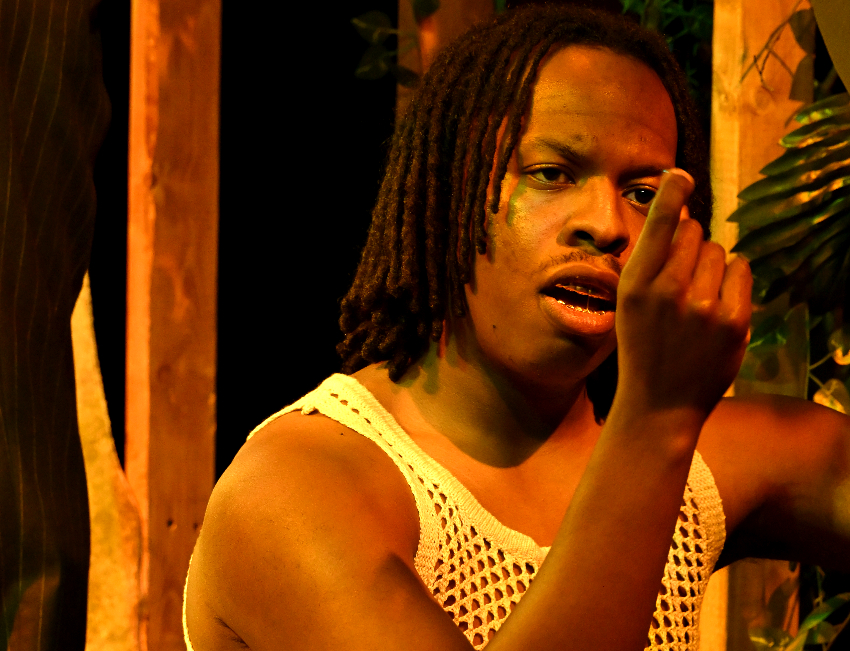
Jimmie Roger III
At this point, the play makes a departure. It remains a parody and these activists do seem inept, but they are also caught in an existential quandary. This takes shape in the lone land line on the wall, a 1990s touch tone wall phone, which will be their means to call the FBI and take claim for the bombing, and make a statement of their motives.
Over the remainder of the play, this brigade of the People's Diasporatic Party swings between ruminations on the morality of their action, or attacking each other. Percy’s Ahmed phrases his sense of their predicament, “I ain't afraid of death. I’m afraid of nobody noticing it. I want my death to be a defining event.”
That phone sits on the wall, a mute expression of the culmination of their destructive act: taking credit for it. Between the tense discussion, the five each take a turn at calling in, when the pressure of the moment drives them to the phone. Yet there is one constraint after another that inhibits them from successfully completing the call: first, they don’t have the number; then they are reluctant to pay 75 cents to “the system” to get directory assistance; after they tear the number from the phone book Lewis calls, and realizes he doesn’t know what to say and hangs up. Tamara calls, but becomes mired in voice mails and transfers and gives up.
Ford’s Tamara seems the most tormented by moral issues of having killed children. Notably, whenever Kwami wants to rally the group, he addresses them as “brothers” then throws in a lagging “and sister,” a low-key running joke for the audience, though not the characters on stage. Eventually the phone call gets through in a resolution of that conceit, which Nottage has used effectively to put each personality on display.
Early works by writers arrive unfettered by reputation and uncontaminated by any self-consciousness with which acclaim may impart. It is my feeling that early writing by authors of any medium allows us a window into that unbridled creative energy.
In Por’ Knockers Nottage inserts that sixth character, the silent, machete wielding Lance, who appears periodically, visible only to Kwami. He prowls the stage front during these brief magical interludes, humming or singing softly. When the other four see Kwami drifting away, he self-consciously explains he is channeling ancestors.
Nottage’s success has not diminished her work, but only affirmed her remarkability. Two subsequent plays like Ruined (its 2008 world premier was at the Goodman, where it returns as part of the next season) and Sweat both won Pulitzers, a first for a woman playwright. Nottage also wrote the book for two Broadway musicals: MJ and The Secret Life of Bees.
Por’ Knockers, which comes recommended, runs through October 4, 2026 at The Greenhouse Theatre.
Powerhouse Performances on Display in Gwydion's Dry Powder
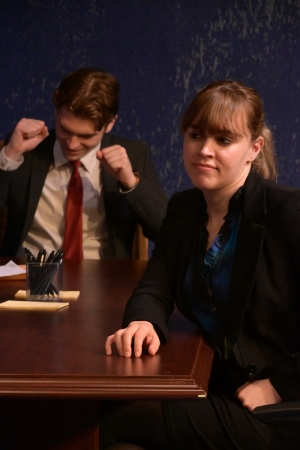
In the sharp-tongued world of Sarah Burgess’s Dry Powder, presented by Gwydion Theatre Company at the Greenhouse Theater Center, the pursuit of money is a blood sport. The play centers on a high-stakes private equity firm caught in a massive public relations nightmare after laying off thousands of grocery store workers the same week its co-founder threw a flashy engagement party featuring an elephant – but it was just one elephant!
All hope isn’t lost for their reputation, however. A potential way out comes thanks to a struggling, American-made luggage company that believes the firm can save them. Of course, as the firm weighs the acquisition, their definition of “help” may not align with the company’s. At the helm is Rick, the ultimate decision-maker, who has two distinct angels on his shoulders: Seth, the optimistic partner who brought the deal to the table, and Jenny, his cold-hard-cash counterpart. From Seth’s perspective, the deal is a perfect fit; they can rescue an American brand without layoffs and emerge as heroes. For Jenny, this luggage company is just baggage—unless it can be downsized, moved overseas, and engineered into something it once stood against.
Directed with precision by Ellie Thomson, Dry Powder completes Gwydion Theatre’s season, which has explored themes of class, money, and power, and how all three can entangle the soul. The production asks what happens to our humanity when everything is reduced to a column on a balance sheet.
The production thrives on the electric, friction-filled chemistry of its cast, anchored by a series of standout performances.
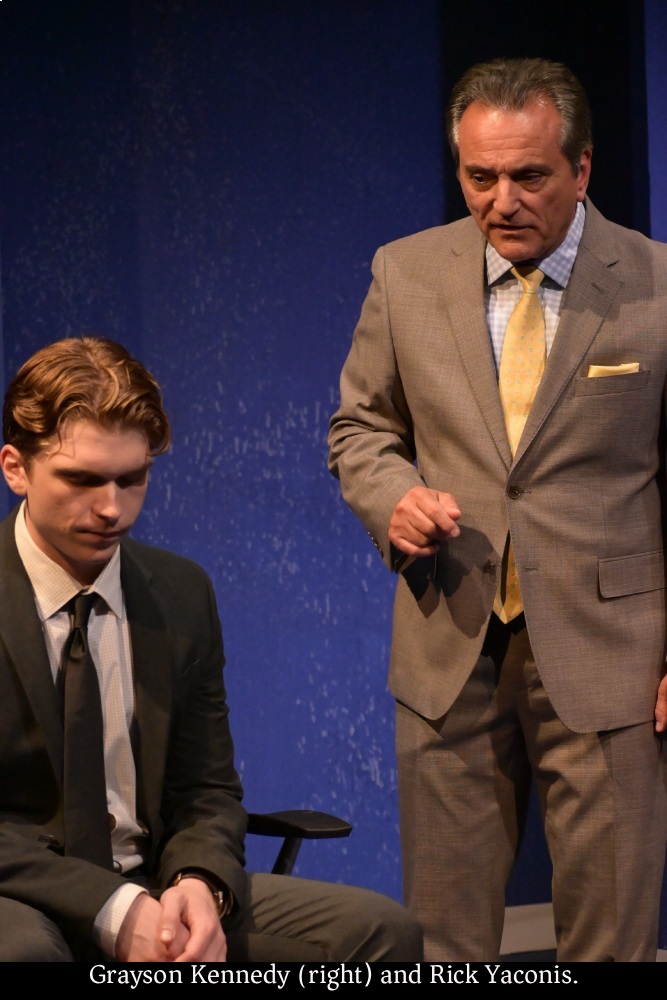
Carol Kelleher delivers a masterclass performance as Jenny. Playing the de facto villain of the piece, Kelleher crafts a remarkably complex and compelling performance that is utterly enjoyable to watch. She doesn’t just play the role; she completely becomes the character, infusing Jenny’s brutal, unrelenting perspective of greed with a sharp humor. Her performance ensures that even at Jenny’s most calculating, you cannot look away.
As the firm’s head, Rick Yaconis turns in a powerful performance, deftly striking the balance between a paternal mentor and a greasy titan. He shifts effortlessly between a ruthless opponent and a pat-you-on-the-back salesman.
Grayson Kennedy, a founding member of Gwydion Theatre, brings immense depth to Seth, the firm’s supposedly earnest, morally grounded partner. His clean-cut delivery fits the role perfectly.
Tommy Thams, co-founder of the theatre company, rounds out the dynamic as Jeff, the CEO of the targeted luggage company. Thams infuses Jeff with the relaxed, easygoing charm of an old buddy, making the audience root for the company’s success and feel genuinely betrayed by what unfolds in the final act.
Burgess’s script is complex, mining dark humor from the shifting dynamics and war of words between these characters.
Ultimately, Dry Powder leaves the audience reflecting inward. It might be easy to dismiss this play if we aren't personally in a position to dismantle - or attempt to save - a multimillion-dollar company, but the narrative transcends the boardroom. The play holds up a mirror and forces us to look closely at ourselves: Are we good or are we just being nice?
As Jenny pointedly notes, she never lies to the client. Her emotions, her greed, and her hawkish nature are never disguised. Seth, conversely, hides behind a comforting “nice guy” persona, genuinely believing he occupies the moral high ground. But in trying to appease both sides – a greedy firm and a company that needs help – is he actually better or just deceiving himself?
It’s these thought-provoking questions that make Gwydion Theatre’s production a gripping triumph that lingers long after the final blackout.
Dry Powder plays at the Greenhouse Theater until July 26. Tickets and show information here.
Couch Penny Ensemble’s An Oak Tree: A Raw, Unrehearsed Descent Into Grief
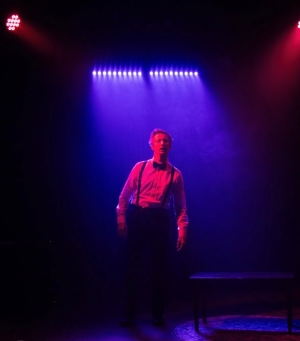
Couch Penny Ensemble, in association with Theatre Arcana, presents the ambitious and experimental An Oak Tree, a raw, unconventional approach to theater that is sure to spark conversations on the nature of grief and the experience itself.
In writing An Oak Tree, playwright Tim Crouch wanted to replicate the disorienting nature of grief. The play features two actors - one who has rehearsed the script (the Hypnotist) and another who has neither seen nor read it (the Father). The Hypnotist acts as a dual guide both for the actor playing the Father and the audience, as this one-of-a-kind experience comes to life.
For each performance, a new, different actor takes on the role of the Father, and it’s their job to live in the moment, breathing life into this character through the use of real-time instructions (given via headphones) and script lines given to them on the spot. The result is an unpolished, raw theater experience. The format is intriguing and innovative - a reflection on grief itself. When tragedy happens, you aren’t prepared for it, and you suddenly find yourself wrestling with a script that is unrehearsed.
Under Bryce Lederer’s direction, the production leans into the play’s shifting dynamics, shaping its unpredictability into something sharply focused and theatrically alive.
Riles August Holiday anchors the evening as the Hypnotist, delivering a technically demanding and well-acted performance. Holiday does a fantastic job of drawing a sharp line between his moments in character - playing a defensive, fragile man - and his moments acting as an administrative guide, calmly steering both his co-star and the audience through the mechanics of the script.
On this evening, Suzy Krueckeberg played the Father, and one can only imagine the excitement and the nerves of taking on such a role. As the Father, she was required to relive the trauma of losing a daughter and process the deterioration of her family without rehearsing - no small task. Krueckeberg did a good job finding the part and taking the audience on the journey with her.
For all its ingenuity, An Oak Tree serves a very specific appetite. This is avant-garde, experimental theater through and through. If you are an audience member searching for that specific brand of rule-breaking performance art, there is plenty to analyze here. Personally, I felt the script left something to be desired. In an examination of grief, I felt at times it was too simplistic or trod ground others had covered more effectively.
That said, it was a unique and interesting experience to see an actor walk a tightrope, constructing a character in front of the audience’s eyes. Holiday’s emotional depth on stage was a treat as well.
An Oak Tree runs at Greenhouse Theater Center until July 5th.
This review is proudly shared with our friends at www.TheatreInChicago.com.
Review: Couch Penny Ensemble's 'Everybody' at Greenhouse Theater Center

A quick disclaimer for this review: Couch Penny Ensemble's Everybody, by Branden Jacobs-Jenkins, is written with a caveat for anyone who dares to perform it. At the start of each performance, the actors are randomly assigned their roles by lottery, creating 120 possible cast combinations. In other words, the Everybody I saw will likely not be the Everybody you see. This structure demands something borderline absurd from its cast: each actor must memorize the entire script, remain flexible until the show closes, and sacrifice the comfort of traditional rehearsals.
What’s more astonishing is that the performance I saw was effectively unrehearsed yet never unprepared. It was incredible, and knowing it was done only once, just for this audience, is an experience you can’t get anywhere else. Rather than feeling unpolished or improvisational, the production felt confident, precise, and alive—a balance that speaks not only to the performers’ skills but also to the steady hand of director Greta Mae Geiser. It is the kind of theatrical gamble that only Jacobs-Jenkins would demand—and that only the right creative team could successfully meet.
For my production, the role of Everybody was played by Renzo Vincente. As the main character, Vincente was nothing short of phenomenal. His facial expressions, genuine tears, and overall emotional execution gave me goosebumps. There was an openness to his performance that made Everybody’s fear, confusion, and longing feel immediate and shared, and he truly left every part of himself on the stage, perfectly portraying everybody.
The rest of the cast – Caitlin Frazier, Jessica Posey, Ellie Duffey, and Dryden Zurawski, the other “Everybodies” – were randomly assigned one of four other roles, each encompassing three distinct characters. These twelve figures function less as traditional “characters” and more as personified concepts, broad, sometimes exaggerated reflections of the forces and relationships that shape everybody’s life. The actors who were not selected to play Everybody must step into their assigned parts with no prior expectation of fit. The result is an entertaining inconsistency that works entirely in the production’s favor: across the twelve roles, there ends up being a spontaneous mix of uncannily fitting performances alongside equally impressive but parodic ones. At any given moment, there is no way to predict who will enter the stage with manic sincerity or with hilariously inflated vanity, but it is clear throughout that each of the five actors possesses the range and control to deliver any role with intention and impact.
An unspecified role is not a prerequisite for a great performance, however, as Everybody also features four additional, standardly cast roles. Even with a fixed assignment, the demands of the show are formidable. The amount of memorization required for Usher (Jodianne Loyd), who establishes the world of the play with omniscient authority, is no easy task. A final shoutout goes to Zay Alexander, who not only delivered a personable performance as Death but also sang and played guitar hauntingly.
By rejecting conventional polish altogether, Everybody makes room for humor, heart, and an unmistakable dedication from its incredible cast.
Everybody is running at Greenhouse Theater Center through December 21st. Tickets are available at https://ci.ovationtix.com/36644/production/1258591.
Humble and Radiant: Charlotte's Web at Greenhouse Theatre

The adage goes that you can’t choose your family but you can choose your friends. Throughout our lives, we meet people we connect with who see the beauty and potential within us even when we can’t see it ourselves. People who simply get us. Friendship is one of the most magical experiences we can have in life. It’s no wonder this theme is so consistently visited in media, literature, and theatre and stands the test of time. There’s no better representation of the true meaning of friendship than that of Charlotte’s Web, now playing at Greenhouse Theatre Center.
Charlotte’s Web is a story about an unlikely friendship between Wilbur the pig and Charlotte the spider. On a small farm, a young girl is determined to save the life of a diminutive newborn pig. But the young animal’s fate remains uncertain until a courageous and determined spider spins remarkable webs to prove that “Wilbur isn’t just any ordinary pig!”

The Young People’s Theatre of Chicago brings this beloved children’s classic to the Greenhouse Theatre Center for a limited run this May. Based on E.B. White’s Newberry Honor Award-winning story, Charlotte’s Web explores bravery, selfless love, and the true meaning of friendship. Artistic director Randy White says it best, “E.B. White’s beloved story demonstrates above all that friendship is immeasurably valuable.” With Renzo Vicente as Wilbur and Mary Margaret McCormack as Charlotte leading the cast, the Young People’s Theatre ensemble embodies the story’s themes of compassion, kindness, and perseverance, bringing humor and heart to a simple and timeless story.
Friendship is not only a theme of the play but also radiates throughout the cast and crew. Behind the scenes, the staff’s long-standing friendship and partnerships weave design magic that can be felt in every scene and one that Randy White acknowledges, “Staging a beloved family favorite with so many friends is a perfect way to bring to a close the YPT’s most successful and exhilarating season yet!” With a humble yet radiant set and spirited cast put on a simple, charming, and endearing production that young audiences can follow and mature audiences can appreciate. The Young People’s Theatre reminds us that sometimes all we need is a friend to believe in us, to fight for us, to remind us that we are remarkable just the way we are. Charlotte’s Web And sometimes, if we're very lucky, we get to sit right next to that person to take in a wonderful show.

Charlotte’s Web is now playing on a limited run from May 10- June 1 at Lincoln Park’s historic Greenhouse Theater Center (2257 N. Lincoln Avenue). Run time is 1 hr and is best enjoyed by everyone 5+. For tickets and additional information, visit yptchi.org or call the box office at 773-404-7336.
Gusto Performances in ‘Spring Awakening,’ Vibrant Staging of 1906 Basis of Broadway Musical

“Spring Awakenings,” now playing at Chicago’s Greenhouse Theater Center, is not the Tony-winning 2006 Broadway musical “Spring Awakening,” but an adaptation of its original basis, an 1891 German play by Frank Wedekind that was first performed in 1906. Translated by Francis J. Ziegler, and directed and adapted by Lazy Susan Theatre Co. company member Matthew Masino, it is a fervent and vibrant production with a cast clearly filled with passion for what might be seen as something of a theatrical novelty.
An exploration of the angst of sexual awakenings of teenagers, it was also a social commentary on the damaging effects of sexual repression, those things we haven’t liked to talk about - puberty, erotic dreams, BDSM, pregnancy, abortion - all on stage. And other things, too - teen suicide, the stress of scholastic competition, and societally enforced sexual repressiveness.
Measured against this window into the past, we must have learned something over the decades. At least we’ve been talking about these matters more.

Though not a musical, it is laced with song, and actor performers on cello (Nicholas Ford Kinney, and in the role of Georg), guitar (Grace Trivax, and in the role of Martha), flute (Phoebe Webstbrooks, also playing Otto) and piano (Pierce Howard, and in the role of Hänschen). Music for the show is composed by Michael Van Bodegom-Smith, with musical direction by Dominic Rinker.
Remarkable in their performances and the core of the drama are the trio of Isabelle Grima as Wendla, Jake Griffith as Melchior, and Bryce Lederer as Moritz. As the show runs on (two hours, no intermission) one begins to realize that Lederer has the most demanding role, and he really delivers. His Moritz is central to the storyline, heavily laced with tragic turns.
Moritz confides to his classmate Melchior that he struggles with confusing dreams. The more seasoned and knowledgeable Melchior quickly tells him essentials of the facts of life, explaining that these are erotic dreams, a natural companion to sexual development. Wendla, who has a thing for Moritz, asks her mother to explain where babies come from, and is met with obfuscation. Uninformed, she soon enough ends up in the hay with Melchior, and pregnant.
Set in Germany—young men wear short pants, young women just trading girlish skirts for long dresses—these school chums are a bonded group, and display real affection for each other. Characters are fully fleshed out in the charming production, even lesser roles like Ryan Vu’s Ernst, Quinn Skelly’s Rupert, both so good in their performances. A real standout is Hannah Loessberg as Thea.
Other than its historic theatrical interest, Is there a message in this show? Perhaps. With the rise in illiberalism fueled by drastic governmental shifts, it’s beneficial to look at the harms we suffer when social repressiveness suppresses openness to talk about taboo subjects. And this show is just plain fun, as well.
“Spring Awakenings” runs through May 11, 2025 at Greenhouse Theater Center.
Don’t Miss this Rollicking Rendition of “Don’t Let the Pigeon Drive the Bus”

If you’re looking for a way to entertain the children (or grandchildren) this holiday season that doesn’t involve long lines, icy cold temps or going to the mall, look no further than the Greenhouse Theatre Center’s production of Mo Williams’ smash hit musical, “Don’t Let the Pigeon Drive the Bus.”
After two years of successful productions aimed largely at school groups, the Young People’s Theatre of Chicago is transitioning from an intermural Greenhouse Theatre Center project to a stand-alone, professional children’s theatre. And just in time for the Thanksgiving Day weekend, the YPT is kicking off its inaugural season with the return of William’s beloved and beleaguered Pigeon, in his own adaptation of his best-selling Caldecott Honor Award-winning book bearing the same name.
This high-energy hourlong offering of pure silliness and joy is the perfect way to introduce the younger crowd to the magic of live theatre. From the very beginning, as the woebegone Pigeon pops out from the windows of the cleverly engineered and colorful set to lament over his tedious days, kids are immediately engaged in the unfolding story.
Pigeon is skillfully brought to life by YPT veteran Brade Bradshaw as a hand-and-rod styled puppet in the technique first showcased in the Broadway hit Avenue Q. In fact, all the puppets were built and designed by Rick Lyon, the puppeteer designer for Avenue Q. The combination of performer and puppet are so seamless that at some point you forget that Pigeon is a puppet.
Bradshaw is joined onstage by another YPT veteran, Karla Seretto, who shines as the indomitable bus-driving Bus Driver. With her “officially official” cap and dedication to her job, you never doubt that her main passion in life is to drive her bus and never be late. Also returning to the YPT stage are the talented Tamsen Glaser as the Duckling and Bus Engine, and Marquis Bundy as Teenage. They are joined by experienced Chicago actors Jake Elkins as the Hot Dog Vendor and Businessman, and the hilarious Dakota Hughes as the Little Old Lady.
As his young fans well know, Pigeon never gets to do anything he wants to do. And that’s where the fun begins. In the opening number, Pigeon laments that he never gets to do anything, not even eat a hot dog – which, he claims, is all he really wants to do. Even a visiting Duckling gets a hot dog, but not Pigeon. He’s just told by everyone to “fly away, bird.” What’s a hot-dog loving, adventure-seeking Pigeon to do?
Life changes dramatically for Pigeon when a new bus line opens near Pigeon’s hangout, and he encounters Bus Driver and her brand-new bus. Pigeon is immediately entranced and now the only thing he wants to do is drive the bus! Working up his courage, Pigeon approaches the Bus Driver and sings, “Can I drive the bus?” to which the Bus Driver and all her passengers chorus, “No! Don’t let the pigeon drive the bus.” But when the bus breaks down and the Bus Driver has to find a way to alert the people along the route the bus is running behind, she turns to Pigeon to help her out. Together, Bus Driver helps Pigeon discover his true purpose and dream.
The Greenhouse Theatre is the perfect venue for a younger audience to watch the performance. It’s compact, and with the front row right on the stage, it provides an intimate interaction with the actors. To the absolute delight of the audience, Pigeon goes “flying” through the theatre to alert them that the bus will be late, and they become part of the show as well.
The show got two-thumbs up by my grandchildren, ages 8 and 6, who loved the antics of the Pigeon as he tried his very best to fulfill his dream to drive the bus. But they especially loved the ending when, even after Pigeon discovers his true purpose in life, he spies a plane in the sky and suddenly all he wants to do is “fly the plane.” The entire audience joins in with the cast in the chorus and shout, “No! Don’t let the pigeon fly the airplane!”
There’s something for everyone in the show. I particularly loved Dakota Hughes as the Little Old Lady, who continually threw birdfeed at Pigeon in a well-meaning attempt to give him a treat. (“What is this stuff?” Pigeon indignantly wants to know.) And Tamsen Glaser made a hilarious bus engine with her sputtering and spattering noises as the bus breaks down.
Under Randy White’s astute direction, the action never stops, and the music, composed by Deborah Wicks a Puma, an acclaimed artist in Theatre for Young Audiences, keeps the story moving along, making for a manageable and totally enjoyable theatre experience for children of all ages.
You can catch “Don’t Let the Pigeon Drive the Bus” at Lincoln Park’s historic Greenhouse Theatre Center (2257 N. Lincoln Ave.) from Nov. 23-Dec. 22. For ticket information and performance times, visit ytpchi.org.
Outstanding Performances Make 'This Is Our Youth' a Winning Production

“This Is Our Youth,” with mesmerizing performances by Kason Chesky as Warren, Grayson Kennedy as Dennis, and Annalie Ciolino as Jessica, is still vital and fresh nearly thirty years after its Off Broadway premiere. Playwright Kenneth Lonergan set it in 1982 during the Reagen era, but these 48 hours in the lives of three dissolute young adults read fresh and vital today as it did almost 30 years ago.
Much of that is attributable to the outstanding performances of all three actors in Gwydion Theatre’s production at Greenhouse Theatre. Under the direction of Andrew Shipman, this trio really gives voice to Lonergan’s deftly drawn characters - locked in their personal traumas and immersed in the travails of their emergence from their upper middle class homes to independence. It’s just a snapshot - two days - during which the characters have some of their best and worst moments.
The two-act play is simple and straightforward: 19-year-old Warren has been booted from his house by his abusive dad, a driven businessman, and secretly lifts $15,000 of dad’s cash as he heads out. Arriving at his friend Dennis’s apartment, suitcase in hand, Warren is a dweeb and awkward, totally aggravating, and we soon side with the more dynamic and charismatic Dennis, who doesn’t want the risk of harboring Warren and his cash.
But Dennis relents, and hatches a plan for the hapless Warren to replenish the missing funds that he has carelessly spent along the way. Here’s how Buzz editor Ken Payne described it in the 2014 Steppenwolf production: a hair-brained scheme where they would buy some coke, keep some for themselves, cut it and then resell it for a profit exceeding the amount needed to replace the full fifteen thousand dollars.
Though I saw the 2014 Steppenwolf version of “This Is Our Youth,” which starred Michael Cera and Kieran Caulkin, I liked this version much, much better. Cera, in the Warren role, was a one-note actor, and Caulkin had nothing to play against - I really didn’t notice how good the script was. In Gwydion Theatre’s sterling production, we quickly learn that these young men have a neurotically abusive relationship.
Dennis is an ill-tempered drug user and purveyor; and Warren weathers a constant barrage of his demeaning put-downs and mean-spirited physical jousting.
When Dennis departs to carry out the scheme, we have a chance to meet Jessica, and Ciolino’s performance is outstanding. Her character allows the other dimensions of Warren’s personality to unfold, and we gain empathy andrespect for the two as more fully emotionally developed individuals, especially compared to Dennis.
Throughout the play, the conversations deliver the exposition and backstories effortlessly, another tribute to Lonergan’s script, and why this play resurfaces so frequently, and remains fresh and meaningful. The two-act run time is over two hours plus intermission. But it grips our interest throughout, and never really falters. Chesky’s Warren is onstage nearly throughout, and he delivers a remarkable performance, but Kennedy and Ciolino are every bit his equals. The energy required of Kennedy in the role of the manic, drug-altered Dennis, may be a formula for stage burn-out, but he carried it off admirably on opening night.
“This Is Our Youth” comes highly recommended, and runs through September 28 at the Greenhouse Theatre Center on Lincoln Avenue in Chicago.
'Can’t Pay? Won’t Pay!' by Dario Fo Incredibly Funny and a Complete Surprise

“Can’t Pay? Won’t Pay!" by Dario Fo is incredibly funny and a complete surprise. I’d seen one other hilarious play based on a Daniel Fo script, “Accidental Death of a Black Chicago Motorist,” but that liberally adapted work by The Conspirators hadn’t prepared me for how funny this 1997 Nobel Laureate’s writing is.
In a fresh translation from the 1974 Italian original, “Can’t Pay? Won’t Pay!” is a two-act political farce that zings in the hands of the Gwydion Theatre troupe, some of them recent arrivals from their native Los Angeles, and whose style and performances are unlike other Chicago companies—as good as the best Chicago has, but with a fresh approach.
Directed by ensemble member Nena Martins, the story centers on Antonia (Audrey Busbee) and Margherita (Ellie Thomson), two working-class Italian housewives who participate in a women-led action wherein they steal from the supermarket as a response to an unconscionable rise in prices. Fearful of the police, and criticism from their husbands Giovanni (Caleb Petre) and Luigi (Jason Pavlovich), they try to cover their misdemeanors in a most amusing way.
The performance relies on a world-premiere translation adapted by Ember Sappington, laced seamlessly with contemporary American idiom. Fo taps a European tradition of commedia dell'arte and farce, so its humor is at times broad but still funny. The performers are uniformly excellent, each in their own way, Antonia, played excellently by Audrey Busbee (a product of Chicago’s Columbia College) gives the play its weight.
A real standout is the performance by Jason Pavlovich as Luigi, who is completely natural and believable, and seems to be acting on another plane from the rest, but it works. Also notable is Andrew Shipman in three roles as Officer/Carabiniere/Senior, also with a style all his own.
Gwydion Theatre, with Grayson Kennedy as artistic director, formed in LA in 2019 by a group of actors fresh out of training soon tackling full scale productions at the Hollywood Fringe Festival. They say that following the pandemic, they decided to move to Chicago “in order to connect with a more artistic theater landscape.” Well, welcome!
It’s a sign of the seriousness of Gwydion Theatre that they selected a work by Fo—once a popular and highly regarded contemporary playwright (he died in 2016).”Can’t Pay? Won’t Pay!” is said to have inspired a real-life protest in Milan in which housewives took over the checkout stations at a Milan grocery store. Gwydion’s inaugural season in Chicago opened with Edward Albee’s "The Zoo Story," and will finish with the American classic ‘Waiting for Lefty’ by Clifford Odetts."Can't Pay? Won't Pay!" runs through December 17 at The Greenhouse Theater Cemter, 2257 N. Lincoln Ave. in Chicago.
A New Play Called ‘N’ Grazes a Third Rail in Social Conventions

We all know that certain words are verboten in polite society - some because they are coarse, like expletives; others because they are demeaning or belittling, or off-limits.
One of these – the N-word – is the hook that triggers the action in a new play, called, simply, ‘N,’ at the Greenhouse Theater Center. Smoothly directed by TaRon Patton, the story revolves around an ambitious young actor, Eddy (Ryan Smetana) who has been hired as a live-in aid for the 70-year-old Mrs. Page (Stacie Doublin).
Immediately we are intrigued by Mrs. Page, who is a character rarely (if ever) portrayed, an African-American Goldwater Republican. Eddy, who is white, is all about proper liberal social behavior, in visible arenas, like recycling, and bringing his own shopping bags to the grocery store. He is also rather a narcissist, and the consummate guy with his heart-on-his-sleeve.
Mrs. Page does not suffer his foolishness gladly, and has reluctantly accepted his arrival in her home. She quickly sets, and carefully maintains, a dividing line to ward off any emotional intimacy with this intruder. But Eddy is young, and crashes and burns a couple times – expecting and eventually getting emotional support, though its dispensed sparingly by Mrs. Page.
Things all come to a head when Eddy gets his career break with a major name theater production. But then, a script rewrite inserts the ‘N’ word in the show, and he resigns the role. There are stormy moments for both parties.
And Mrs. Page, who earns a living as a stock trader and investment advisor, makes a compelling case for her support - as an African-American – for conservative 1960s-era Republican Barry Goldwater, who staunchly defended the right of the individual. “Contrary to popular opinion,” Mrs. Page tells Eddy, “you are a minority – of one.”
Playwright David Alex shows canny skillfulness in the craftsmanship of ‘N.’ For example, as the play opens, Eddy is auditioning with lines from Oedipus concerning fate versus free will, done in a Southern dialect - foreshadowing the discussions ahead.
Still the first act needs polishing: lines by Mrs. Page like, “Your employment includes room and board,” and “Understand it is not by my choice that you are employed here,” seem less like dialog than scene-setting pronouncements. At two different points, in a darkened room, a phone call is overheard by an unseen third party – that seems contrived. And Eddy behaves and speaks with unnatural familiarity as a new arrival in Mrs.Page's home. Likewise for Mrs. Page, though she is rough, not friendly like Eddy.
There seem to be some distracting plot points, e.g., Mrs. Page is an avid astrologist, but has been housebound since one of her predictions led to tragedy. And she cooks Jewish dishes for a neighbor.
The second act, though, completely redeems things – suggesting that first half may be in development still. We really see the characters come into their own. Stacie Doublin is powerful in the later dialog. And a final, doleful scene performed in silence by Eddy and Mrs. Page is moving and strongly affecting.
Also noteworthy is the performance of Reginald Hemphill as Eddy’s buddy DeShawn, who commands the stage for his brief time on it. Speaking also on word usage, “You are not a ‘brother,’” DeShawn, who is African-American, advises Eddy. “This may come as a shock to your white liberal sensibilities, but you are not black!”
Alex, who is a fixture in Chicago theater, has written more than a dozen other scripts, including Eroica at Red Twist Theatre, and Ends, which won an African-American Theater Festival Award at the University of Louisville. ‘N,’ thought provoking and lively, comes recommended. ‘N’ runs through November 17 at Greenhouse Theatre in Chicago.




Latest Articles
-
 “A Strange Loop” Lets the Intrusive Thoughts Win at Raven Theatre in partnership with About Face Theatre
Written by John AccroccoA musical, but it’s just the voices in your head. Sounds just crazy enough to win the 2020 Pulitzer for Drama. “A Strange Loop” by Michael R. Jackson finally makes its Chicago premiere at Raven Theatre in a co-production with…
“A Strange Loop” Lets the Intrusive Thoughts Win at Raven Theatre in partnership with About Face Theatre
Written by John AccroccoA musical, but it’s just the voices in your head. Sounds just crazy enough to win the 2020 Pulitzer for Drama. “A Strange Loop” by Michael R. Jackson finally makes its Chicago premiere at Raven Theatre in a co-production with… -
 Announcing Goodman's 22nd New Stages 2026 Festival Line-Up
Written by Buzz Center StageFrom a "Kung Fu rom-com" to a witchy new musical, The Goodman's popular New Stages Festival in its 22nd year continues to offer a first glimpse at the latest works by a handful of the hottest contemporary playwrights. This year's four-play…
Announcing Goodman's 22nd New Stages 2026 Festival Line-Up
Written by Buzz Center StageFrom a "Kung Fu rom-com" to a witchy new musical, The Goodman's popular New Stages Festival in its 22nd year continues to offer a first glimpse at the latest works by a handful of the hottest contemporary playwrights. This year's four-play… -
Chicago Danztheatre Ensemble Announces 2026-2027 Season
Written by Buzz Center StageChicago Danztheatre Ensemble (CDE) is pleased to announce its 2026 - 2027 season. CDE will open this artistic season with Copestic Vibrations: A Music Festival, Friday, Nov. 13 and Saturday, Nov. 14, followed by a fully staged production of For…
-
Eos Theatre Company Announces Second Production with The Thin Place
Written by Buzz Center StageEos Theatre Company is pleased to announce their second production with Lucas Hnath's horror play The Thin Place, directed by JC Clementz (Steppenwolf's Director of Casting and Artistic Operations), playing February 5 - 28, 2027 in Bramble Arts Loft's Beatrice Theater, 5545 N…


Does your theatre company want to connect with Buzz Center Stage or would you like to reach out and say "hello"? Message us through facebook or shoot us an email at This email address is being protected from spambots. You need JavaScript enabled to view it..
*This disclaimer informs readers that the views, thoughts, and opinions expressed in the text belong solely to the author, and not necessarily to Buzz Center Stage. Buzz Center Stage is a non-profit, volunteer-based platform that enables, and encourages, staff members to post their own honest thoughts on a particular production.