
Displaying items by tag: Chicago plays
Dead Girl's Quinceañera - Goodman Theatre - Through November 8th

Secrets, sisterhood and solving crime take center stage this fall in the world premiere co-production of Dead Girl's Quinceañera by Miami native playwright Phanésia Pharel. Director Melia Bensussen's ensemble cast includes Carmen Berkeley (Hartford Stage's Romeo and Juliet), Ariana Burks (A Christmas Carol), Andrea Ferro (Columbia Lenfest Center's Big Love) and Jacqueline Guillén (Off-Broadway, Torera). Understudies will be announced at a later date. Co-produced with Barrington Stage Company and Hartford Stage, Dead Girl's Quinceañera appears in the Owen Theatre September 26 – November 1. For tickets ($34 - $79; on sale August 7), call 312.443.3800 or visit GoodmanTheatre.org/Quince. The Goodman is grateful for the support of Conagra Brands Foundation (Corporate Sponsor Partner), The Elizabeth Morse Charitable Trust (Lead Sponsor of IDEAA Programming) and Bold Ventures (Production Support).
"Dead Girl's Quinceañera is a celebration of young women's imagination, initiative and courage," said director Melia Bensussen, who is also Artistic Director of Hartford Stage. "Although all four identify as Latina, each one arrives with a different personal experience and history. In their collaboration and friendship, we see our own journeys reflected – as they harness their power and agency, we too, watching them, celebrate our own transformations and those of our neighbors. ¡Que feliz estar haciendo este trabajo en Chicago!"
FACT: Maria was last seen at her Quinceañera. FACT: The party ended early due to an unknown emergency. FACT: Maria has not responded to any messages in 19 hours. Now, her three best friends—armed with confidence, questionable clues and zero adult supervision—are on the case, racing against the clock to find out what happened. The pressures of Latine girlhood punctuate the joy ride through the power and pleasure of adolescent friendships in this comic thriller.
"I'm in awe that my play appears at The Goodman at the start of their 101st Season and second century," playwright Phanésia Pharel said. "I wrote this play for my best friend, to celebrate how much our relationship changed my life. It's been a beautiful experience to see this coming-of-age story resonate with people who may have never been to Miami and/or who might not be of Hispanic descent. It reminds me that even at this moment where forces are hoping to divide us, theater can connect us all to our true humanity."
ABOUT THE ARTISTS
Phanésia Pharel (Playwright) is a Haitian-American playwright and screenwriter from a dragon fruit farm in Miami. She is the daughter of an immigrant teacher and farmer. She recently made her Off-Broadway debut at the WP Theater with her play The Waterfall. She is the Playwriting Fellow (2025-2027) at Emory University, where she serves as a visiting professor and has a new play produced by their repertory company. Her plays have been developed at the Eugene O'Neill Theater Center's National Playwrights Conference, New Harmony Project, Playwrights' Center, New York Stage and Film, SolFest, Thrown Stone, Shattered Globe and Echo Theater Company. She has received commissions from the Atlantic Theater, Lucille Lortel (Alcove), La Jolla Playhouse, Miranda Family Fund, Hero Theatre, City Theatre Miami and the Latinx Playwrights Circle. Pharel is a member of the Obie-winning EST/Youngblood group and The Wish Collective. As a screenwriter, she is a member of Lena Waithe's Hillman Grad Screenwriting Lab. Her honors include The Kilroys Web, five awards from the Kennedy Center and an A is For Playwriting Award recipient. She holds a BA in Urban Studies from Barnard College of Columbia University and an MFA in Playwriting from the University of California San Diego.
Melia Bensussen (Director) is an award-winning director, teacher and artistic leader who has directed extensively at leading theaters throughout the country. The first woman to lead Hartford Stage, she has been its Artistic Director since the summer of 2019. Devoted to new work as well as to classic texts, she was appointed Artistic Director of the National Playwrights Conference at the O'Neill Theater Center in 2024. Raised in Mexico City, Bensussen is fluent in Spanish and has translated and adapted a variety of texts, including her edition of the Langston Hughes translation of Federico Garcia Lorca's Blood Wedding, published by Theater Communications Group. Among her credits developing and premiering new works, she co-conceived and directed, alongside playwright Kirsten Greenidge, the theatrical adaptation of Anthony J. Lukas' Pulitzer Prize winning Common Ground, which premiered at the Huntington Theater in Boston. A graduate of Brown University, Bensussen serves on the Arts Advisory Board for the Princess Grace Foundation, and on the executive board of the Stage Directors and Choreographers Society (SDC). Prior to her position at Hartford Stage, she was Chair of the Performing Arts Department of Emerson College, in Boston. She is the recipient of an OBIE Award for Outstanding Direction, as well as the Statue Award from the Princess Grace Foundation for Excellence in Directing.
Company of Dead Girl's Quinceañera
By Phanésia Pharel
Directed by Melia Bensussen
A World Premiere Co-Production with Barrington Stage Company and Hartford Stage
Carmen Berkeley...Ensemble
Ariana Burks...Ensemble
Andrea Ferro...Ensemble
Jacqueline Guillén...Ensemble
Creative Team
Set Designer...Sara Brown
Lighting Designer...Dan Kotlowitz
Sound Designer...Salvador Zamora
Costume Designer...Raquel Adorno
Movement Choreographer...Mayte Natalio
Dialect Coach...Cynthia Santos Decure
Associate Director...Ludmila de Brito
Assistant Director...Lorenzo Rush, Jr.
Assistant Set Designer...Daniel Prosky
Assistant Lighting Designer...Emma Berry
Assistant Sound Desiger...Harper Justus
Line Producer...Malkia Stampley
Second Line Producer...Sarah Slight
Casting by Alaine Alldaffer, CSA, Lisa Donadio and Lauren Port, CSA.
ENHANCED AND ACCESSIBLE PERFORMANCES
Visit GoodmanTheatre.org/Access for more information about The Goodman's accessibility efforts.
ASL-Interpreted...October 16 at 7:30pm – An ASL interpreter signs the action/text as played.
Audio-Described...October 17 at 2pm; Touch Tour; 12:30pm – Action audibly enhanced via headset.
Spanish-Subtitled...October 17 at 7:30pm – Spanish-translated dialogue via LED sign.
Open-Captioned...October 18 at 2pm – LED sign presents dialogue in sync with the performance.
ABOUT THE GOODMAN
Since 1925, The Goodman has been a theatrical home for artists and a gathering space for Chicagoland, where bold stories spark connection, conversation and change. Now, as it enters its second century, The Goodman builds on that legacy with an eye toward the future. Under the leadership of Walter Artistic Director Susan V. Booth and Executive Director John Collins, the theater continues to champion new work—following hundreds of plays developed and a national reputation for commissioning and premiering original stories by living writers—while reimagining classics and produce large-scale musicals.
But The Goodman's reach today extends beyond its home in the heart of the Loop. From the intimate magic of The Magic Parlour, now in its third year, to the boundary-pushing world of Theater of the Mind—an immersive experience that blurs the lines between science, storytelling and sensation—and from citywide initiatives like 100 Free Acts of Theater to partnerships with artists and companies across Chicago and around the world, The Goodman is expanding what theater can be, and where it can live.
At its core, The Goodman is driven by a belief that a more empathetic, more connected city is built one story at a time. Generation-spanning productions and programs offer theater for a lifetime—from babies and young children to teens, adults and seniors—including Theater for the Very Young (ages 0–5) and the beloved annual A Christmas Carol, which has welcomed audiences for five decades. Education and Engagement programs, led by Clifford Director Jared Bellot and based in the Alice Rapoport Center, use the tools of theater to spark imagination, reflection and belonging—reaching thousands each year, the majority from underserved communities.
With nearly 200 world or American premieres, two Pulitzer Prizes, 22 Tony Awards and nearly 200 Joseph Jefferson Awards, The Goodman remains a defining force in American theater—and the first to produce all 10 plays of August Wilson's American Century Cycle. The theater also frequently serves as a production partner—from national and international companies to Chicago's Off-Loop theaters—to help amplify a wide range of theatrical voices.
Founded by William O. Goodman and his family in memory of playwright Kenneth Sawyer Goodman, the theater carries forward a legacy of artistic ambition and civic generosity. With the help of Mr. Goodman's descendants—Albert Ivar Goodman and his late mother, Edith-Marie Appleton—that spirit continues to shape its future as The Goodman expands its impact across Chicago and beyond. Marsha Cruzan is Chair of the Goodman Theatre Board of Trustees; Diane Landgren is Women's Board President; and Kelli Garcia is president of the Scenemakers Board for Young Professionals.
The Goodman stands on the unceded homelands of the Council of the Three Fires—the Ojibwe, Odawa, and Potawatomi Nations—and acknowledges the many other Nations for whom this land now called Chicago has long been home, including the Myaamia, Ho-Chunk, Menominee, Sac and Fox, Peoria, Kaskaskia, Wea, Kickapoo, and Mascouten. The Goodman is proud to partner with the Gichigamiin Indigenous Nations Museum (Gichigamiin-Museum.org) and the Center for Native Futures (CenterForNativeFutures.org)—organizations devoted to honoring Indigenous stories, preserving cultural memory, and deepening public understanding.
TOPDOG/UNDERDOG - Steppenwolf Theatre - Through November 1st
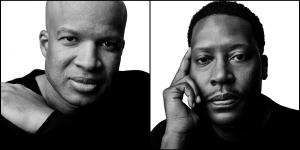
Steppenwolf Theatre Company, the nation's premier ensemble theater company, is pleased to launch its 51st Season with Suzan-Lori Parks' Pulitzer Prize-winning drama Topdog/Underdog, helmed by Tony Award-winning director Kenny Leon, who returns to Steppenwolf following his hit production of King James. Ensemble members Glenn Davis (Windfall, Purpose–Chicago/Broadway, King James) and Namir Smallwood (Windfall, The Book of Grace, Bug–Chicago/Broadway) go head-to-head in this highly-anticipated revival, more than two decades after the company's celebrated 2003 production.
Topdog/Underdog will play a limited engagement September 17 — November 1, 2026 in Steppenwolf's Downstairs Theater, 1650 N. Halsted St. in Chicago. Single tickets go on sale Thursday, July 9, 2026 at steppenwolf.org or the Box Office at (312) 335-1650.
About the Production:
Brothers Lincoln and Booth, named in jest, are two Black men living in America just trying to get by. Lincoln dresses like his namesake, reenacting his assassination for money and laughs. Booth stays stuck in their apartment, working tirelessly on his three-card hustle. Sibling rivalry and a lifetime of resentment come to a head in this fast-paced and ferocious thrill ride. The deck is stacked with a Tony Award-winning director, a Pulitzer Prize-winning script and a tour-de-force showdown for ensemble members Glenn Davis and Namir Smallwood. "Take thuh cards and show me whatcha got!"
The creative team includes Arnulfo Maldonado (Scenic Design), Dede Ayite (Costume Design), Lee Fiskness (Lighting Design), Justin Ellington (Sound Design), Patrick Zakem (Creative Producer), Elise Hausken (Production Manager), JC Clementz, CSA (Casting), Laura D. Glenn (Production Stage Manager) and Jaclynn Joslin (Assistant Stage Manager). For full cast and creative team bios, click here.
Production Details:
Title: Topdog/Underdog
Playwright: Suzan-Lori Parks
Director: Kenny Leon
Cast: ensemble members Glenn Davis (Lincoln) and Namir Smallwood (Booth)
Understudies: Anthony Fleming III (Lincoln) and Patrick Newson Jr. (Booth)
Location: Steppenwolf's Downstairs Theater, 1650 N. Halsted St., Chicago
Dates: Previews: Thursday, September 17 – Saturday, September 26, 2026
Regular run: Tuesday, September 29 – Sunday, November 1, 2026
Curtain Times: Tuesdays, Wednesdays, Thursdays and Fridays at 7:30 pm; Saturdays at 3 pm & 7:30 pm; and Sundays at 3 pm. Please note: there will not be 7:30 pm performances on Tuesday, September 22, Thursday, October 1, Tuesday, October 6, Tuesday, October 13, Wednesday, October 21 or Thursday, October 22; there will be an added 2 pm matinee on Wednesday, October 21.
Tickets: Classic Memberships starting as low as $165 are now on sale for Steppenwolf's 2026/27 season at steppenwolf.org/myseason. Single tickets for Topdog/Underdog ($20 – $124*) go on sale Thursday, July 9, 2026 at steppenwolf.org and the Box Office at (312) 335-1650. Steppenwolf Flex Memberships are currently on sale: Black Card Memberships with six tickets for use any time for any production and RED Card Memberships for theatergoers under 30. *Pricing includes an $8.50 handling fee
Steppenwolf offers 20 tickets for $20 (no added fees) for each performance of every membership series production. Use promo code 20FOR20 to redeem this offer online, available in advance until they're sold out for every main series show. Limit 2 tickets per person. You can also purchase by phone at (312) 335-1650 on the day-of show at 12 pm for main series performances. Limit 2 tickets per person.
Accessible Performance Dates:
Audio-Described and Touch Tour: Sunday, October 25 at 3 pm (1:30 pm Touch Tour)
Open-Captioned: Thursday, October 8 at 7:30 pm & Saturday, October 17 at 3 pm
ASL-Interpreted: Friday, October 16 at 7:30 pm
Education and Engagement:
Throughout the 2026/27 season, Steppenwolf continues its commitment to the next generation of theatre learners, makers and appreciators with robust education and engagement programming. Programming includes dedicated student matinee performances during four of the five Membership Series productions including Topdog/Underdog, Adirondack Chair Circle, The Comeuppance and Ellen B., in-school residencies in partnership with Chicago Public schools, workshops, panels and events specifically geared towards teens, as well as professional development trainings and resources for educators. Additionally, Steppenwolf is reimagining their community engagement and will pilot new public programming, continue accessibility programming and offer opportunities for deeper explorations for audiences throughout the season. For additional information about Steppenwolf's Education and Engagement programming and to register your school for a field trip visit steppenwolf.org/education-and-engagement/steppenwolf-field-trip-series.
Artist Biographies:
Suzan-Lori Parks (Playwright) is a multi-award-winning writer and musician. She is the first African-American woman to receive the Pulitzer Prize for Drama for Topdog/Underdog, which recently won the 2023 Tony Award for Best Revival. Her other plays include Sally & Tom (2024), Plays for the Plague Year (Drama Desk Award, Best Music, 2023) and Father Comes Home From The Wars (2014). Parks' first marathon-writing "micro diary plays," 365 Days/365 Plays were produced worldwide in what was the largest grassroots collaborative theatre project to date. She is a MacArthur "Genius" Fellow, a novelist: Getting Mother's Body (Random House); and a screenwriter: Girl 6, Genius: Aretha, and The United States vs Billie Holiday. Parks also writes songs and fronts her band "SLP& The Joyful Noise," with her punk-couture medicine show, The Tune Up, world-premiering this summer. As a college student Parks is grateful to have studied creative writing with James Baldwin, who encouraged her to write for the theatre.
Kenny Leon (Director) is a Tony Award-winning director. Broadway: The Balusters, Othello, Our Town, HOME, Purlie Victorious: A Non-Confederate Romp Through the Cotton Patch, Topdog/Underdog, Ohio State Murders, A Soldier's Play, American Son, Children of a Lesser God, Holler If Ya Hear Me, A Raisin in the Sun, The Mountaintop, Stick Fly, August Wilson's Fences, Gem of the Ocean and Radio Golf. Off-Broadway: The Conversation (Astor Place Theatre), This World of Tomorrow (The Shed), King James, The Underlying Chris, Everybody's Ruby, Emergence-See! (The Public), Smart People (Second Stage). Opera: Amahl and the Night Visitors, Margaret Garner. Television: Robin Roberts Presents: Mahalia, Colin in Black & White, 4400, Amend: The Fight for America, American Son (adapted for Netflix), Hairspray Live!, The Wiz Live!, Steel Magnolias, Dynasty, In My Dreams. Author: Take You Wherever You Go. Artistic Director Emeritus: Kenny Leon's True Colors Theatre Company. Senior Resident Director: Roundabout Theatre Company. Awards: Obie, Actors Fund Medal of Honor, George Abbott Lifetime Achievement for American Theatre, Jason Robards Award for Excellence in Theatre.
Glenn Davis (Lincoln) is an actor, producer and Artistic Director of Steppenwolf Theatre Company, alongside Audrey Francis, where he has been an ensemble member since 2017. His Steppenwolf credits include Downstate, The Christians, You Got Older, The Brother/Sister Plays, Head of Passes, King James (also Mark Taper Forum), Describe the Night, Purpose and Windfall. Broadway credits include: Purpose; Bengal Tiger at the Baghdad Zoo (also Kirk Douglas Theatre, Mark Taper Forum). Off-Broadway credits include Transfers (MCC Theatre), Wig Out! (Vineyard Theatre), Downstate (Playwrights Horizons, Outer Critics Circle Nomination) and King James (MTC). Other regional credits include Moscow x6 (Williamstown Theatre Festival). International credits include Downstate (National Theatre, UK), Edward II, The Winter's Tale and As You Like It (Stratford Festival), Othello (The Shakespeare Company). Television credits include Billions, 24, The Unit, Jericho and The Good Wife. Glenn is an Artistic Associate at the Young Vic in London and at the Vineyard Theatre in New York. He is also a partner in Cast Iron Entertainment, a collective of artists consisting of Sterling K Brown, Brian Tyree Henry, Jon Michael Hill, Andre Holland and Tarell Alvin McCraney. Cast Iron is currently in residence at The Geffen Playhouse in Los Angeles. In 2021, Glenn founded The Chatham Grove Company along with his producing partner Tarell Alvin McCraney.
Namir Smallwood (Booth) joined the Steppenwolf Theatre Company ensemble in 2017. Steppenwolf: Windfall, Mr. Wolf, You Will Get Sick, The Book of Grace, Seagull, Bug, True West, BLKS, Monster, Man In Love, The Hot L Baltimore, Last Night and the Night Before. Broadway: Pass Over, Bug. Off Broadway: Pipeline, Pass Over (Lincoln Center). Chicago: The Lost Boys of Sudan (Victory Gardens Theater); Charm (Northlight Theatre); The Grapes of Wrath (The Gift Theatre); East Texas Hot Links (Writers Theater). Regional: Marin Theatre Company, Pillsbury House Theatre, Ten Thousand Things, Guthrie Theater. International: True West (Galway International Arts Festival). Television: Chicago Fire, Betrayal, Elementary, American Rust (Showtime/FreeVee); Power Book IV: Force (STARZ). Film: Rounding, About Time, Bailey's Blues.
Accessibility:
As a commitment to make the Steppenwolf experience accessible to everyone, performances featuring American Sign Language Interpretation, Open Captioning and Audio Description are offered during the run of each STC production. Assistive listening devices (ALDs), large-print programs and Braille programs are available for every performance and all our spaces are equipped with an induction hearing loop. Our building features wheelchair accessible seating and restrooms, push-button entrances, a courtesy wheelchair and all-gender restrooms, with accessible counter and table spaces at our bars. For additional information regarding accessibility, visit steppenwolf.org/access or e-mail This email address is being protected from spambots. You need JavaScript enabled to view it..
Sponsor Information:
United Airlines is the Official and Exclusive Airline of Steppenwolf. Steppenwolf is also grateful for the significant season support from lead sponsors Allstate Insurance Company, Paul M. Angell Family Foundation, Bloomberg Philanthropies, Crown Family Philanthropies, Caroline and Keating Crown, Julius Frankel Foundation, Lefkofsky Family Foundation, Northern Trust, Anne and Don Phillips, John Hart and Carol Prins, Shubert Foundation, Inc, Walder Foundation, and Zell Family Foundation. Steppenwolf also acknowledges generous support from premier sponsors Anonymous, Andrew and Amy Bluhm, Michael and Cathy Brennan, Ann and Richard Carr, Chicago Community Trust, Conagra Brands Foundation, Rich and Margery Feitler, FROST CHICAGO, John D. and Catherine T. MacArthur Foundation, The Orlebeke Foundation, Polk Bros. Foundation, Sacks Family Foundation, Harold and Mimi Steinberg Charitable Trust, Thoma Bravo and Bryan Traubert and Penny Pritzker. Steppenwolf also acknowledges support from the Illinois Arts Council and the City of Chicago Department of Cultural Affairs and Special Events.
About Steppenwolf Theatre Company:
Steppenwolf Theatre Company is the nation's premier Ensemble Theater with 50 members who are among the top actors, playwrights and directors in the field. Thrilling, powerful, groundbreaking productions have made this theatre legendary. From the early phenomenon of Balm in Gilead, to The Grapes of Wrath, August: Osage County, Downstate, The Brother/Sister Plays, and more recently, the Pulitzer Prize and Tony Award-winning Purpose, Steppenwolf Theatre has had a long-running and undeniable impact on American Theatre and Chicago's cultural landscape. Founded in 1974 by Terry Kinney, Jeff Perry and Gary Sinise, Steppenwolf started as a group of friends in their teens and early 20s performing in the basement of a school in Highland Park, Illinois. Today, the company's artistic force remains rooted in the original vision of its founders: an artist-driven theatre, whose vitality is defined by its appetite for bold and innovative work. Every aspect of Steppenwolf is rooted in its Ensemble ethos, from the intergenerational artistic programming to the multi-genre performance series LookOut, to the nationally recognized work of Steppenwolf Education and Engagement which serves nearly 15,000 teens annually. While grounded in the Chicago community, more than 40 original Steppenwolf productions have enjoyed success nationally and internationally, including Broadway, Off-Broadway, London, Sydney, Galway and Dublin. Steppenwolf also holds accolades that include the National Medal of Arts, 14 Tony Awards, two Pulitzer Prize-winning commissions and more. Led by Artistic Directors Glenn Davis and Audrey Francis, Executive Director E. Brooke Flanagan and Board of Trustees Chair Keating Crown — Steppenwolf continually redefines the boundaries of live theater and pushes the limits of acting and performance.
Steppenwolf's Mission: Steppenwolf strives to create thrilling, courageous and provocative art in a thoughtful and inclusive environment. We succeed when we disrupt your routine with experiences that spark curiosity, empathy and joy. We invite you to join our ensemble as we navigate, together, our complex world. steppenwolf.org, facebook.com/steppenwolftheatre, twitter.com/steppenwolfthtr and instagram.com/steppenwolfthtr.
Redtwist Theatre Announces its 2026 - 2027 Season, "State of Violence"

|
|
|
|
|
No Dogs’ Delivers an Unfamiliar Earnest
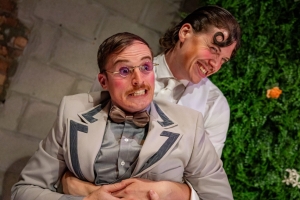
Oscar Wilde’s The Importance of Being Earnest is one of the greatest farces ever written. His wordplay caricatured high society, and clever pay-offs are hilarious when executed properly. The play was first performed on February 14, 1895 (Valentine's Day). The premiere took place at the historic St James's Theatre in London. Wilde famously subtitled the work “A Trivial Comedy for Serious People,” a reminder that its brilliance lies in treating absurdity with absolute sincerity. Unfortunately, No Dogs in the Kitchen Theatre Company’s recent production, directed by Genevieve Corkery, misses the mark when bringing this beloved play to the stage.
For those unfamiliar, the classic comedy follows two high-society bachelors, Jack Worthing and Algernon Moncrieff, who invent secret personas to escape the boredom of everyday life. Trouble arises, however, when Jack (going by the name of “Ernest”) proposes to Gwendolen, who is intent on only marrying a man with that specific name. Matters are complicated further when the carefree, mischievous Algernon also dons the moniker “Ernest” to woo Jack’s ward, Cecily, who shares the exact same romantic obsession with the name. To find happiness, the lovers must quickly untangle a web of ridiculous misunderstandings and mistaken identities. The true brilliance of Wilde’s script lies in its wordplay and sharp societal satire, taking the audience on a wild, hysterical ride where the utterly absurd is treated with the utmost importance.
Founded in 2023, No Dogs in the Kitchen is still a young company, and a certain learning curve is both natural and expected as they continue shaping their artistic identity. Their past work has already shown a clear interest in bold, unconventional staging, often embracing heightened physicality and playful absurdism. That adventurous spirit is a defining part of their aesthetic, and it’s evident the ensemble values experimentation and a willingness to push familiar texts in unexpected directions. While this production didn’t always find harmony between those impulses and Wilde’s finely tuned verbal wit, the company’s enthusiasm, imaginative framework, growing technical confidence, and emerging vision suggest they have the tools to grow into a distinctive and compelling presence within Chicago’s storefront theatre scene.
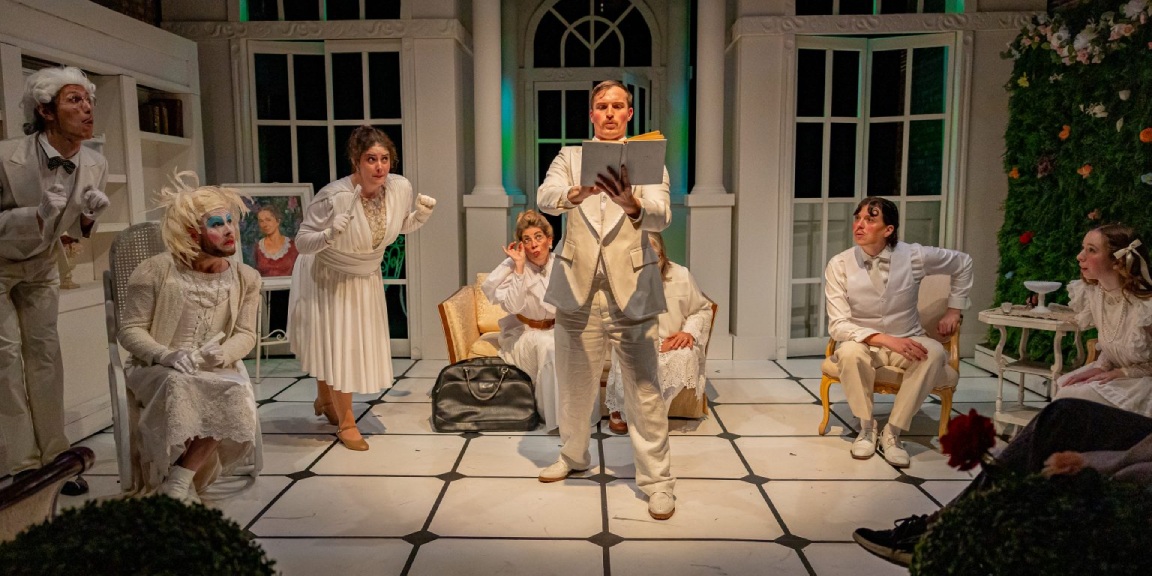
The cast of No Dogs in the Kitchen’s “The Importance of Being Earnest” at Facility Theatre.Photo: Alex Albrecht
That said, where this production struggles is in its apparent distrust of the script, adding jumbled and superfluous elements that only serve to undercut the humor it tries so hard to generate. It is as if the creative team didn't believe the script was funny enough on its own, choosing instead to pile on unnecessary subtext that needlessly deviated from - and was unsupported by - Wilde’s text.
This staging regularly undermines its own comedic timing with added, cartoonish sound effects that reduce wit to silly gags. From boinging springs to breaking plates, it felt as if someone was trying to use every button on a soundboard. Furthermore, a heavy hand of physical humor frequently distracts from the brilliant dialogue. During several monologues, cast members distracted the audience with routines like fighting on a sofa. Another oddity occurred in the final act when multiple cast members broke the fourth wall to deliver lines - a trick they hadn't used up until that point. It’s unclear why there was such distrust in the source material, and why a surplus of additions was believed to be the solution.
The performances also suffered from this same directive, often relying on over-the-top delivery. Mitch Karmis, who played two different butlers, mugged for the audience and utilized an almost cartoon-like physicality. David Lovejoy portrayed Lady Bracknell as a Mommie Dearest caricature instead of the formidable, sophisticated society matriarch who delivers scathing lines with dry, icy wit. The performance moved between widely contrasting vocal registers, creating an uneven tone that often felt out of step with Lady Bracknell’s traditionally controlled presence. It was also unclear why, in the final act, Lady Bracknell suddenly transformed into a flirtatious aggressor who growled at Jack and threw herself at the butler. Another odd decision was to have Dr. Chasuble played by Sara Corkery in a rubber race mask.
Amidst these choices, there was a bright spot in Garret Weigel’s Jack. For the most part, Weigel found the right balance between inventive character choices and a respect for the script. Jack could easily be played as a boring straight-man when up against the whimsical Algernon, but Weigel added a distinct flair to his interpretation without straying too far from the original play.
It is genuinely unfortunate that the production chose to deviate so drastically from the text. When done faithfully, The Importance of Being Earnest is a true theatrical gem. While there were moments that elicited genuine laughter, they occurred when the text was allowed to speak for itself, rather than being buried under extraneous gags.
While this hyper-stylized, over-the-top version might appeal to theatergoers seeking a radical, alternative spin on a classic, those looking for a faithful, witty adaptation of Wilde’s masterpiece will likely find this production is not the one.
The Importance of Being Earnest runs through July 26th at Facility Theatre. For more information and/or tickets, visit https://nodogsinthekitchen.org/.
Suffs and the Women Who Refused to Wait

Suffs is a musical about history, yes, but more importantly, it is a musical about momentum: who creates it, who resists it (and why), who gets left behind by it, and what it costs to keep pushing it forward.
Set during the height of the women’s suffrage movement in the 1910s, the show follows a group of young suffragists led by Alice Paul, the real-life founder of the National Woman’s Party. Together, they organize, protest, clash with political leaders, become political prisoners, and (spoiler alert) eventually help gain women the right to vote through the 19th Amendment. But Suffs is not content to frame that victory as clean or uncomplicated, or to pretend that, even a century later, the battle is anywhere near over. The musical is just as interested in the fractures within the movement itself: the younger, more aggressive activists pushing against the older, more “respectable” wing of the Suffrage movement, and the women of color forced to fight for a movement that still asks them, again and again, to wait their turn.
That is where Suffs feels most relevant. It is not only a story about the past, but about the way progress still happens now: through generational disagreement, imperfect coalitions, strategic compromises, moral failures, and the constant fear that too much change too quickly might provoke as much backlash as liberation. Shaina Taub’s book, music, and lyrics do an incredible job balancing real history with theatrical fiction, making the politics legible without flattening the people involved into saints or symbols.

Marya Grandy (Carrie Chapman Catt) and company in SUFFS.
Under director Leigh Silverman, the first national tour’s production is just as anchored by its remarkably talented cast as it is by history; the entirely female company takes on both women and men throughout the story. Maya Keleher is excellent as Alice Paul, bringing both vocal strength and exactly the right kind of young, audacious drive to the role. Her Alice has the spunky determination of a character like Newsies’ Katherine, but grown up: sharper, more self-assured, and driven by something deeper than ambition. She is unabashedly devoted to her cause and makes it clear that, no, it’s not just because she’s young.
Playing opposite her are historical figures Carrie Chapman Catt (Marya Grandy), the mature and strategically tactful leader of NAWSA, and President Woodrow Wilson (performed by u/s Merrill Peiffer). Grandy’s dynamic with Alice Paul is one of the production’s strongest relationships, the two women foiling each other beautifully as they reveal different forms of conviction, compromise, and care. Peiffer’s handling of the presidential role was especially smart: funny and pointed, but never so exaggerated that it breaks the world of the show.
A special shoutout also has to go to the trio of Ida B. Wells (Danyel Fulton), Mary Church Terrell (Trisha Jeffrey), and Phyllis Terrell (Victoria Pekel). Multiple times, the energy in the theatre seemed to shift the moment the three of them took the stage together. Their scenes carried a stillness and gravity that made the room go quiet in the best possible way.

Brandi Porter (Dudley Malone) and Jenny Ashman (President Woodrow Wilson) in the First National Touring Company of SUFFS.
Suffs, which premiered Off‑Broadway in 2022 before its award‑winning 2024 Broadway run, continues to prove its power throughout its highly anticipated national tour. The score delivers some of the musical’s most defining moments, from the sharp, scene‑setting opener “Let Mother Vote” to the driving protest energy of “The March (We Demand Equality).” The emotional weight lands beautifully in “I Was Here,” a moving tribute to Ida B. Wells and Mary Church Terrell, while “Keep Marching” rises as the show’s breakout anthem, capturing the spirit of persistence that fuels the entire production.
If I have a critique, it’s that the show leans a bit too heavily into the idea of the production’s scale growing in tandem with the movement’s momentum. Conceptually, I love that choice. In practice, however, especially within the limits of a touring production, the early restraint makes the show take a long time to feel truly sweeping. The first act is good, but it was not until the second half of the second act that I found myself thinking, “Why haven’t they been singing like that, and dancing like that, the whole time?” The choreography has similar highs and lows: effective in moments, but not always as polished as it needs to be for the more intricate sections to feel truly stunning.
Still, by the end, Suffs lands exactly where it needs to. It leaves the audience empowered without pretending that empowerment is the same as change. The show understands that history is not something we revisit for comfort, but something we return to for instruction. Its final message, “your ancestors are all the proof you need / That progress is possible, not guaranteed,” is both a warning and a call to action. Suffs reminds us that the march is not over - and that the responsibility to keep moving belongs to all of us.
Recommended.
Presented by Broadway In Chicago, Suffs is running at CIBC Theatre through July 19th. Tickets are available here.
Goodman’s Iceboy! Is a Full‑Tilt Blast of Comic Mayhem

Goodman Theatre’s Iceboy! arrives as a gleefully off the rails musical that blends Broadway glamour, Neanderthal chaos, and theatrical myth making into one of the most delightfully strange premises to hit Chicago in years. It’s a satire, a love letter to showbiz, and a playful reimagining of how Eugene O’Neill might have found inspiration for The Iceman Cometh - if history had taken a wildly different turn.
Set in 1939, Iceboy! or The Completely Untrue Story of How Eugene O’Neill Came to Write “The Iceman Cometh” follows Broadway superstar Vera Vimm, who purchases the newly thawed 40,000‑year‑old Neanderthal after he’s discovered in the Arctic. An orphan herself, Vera risks the last of her money because she sees in Iceboy not just a curiosity, but the possibility of a son. Once he thaws, “Iceboy” unexpectedly becomes a theatrical sensation, charming Manhattan and quickly rising to stardom. His meteoric fame threatens Vera’s own spotlight, creating a comic rivalry as she scrambles to maintain her status.
Meanwhile, playwright Eugene O’Neill - stuck in a bout of severe writer’s block - becomes fascinated by Iceboy’s sudden cultural impact. In this fictionalized retelling, Iceboy’s presence and persona inspire O’Neill to write The Iceman Cometh, intertwining the Neanderthal’s improbable celebrity with one of American theatre’s most iconic works. The musical plays as a satirical backstage romp - part showbiz fable, part absurdist comedy - where ambition, ego, and theatrical legend collide, all delivered with a cheerful, madcap sensibility that feels straight out of the Mel Brooks playbook. The tone is broad, cheeky, and joyfully irreverent, embracing the kind of anything goes comic mayhem Brooks perfected in The Producers and Young Frankenstein.

Megan Mullally as Vera Vimm and Nick Offerman as Eugene O'Neill in Iceboy! at Goodman Theatre. Photos by Todd Rosenberg.
To appreciate just how boldly Iceboy! reframes O’Neill’s legacy, it helps to remember what The Iceman Cometh actually is.
O’Neill’s future Pulitzer Prize offering inspired a four-hour film that’s essentially a parade of drunks in a dim bar, each clinging to dreams they’ll never pursue - the bar itself a metaphor for their inability to move forward, trapped in the same place both physically and emotionally. The 1973 film adaptation centers on the down and out patrons of Harry Hope’s saloon in 1912 Greenwich Village. These men - alcoholics, former revolutionaries, disgraced professionals - spend their days drowning in booze and clinging to “pipe dreams” of future redemption.
Their routine is disrupted when charismatic salesman Theodore “Hickey” Hickman arrives - sober, zealous, and determined to force everyone to abandon their illusions. Hickey’s mission to strip the barflies of their comforting fantasies leads to emotional unraveling, bitter confrontations, and ultimately a chilling confession about his own past. The story is a tragic, philosophical exploration of hope, delusion, and the brutal cost of facing reality.
All of that brooding, booze-soaked existentialism makes Iceboy!’s approach even more refreshing. Where O’Neill’s world traps its characters, this musical unleashes its own with joyful abandon - led by an ensemble so charismatic and so sharply funny that the show vibrates with life.
Guiding the production is director Marc Bruni, who shapes the show with crisp timing and a clear sense of comic architecture, keeping its wild premise buoyant without letting it unravel. The music by Mark Hollmann gives the story a light, upbeat foundation, and the lyrics by Hollmann and Jay Reiss add steady humor throughout. The book by Erin Quinn Purcell and Reiss keeps the tone approachable, offering just enough structure for the characters to play within. Joann M. Hunter’s choreography provides simple, well‑placed movement that supports the show’s comic rhythm without calling attention to itself.
It certainly helps that Iceboy! is powered by an outrageously talented and instantly likeable ensemble. Husband and wife duo Nick Offerman and Megan Mullally make a dynamite team - Offerman is superb, bringing his signature deadpan charm to Eugene O’Neill, the same understated precision and dry, unflappable humor that’s made him beloved in Parks and Recreation, Devs, and The Last of Us. Mullally, best known for her Emmy winning turn as Karen Walker on Will & Grace, her unforgettable Tammy II opposite husband Nick Offerman on Parks and Recreation, and her Broadway run in How to Succeed in Business Without Really Trying, delivers a riotously funny, razor sharp performance as Broadway titan Vera Vimm. She tears into the role with fearless comic bravado and vocal firepower that reminds you she’s a true musical theatre pro - her belt is thrilling, her phrasing wickedly playful, and her comedic musicality is a show in itself. Few performers can time a sharp aside with Mullally’s precision.

(L-R) Melanie Brezill, Shawn Pfautsch, Megan Mullally, SarahStiles and Grey Henson in Iceboy!
Cedric Yarbrough, best known for Reno 911! and Speechless, is terrific as Floyd Richards, Vera’s devoted lover and perpetually stressed playwright. He brings a warm, rumpled charm to the role, layering Floyd’s desperation with impeccable timing, sly vocal humor, and a steady stream of perfectly landed one-liners. His presence gives the show a grounded comic pulse that keeps the chaos humming - and his baritone is impressive.
Chicago favorite Alex Goodrich is a delight as Frankenstein, one of Vera’s long-suffering caretakers, layering the role with buoyant physical comedy and a wonderfully off-kilter energy that fits the show’s boisterous comic verve.
As Iceboy or “Jeff,” Grey Henson is a revelation - wide eyed, instinctive, and musically explosive. He plays the Neanderthal with such innocence and uninhibited theatrical gusto that the audience can’t help but root for him. He’s a genuine surprise as well, offering several scene-stealing moments that deepen the show’s comic momentum and give its wild energy an extra spark.
And Sarah Stiles, as Lambert, Vera’s whip‑smart, perpetually overwhelmed assistant, makes every appearance count with her explosive comedic instincts and razor‑precise delivery. Her timing is immaculate - every flustered aside, every clipped retort, every moment of mounting panic lands with such clarity and control that she elevates even the smallest beat. Stiles has a way of shaping a line so it hits with both intelligence and impact, turning Lambert’s exasperation into one of the show’s most consistently funny throughlines.
Together, this ensemble - Offerman, Mullally, Yarbrough, Henson, Stiles, Goodrich, and a bench of other strong players rounding out the cast - forms an ecstatically silly comedy machine, a group so talented and irresistibly likeable that the laughs never let up and every performer feels essential to the show’s delirious momentum.
The musical numbers are wonderfully fun. Songs like the opening number “Historic Find,” the gloriously unhinged “Can You Call Me ‘Mama’?,” and the full company showstopper “Hooray for Iceboy!” set the tone for the musical’s raucous spirit. Each one is packed with sharp wit, big Broadway energy, and the kind of gleeful absurdity that keeps the audience laughing long after the button. “Historic Find” opens the show with a clean burst of discovery‑driven momentum, “Can You Call Me ‘Mama’?” makes full use of Mullally and Henson's sharp comic instincts, and “Hooray for Iceboy!” brings the full company together for a lighthearted, good‑natured celebration. This sample size of songs highlights how musically nimble and consistently funny Iceboy! is - a score that shifts easily between cleverness, silliness, and moments of heightened theatrical play.
One of the funniest musical numbers in the show is “Marry Me,” sung with perfect comic contrast by Grey Henson and Sarah Stiles. In it, Iceboy proposes to Lambert with disarming sincerity, offering what he believes are tender declarations of affection - only to fold in a series of prehistoric “courtship traditions” drawn from his caveman understanding of romance. Throughout the song Iceboy sings to her, “I want to take you from behind,” his way of saying he'd like to marry her. The result is a wonderfully off‑balance duet that lands as one of the show’s most genuinely hilarious moments.
Adding to the show’s irresistible charm is the fantastic Art Deco set designed by Paul Tate Depoo, which instantly places us inside Vera Vimm’s lavish living room - all gleaming lines, bold geometry, and glamorous period detail. Depoo’s design captures the theatrical excess of 1939 Broadway while giving the actors a playground of visual delight. On each side of the stage, Eugene O’Neill’s writing desks sit like dueling stations of inspiration and frustration, a clever touch that keeps his presence woven into the action. And, true to O’Neill’s legacy, there’s always a bottle within reach, a sly nod that becomes both a running joke and a thematic anchor. It’s a smart, stylish environment that supports the comedy while grounding the show in a richly imagined world.
Iceboy! or The Completely Untrue Story of How Eugene O’Neill Came to Write “The Iceman Cometh” is an outrageously inventive, joy-charged burst of musical comedy that proves Goodman Theatre can still surprise us in the best possible ways. With its fearless cast, sharp writing, and deliriously fun score, it’s the kind of show that sends you out grinning and grateful for the sheer imagination on display. Iceboy! runs through August 9th at Goodman Theatre and stands as one of the most riotously entertaining nights out you’ll find this summer.
Very highly recommended.
Now extended through August 16th. For tickets and/or more show information, click here.
The Art of Awe: Water for Elephants Balances Spectacle and Soul

The musical Water for Elephants, presented by Broadway In Chicago and based on Sara Gruen’s 2006 novel, is the rare touring Broadway production that feels like two forms of live entertainment fused perfectly. It is a sweeping musical, yes, but it is also a full-blown circus spectacle – and, more impressively, it manages to blow you away on both fronts.
Told through the memories and ghosts of an elderly Jacob Jankowski, Water for Elephants follows a young Jacob who, under unfortunate circumstances, follows the age-old childhood dream of running away with the circus. The show brings to life the complicated realities behind that fantasy: the idea of stumbling into a secret, self-contained world where danger, wonder, chosen family, and reinvention all exist under one big top. From the moment Jacob enters that world, the audience is drawn in with him.
Particular standouts in the principal cast were Zachary Keller as Jacob Jankowski, whose vocal talent and charisma are matched only by Robert Tully as Older Jacob – the perfect pairing across time. As Marlena, Helen Krushinski commanded the theatre like a pure-of-heart ringmaster, capturing our attention both on trapeze and vocally. However, no one made the audience laugh harder than Tyler West as Walter, the gritty, spunky clown and knife-thrower whose physical comedy was unmatched, projecting every larger-than-life expression to the backs of the theatre.
The show’s creative engine fires on all cylinders: a soaring score from the acclaimed PigPen Theatre Co. (The Tale of Despereaux), a sharply crafted book by four‑time Tony Award nominee Rick Elice (Jersey Boys, Peter and the Starcatcher), and tour direction by Ryan Emmons, faithfully re‑creating Jessica Stone’s Tony‑nominated original staging (Kimberly Akimbo).

(left-right) Connor Sullivan, Helen Krushinski, and Zachary Keller in Water for Elephants. Photos by Matthew Murphy for MurphyMade.
The most immediately astonishing element of this production is, unsurprisingly, the circus work. The show features a truly impressive range of skills, including aerial hoop and silks, Spanish web, trapeze, and dozens of genuinely death-defying acrobatic tricks and stunts. These sequences are not treated as decorative flourishes or occasional spectacle breaks; they are woven directly into the fabric of the show, pulling us behind the scenes of how the circus breathes, moves, celebrates, and survives.
Aside from their incredible acrobatic talent, it is the ensemble’s acting and collective presence that really bring the Benzini Brothers Circus to life. They do not just perform like a group of talented individuals; they feel like a community. Their presence gives the spectacle a lived-in quality, as if we are getting a glimpse into a strange, beautiful little village that existed long before Jacob arrived and will continue on after he leaves. The choreography only deepens that feeling, filling the stage with constant motion that still somehow feels purposeful, like the well-oiled machine behind a traveling circus, rather than chaotic. Even in the busiest moments, there is a sense of shared rhythm and collective trust among the ensemble that’s impossible to fake.
That trust extends beyond performance and into the technical construction of the show itself. Throughout the production, the cast quite literally assembles and dismantles the world around them. The big top is built, broken down, reconfigured, and rebuilt in front of us, using artistry to turn scene transitions into their own kind of performance. For a concept that presents so many obvious challenges – live animals, circus-scale theatricality, and the limitations of a traveling production, to name a few – Water for Elephants meets each obstacle with remarkable creativity and a steady grounding force.

The touring cast of Water for Elephants.
The production design is especially successful because it knows when to lean into abstraction. Rather than attempting to make every element literal, the show often suggests the world of the circus through movement, fabric, shadow, structure, the bodies of its performers, and some of the most beautiful puppets I’ve seen on stage. The amount of thought that went into creating something cohesive, theatrical, and fully transportable - without dulling any of its magic - feels less like standard Broadway stagecraft and more like a feat pulled off by a traveling chosen family.
All of this authenticity, however, at times feels at odds with the musical’s book and score. The ensemble feels so natural, so physically and emotionally connected to one another, that a few of the more dramatic scenes begin to feel noticeably staged by comparison. That is not a question of the principal cast’s talent, but rather a limitation of translating this story from novel to musical. There are moments when the circus – and even the puppets – feels startlingly real, and moments when you are reminded that you are very much watching a musical. Neither approach is inherently wrong, but the gap between them can be jarring. Still, that critique feels small compared to the scale of what the production accomplishes. It is also worth noting how vocally balanced the ensemble remains despite the wide range of performers on stage. In a show that combines musical theatre performers with circus and acrobatic artists, maintaining that level of cohesion is both a performance achievement and a technical one.
Water for Elephants captures the exact feeling it is chasing: awe. It is dangerous, romantic, inventive, and deeply theatrical, with a company that makes the impossible look effortless.
For anyone who has ever wanted to run away with the circus – or simply be reminded of what live performance can do when artists push it to its limits – Water for Elephants is running at James M. Nederlander Theatre through July 5th. Tour information and tickets are available at https://waterforelephantsthemusical.com/.
A People: A Sweeping, Soul‑Stirring Journey That Celebrates Jewish Identity

An extraordinary eight-person ensemble fuels the sweeping storytelling of A People - a production presented collaboratively by Arts Judaica and YI Love Jewish - shifting through nearly 80 characters across generations and geographies. Though only one cast member is Jewish, playwright LM Feldman intentionally assembled a diverse ensemble to reflect the many ways Jewish identity manifests - across culture, theology, race, queerness, and lived experience - underscoring that there is no single way to be part of a people.
The performance thrives on the versatility of this cast, featuring standout contributions from Douglas Levin, who provides an authentic and anchoring sincerity, and Charity Schultz, who illuminates her roles with magnetic charm. Daniel Boughton moves with ease between sharp humor and striking emotional depth, and Jin Ai anchors the production’s stillest moments with a quiet power, enriched by her beautifully integrated guitar work. Zach Kunde cuts through the space with sharp intellect and a commanding vocal presence, while Haley Schenk turns a single, piercing glance into some of the production’s most potent dramatic beats, and she even threads in flute playing that adds a surprising, delicate texture. The momentum never falters thanks to Xavier Mattison’s vibrant energy and tenderness, while Freya Churchwell rounds out the ensemble with impressive, wide‑ranging versatility and delivers some of the play’s genuine laugh‑out‑loud exchanges. Together, they weave a unified and deeply affecting tapestry of human survival.
This remarkable stage chemistry is guided by director Avi Hoffman, an acclaimed figure in global Jewish theater who recently directed and starred in a historic Yiddish production of Death of a Salesman in Bucharest, Romania. Having previously earned a Drama Desk nomination for playing Willy Loman in New York, Hoffman injects this local production with masterful artistic insight. Under his careful guidance, the non-linear, fragmented script by L. M. Feldman avoids confusion, gaining immense clarity and striking a perfect balance between epic historical weight and intimate human connection.

L-R: Jin Ai, Charity Schultz, Freya Churchwell, Zach Kunde, Douglas Levin. Photos by Logan and Candice Conner, Oonphotography.
Starting with the diaspora of the Jewish people that have become scattered throughout the world, the production explores several expressions of Judaism while ultimately reinforcing the idea that, despite their differences, they remain one people - and a remarkable people at that. It touches on beautiful threads of Jewish history, including the teaching that Moses received not only the written Torah referred to as “The Hand” at Mount Sinai but also the Oral Torah referred to as “The Tongue,” which was an interesting fact that I did not ever learn about the Torah in Hebrew school. I was also unaware of another phenomenon that members of the Jewish community called “tonals” actually memorized whole portions of the Torah to recite and sing so that the Torah portion could be performed for groups of students/scholars etc., to discuss and watch. The important thing that came out of this discussion of the Torah and the essential thing that makes Judaism different from other religions is that Jews learned and passed on the teachings of the Torah and the Talmud for the purpose of discussing them and learning from them and interpreting them and re-interpreting them -so as not to force them down anyone’s throat to be followed with blind faith.
As a Jew, I appreciated how the piece pokes gentle fun at our tradition of spirited debate - a trait that can be both energizing and, at times, hilariously counterproductive.
They are so intelligent at debating with each other that sometimes they nitpick each other to the end of a discussion that could otherwise forward the family or community or couple in a more positive way.
One of the production’s most profound scenes comes when a character asks a 90‑year‑old what history lives in the wrinkles of their face - how an entire lifetime, nearly a century of memory, can be held within one fragile human body. Another moment that stayed with me was the gentle but urgent insistence that nurturing future generations is vital to the continuity of the Jewish people.

Back row L-R: Freya Churchwell, Jin Ai, Charity Schultz, Xavier Mattison, Zach Kunde, Douglas Levin. Front L-R: Haley Schenk, Daniel Boughton.
The differences among them are many, yet a shared thread still binds them together. One character argues passionately for a two‑state solution, while another hopes her girlfriend will one day be fully embraced by her community. A rabbi even confronts a group of Jewish Christmas carolers, shouting, ‘Why are you doing this?’ as the story considers how and why some Jews celebrate Christmas - a reflection of how the holiday’s overwhelming cultural presence in America can blur the line between religious observance and simple seasonal participation. And still, beneath all these disagreements and divergences, the play returns to the same essential truth: that despite their varied beliefs, identities, and practices, they remain part of one people.
This production was perfect for me as a Reform Jew who has been struggling in recent years with the current rise in antisemitism and my own childhood feelings of being a “self-hating Jew”. I remember being told as a teenager by my talent agent applying for theater roles that I needed to change my last name from Katz to Cates, implying that I would not be cast with a Jewish last name.
The work also reminded me that many young women today - queer and straight alike - continue to push back against the patriarchal elements of Judaism. It echoes the long history of restrictions found in early texts, where girls as young as 12 years old were defined by their childbearing potential and barred from studying sacred writings.
On the plus side, it brought me back to the beauty of the Yiddish language and how I hunger for the sounds of my great grandmother Fanny’s voice and my grandmother Lillian’s voice saying, ‘Have a little nosh!’ and, ‘We love you so much we’re kvelling!’”
The set is intentionally simple: a large Star of David stretches across the floor of Theater Wit’s intimate in‑the‑round space, immediately grounding the production in its cultural and spiritual roots. A few risers punctuate the stage, giving actors elevated platforms for defining moments, while small prop boxes at either end glow when opened, revealing modest but striking items that carry surprising emotional weight. Puppets appear briefly as well, echoing the woodworking projects referenced in the story and adding a tactile, handmade quality to the world. It’s an effective setup for this play - the open space becomes essential as the ensemble moves fluidly around the stage, frequently breaking the fourth wall to bless a volunteering audience member, pass out challah, ask questions, or coax the crowd into clapping along.
By luck, I chose the seat that happened to be in the spotlight for participation, and I was delighted when one actor asked me to be his ‘bubbe’ - his grandmother. When I said, ‘Yes! I will be your grandma!’ He gently took my hand, giving me a grateful squeeze. At another point, one of the actors - dressed as a bride - asked if he could give one of the audience members a blessing. I immediately said, ‘Yes!’ and he came over and placed his hands gently on my head - he was wearing the traditional lace head covering the bride on her wedding day - and he wished me great life blessings of joy and to find a wonderful husband. It was a delightful, intimate moment, and I hope that everyone who sees the show volunteers to experience that.
Throughout much of the play, the actors also wear small placards hanging from their necks, each bearing a single word such as “wrestle,” “struggle,” and “legacy.” These signs become a quiet but potent visual motif, suggesting the burdens, questions, and inheritances each character carries across time. They function almost like distilled themes of Jewish history itself - reminders that to be part of a people is to wrestle with identity, to struggle for continuity, and to consider what legacy one leaves behind. Other words appear as the ensemble shifts through eras, each one offering a compact window into the emotional or spiritual weight of the moment.

Back row L-R: Douglas Levin, Jin Ai, Xavier Mattison. Front row L-R: Freya Churchwell, Daniel Boughton, Charity Schultz.
My only note - and this is for the author, not the cast or director - is that of all the various types of Jews included in this piece - Reform, Conservative, queer, self‑hating, Orthodox, even atheist - the one type of Jew that was not represented was the Messianic Jew, of which I am one.
Messianic Jews (not to be confused with the organization Jews for Jesus) are Jews who believe that Jesus is the Messiah spoken of in the Old Testament - the ‘Christed One,’ meaning the one anointed with the oil of blessing. In those same scriptures, this figure is described as the blessed one who would be ‘pierced through his hands and feet,’ yet ‘whose bones would not be broken.’
Messianic Jews also believe that, regardless of his lineage - whether Yeshua was a descendant of King David or not - his purpose in allowing himself to be publicly killed, and then healing his own body three days later, was to show that this world is made of spirit, or ‘shimmering motes,’ as he called them. This was long before molecular structure or the effects of consciousness on physical matter were even theorized. All of his miracles were mitzvahs - acts of goodness - centered on healing and feeding the poor, the sick, and the disabled.
At the very least, Jesus was a respected, super advanced, rabbi, rebel and healer who introduced the idea that women were worthy of learning the Torah and receiving healing from his touch whether they were Jewish or not. This Feminist thought alone was a very radical and world changing idea that women of all nations and all religions are eternally grateful for.
Given all that Yeshua represents historically and spiritually to many Jews, I was surprised that his name never surfaced in a piece that explores so many branches of Jewish identity, its factions, and its many splintered paths. I compare his omission from Jewish studies when debating this with my friends to discussing basketball history without mentioning Michael Jordan or discussing physics without ever mentioning Albert Einstein - not a judgment, just an observation about the scope of the narrative.
In any case, author LM Feldman has created a marvelously complex and deliciously enjoyable reminder of all the different expressions of Judaism, and of the lush intelligence and grace of Jewish people around the globe caught up in the current battle to stay alive and well. Le Chaim!
A People was a very deeply inspiring and delightful experience for me, especially at this unprecedented time in history. This heartfelt production of A People helped this Jewish girl from Miami, Florida remember so many of the great things about my Jewish heritage; the sights, the sounds, the heated discussions, the music, the fabulous food, the funny family dinners, my own bat mitzvah… just so many things that make me proud to be a Jew today.
With its blend of live music and rapid-fire storytelling, the production compresses five thousand years of Jewish history and cultural inheritance into a brisk, engaging evening. A People stands out as essential summertime theater, honoring its deep historical foundations while resonating powerfully with contemporary audiences.
Mazel Tov and Highly Recommended!
Running through July 5 at Theater Wit.
Astonrep Approaches Uncle Vanya’s Appeal from a Novel New Angle

Anton Chekhov, a Russian playwright who was also a doctor, can claim a level of regard few writers achieve and maintain so long after their deaths. Born in 1860, the same year the Republican Party nominated Abraham Lincoln for President, his plays are routinely produced on stages in America and around the world because of what they reveal about who we are. That’s especially true for Chekhov’s Uncle Vanya, written in 1899, just a few years before the playwright died. Its popularity may be due to its mystery. Is it about resilience or is it about failure? Is it a comedy or a tragedy? It’s the kind of work that leaves you with questions about not only its two main characters, Sonya and her Uncle Vanya, but also about us.
A part of the city’s theater community since 2011, Astonrep Productions is a small Chicago company intent on “creating compelling and intimate experiences that challenge audiences”. Their interpretation of Uncle Vanya that opened over the weekend at The Edge Off Broadway succeeds in doing so with some reservations.
It’s the first American company to mount this commissioned 2024 Canadian adaptation of Chekhov’s classic. Liisa Repo-Martell’s revamp of the play dutifully adheres to the structure, plot themes and character composition of the original. But the play’s softer aspects, the features that define its essence and purpose, are less reliable and sure.
Displeasure with self is one of first things we get a sense of when the play opens. But even before that awareness sets in, there’s a curiosity the audience notices while they’re selecting their seats before the play begins. A man is slouched in an upholstered chair with one leg over its arm. He’s at the back of the stage and asleep. (We later learn he’s passed out drunk.) Soon after and closer to us, a man and woman are talking. They’re in the sprawling home of a rural Russian estate well over 100 years ago. He’s Mikhail Astrov (Robert Tobin), the local doctor and she’s Marina, a housekeeper very ably played by Liz Cloud, who clearly possesses a warm motherly instinct and a sharp wit. Astrov’s lamenting his fate as a country doctor. It’s all tedium. The people are gossip thirsty “savages”. His life has no fulfillment. He’s not married. He’s not in love with anybody and his youth is behind him. The demands of his work, a sour outlook and his liberties with vodka are catching up with him by slowly dismantling his good looks.

L-R: Robert Tobin, Natalie Hurdle. Photo by Paul Goyette.
By calling him a moron, the doctor’s antipathy for the sleeping man is made clear even before he wakes up.
As more people enter the story, we find ourselves in the middle of a family crisis. Vanya, the man who was sleeping in the chair, and his niece Sonya (Natalie Hurdle) have been the caretakers of the estate since her mother died. Sonya’s father, Alexandre (Geoff Isaac), is a professor in the city who’s been forced out of his university position and has now returned to the homestead. He’d been relying on income from the estate to support his lifestyle in town. He’s not returned alone. Joining him is his much younger and very beautiful second wife, Yelena, with Andi Muriel in the role. Things are tense. Alexandre’s pompous and obliviously demanding. And Vanya, played with visceral intensity by Rian Jairell, is demonstrably resentful.
An appeasing conflict avoider, Sonya’s loyalties are split between the natural draw a child has to her father and her uncle who’s labored with her to keep the estate viable at tremendous personal sacrifice to them both. Now a young woman, she seems to know it’s Vanya who’s been more the nurturing father presence for her and that other than each other, the estate is all that either of them have.
Additional strain is added with the presence of Yelena. Her beauty is like an intoxicant for both Vanya and the dissatisfied doctor, Astrov. They’re both brazen in their desire for her. Watching them shamelessly try to seduce her is equal parts comic and piteous.
With so much instability, friction and doubt in the air, you’d expect to feel the charge of that energy engulfing the air. Directed by Derek Bertelsen, it doesn’t arrive with any real intensity until the second act when Sonya’s father floats the idea of selling the estate. And that’s despite the considerable investments Jairell as Vanya had been contributing up to that point. Because It’s so transparent Alexandre wants the money from the sale to fund his return to the city and his refined form of living, Vanya’s resentment turns to rage. Finally filling the production with heat.
It dials up too when Sonya confesses her attraction, indeed love, for Astrov to Yelena. Unrequited never looked so vulnerable and fragile.
Part of Repo-Martell’s adaptation included revising the language to be more contemporary and ostensibly more approachable. It works in an essential way. Both Jeremiah Barr’s handsome set and Natalie Shoch’s costume designs are ambiguous enough to blur any specific time reference. But in the back of your mind you know this is all happening in a very distant time and place. One where duty and tradition held much more sway. That difference can often be found in the words used to express and explain obligations and choices. Here there’s a nagging sense that you may be missing important steppingstones.
In the end, things aren’t much different from where we found them in the beginning. Except everyone is much more depleted. Drained. But still tasked with shouldering their disappointments and continuing with their lives. In Chekhov’s original script, the word “rest” is used to represent that place of willful resignation that amounts to acceptance of one’s inevitable destiny. In this adaptation, the word “peace” is substituted. They say the same thing about something we’ve all experienced. When we’ve had to pull ourselves up out of the ashes and push forward. Uncle Vanya brings that feeling front and center and offers understanding through catharsis. That alone will keep it in heavy production for a few more centuries at least.
Uncle Vanya
Through July 5, 2026
Astonrep Productions
Venue: The Edge Off Broadway
1133 W. Catalpa Avenue
Chicago, IL 60640
For more information or tickets: https://www.astonrep.com
This review is proudly shared with our friends at www.TheatreInChicago.com.
Couch Penny Ensemble’s An Oak Tree: A Raw, Unrehearsed Descent Into Grief
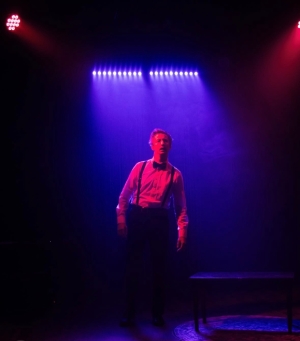
Couch Penny Ensemble, in association with Theatre Arcana, presents the ambitious and experimental An Oak Tree, a raw, unconventional approach to theater that is sure to spark conversations on the nature of grief and the experience itself.
In writing An Oak Tree, playwright Tim Crouch wanted to replicate the disorienting nature of grief. The play features two actors - one who has rehearsed the script (the Hypnotist) and another who has neither seen nor read it (the Father). The Hypnotist acts as a dual guide both for the actor playing the Father and the audience, as this one-of-a-kind experience comes to life.
For each performance, a new, different actor takes on the role of the Father, and it’s their job to live in the moment, breathing life into this character through the use of real-time instructions (given via headphones) and script lines given to them on the spot. The result is an unpolished, raw theater experience. The format is intriguing and innovative - a reflection on grief itself. When tragedy happens, you aren’t prepared for it, and you suddenly find yourself wrestling with a script that is unrehearsed.
Under Bryce Lederer’s direction, the production leans into the play’s shifting dynamics, shaping its unpredictability into something sharply focused and theatrically alive.
Riles August Holiday anchors the evening as the Hypnotist, delivering a technically demanding and well-acted performance. Holiday does a fantastic job of drawing a sharp line between his moments in character - playing a defensive, fragile man - and his moments acting as an administrative guide, calmly steering both his co-star and the audience through the mechanics of the script.
On this evening, Suzy Krueckeberg played the Father, and one can only imagine the excitement and the nerves of taking on such a role. As the Father, she was required to relive the trauma of losing a daughter and process the deterioration of her family without rehearsing - no small task. Krueckeberg did a good job finding the part and taking the audience on the journey with her.
For all its ingenuity, An Oak Tree serves a very specific appetite. This is avant-garde, experimental theater through and through. If you are an audience member searching for that specific brand of rule-breaking performance art, there is plenty to analyze here. Personally, I felt the script left something to be desired. In an examination of grief, I felt at times it was too simplistic or trod ground others had covered more effectively.
That said, it was a unique and interesting experience to see an actor walk a tightrope, constructing a character in front of the audience’s eyes. Holiday’s emotional depth on stage was a treat as well.
An Oak Tree runs at Greenhouse Theater Center until July 5th.
This review is proudly shared with our friends at www.TheatreInChicago.com.
“A Strange Loop” Lets the Intrusive Thoughts Win at Raven Theatre in partnership with About Face Theatre
17 October 2026 in Theatre in ReviewA musical, but it’s just the voices in your head. Sounds just crazy enough to win the 2020 Pulitzer for…

Announcing Goodman's 22nd New Stages 2026 Festival Line-Up
15 October 2026 in Upcoming TheatreFrom a "Kung Fu rom-com" to a witchy new musical, The Goodman's popular New Stages Festival in its 22nd year continues…

TIMELINE THEATRE’S 100TH PRODUCTION, THE CHICAGO PREMIERE OF LAURA WADE’S HOME, I’M DARLING, DIRECTED BY MECHELLE MOE, SATIRIZES THE SEDUCTIVE FANTASY OF A “SIMPLER PAST,” NOVEMBER 11 - DECEMBER 13
14 October 2026 in Upcoming TheatreTimeLine Theatre’s 30th Anniversary Season at its new home in Uptown rolls merrily along in November with the company’s 100th…

Court Theatre announces America@250 - Now is the Time: Artists Go to Work
14 October 2026 in Theatre BuzzUnder the leadership of Marilyn F. Vitale Artistic Director Avery Willis Hoffman and Executive Director Angel Ysaguirre, Court Theatre proudly…
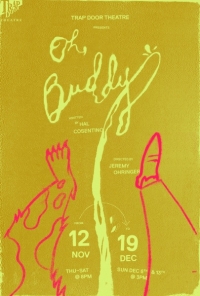
Trap Door Theatre Presents the World Premiere of OH, BUDDY, by Hal Cosentino. Opening November 12th, 2026
14 October 2026 in Upcoming TheatreTrap Door Theatre is thrilled to continue its 33rd season with a Chicago Premiere of Oh, Buddy, written by Hal…
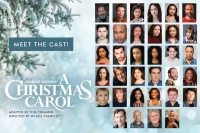
Announcing the Cast of the 49th A CHRISTMAS CAROL
14 October 2026 in Upcoming TheatreTis the season, in spite of today's unseasonable temps, as A Christmas Carol begins rehearsals for The Goodman's 49th annual…

NOVA ENTERTAINMENT CURRENT AND UPCOMING 2026 CIRCA PINTIG UPDATES
14 October 2026 in Now PlayingNova Entertainment is pleased to announce the upcoming performance schedule and updates for CIRCA Pintig, with a visual rebrand and…
Steppenwolf Theatre Announces "ha ha ha ha ha ha ha" January 13 – February 7, 2027
14 October 2026 in Upcoming TheatreThe blurb is: hahahahahahahahahaha hahahahahahaha hihihi hahahahahahaha hoho hahahhahaha hehe hahahahahahahahahaha. Julia Masli's award-winning solo phenomenon ha ha ha ha…

'Sanctuary Stories' Ventures Into Emotional Drama Behind the News on Immigration
13 October 2026 in Theatre in ReviewSanctuary Stories plumbs the line between theater and journalism, and the powerful human dramas both can depict. Funded by a Northwestern…
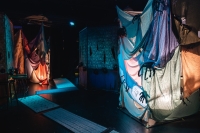
Inside Six Strange Worlds: Exquisite Corpse VI: LULLABIES
13 October 2026 in Theatre in ReviewFor its sixth Halloween season, Rough House Theater Co. has transformed Steppenwolf’s Merle Reskin Garage into a spectacular puppet haunted…
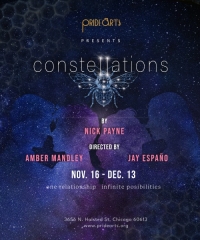
PrideArts announces cast and production teams for Nick Payne's CONSTELLATIONS, performed by alternating same-sex casts, November 13- December 13
12 October 2026 in Upcoming TheatreThursdays – Saturdays at 7:00 pm, Sundays at 3 pm Additional Saturday matinees at 3:00 pm on November 28 and December…
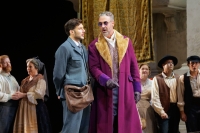
Robert Falls Directs a Sinfully Satisfying Don Giovanni at Lyric Opera of Chicago
11 October 2026 in Theatre in ReviewLet he without sin cast the first stone, Lyric’s “Don Giovanni” seemingly says when they bring up the house lights…

Teatro Vista Productions in collaboration with Audible presents Cafecito & Loops: A Mexodus Listening Tour Headed South Sundays, through November 1st
11 October 2026 in Now PlayingTeatro Vista Productions (TVP), the Midwest's only Latine-led Equity theatre company, in collaboration with Audible, presents Cafecito & Loops: A…
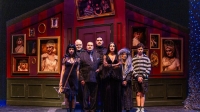
BrightSide’s Addams Family Musical Revives the Wonderfully Weird World of the Addams Clan
10 October 2026 in Theatre in ReviewThey're creepy and they're kooky, Mysterious and spooky, They're altogether ooky, The Addams Family. Yes, ooky. BrightSide Theatre’s production of…
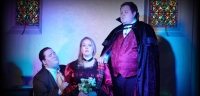
Chicago City Opera Delivers a Rare Operatic Haunting with Der Vampyr
08 October 2026 in Theatre in ReviewWith Halloween creeping closer, there’s something fitting about revisiting one of opera’s earliest flirtations with macabre horror - especially in…

Avalanche Theatre stages the world premiere of They Broke Up by Skyler Tarnas November 6–22, 2026
08 October 2026 in Upcoming TheatreAvalanche Theatre announces the world premiere production of They Broke Up by Chicago playwright Skyler Tarnas, November 6–22, 2026. Opening…

Oil Lamp Theater Announces the cast and creative team for the return of IT'S A WONDERFUL LIFE: A LIVE RADIO PLAY, Nov. 20 - Dec. 27
08 October 2026 in Upcoming TheatreOil Lamp Theater is proud to announce the cast and creative team for its next production and the final production…
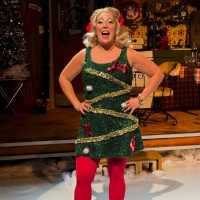
Adults-only holiday fun: Who's Holiday! brings R-rated Cindy-Lou Who back to Theater Wit for her sixth year, Nov. 27-Dec. 27
08 October 2026 in Upcoming TheatreChristmas Day is in our grasp. Why the vodka? Glad you asked! Who's Holiday! brings R-rated Cindy-Lou Who back to…
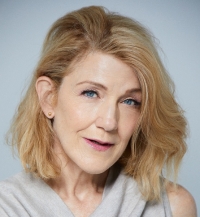
Two-Time Tony Award-Winning Actress Victoria Clark To Receive the Sarah Siddons Society Award at Annual Benefit on Monday, November 9, 2026
08 October 2026 in Theatre BuzzThe Sarah Siddons Society is pleased to present its 2026 Award to actress and director Victoria Clark, who recently starred…
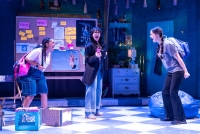
Goodman's Dead Girl’s Quinceañera: When Fifteen Meets the Adult World
07 October 2026 in Theatre in ReviewAt fifteen, the world can feel like a television show you haven't quite figured out how to turn off. For…

Steppenwolf Theatre's ADIRONDACK CHAIR CIRCLE In Rehearsal – Playing October 22 – December 6, 2026 – World Premiere!
07 October 2026 in Upcoming TheatreSteppenwolf Theatre Company, the nation's premier ensemble theater company, is pleased to launch its 51st Season with the world premiere of…
Hell in a Handbag Productions Announces 25th Anniversary Season!
07 October 2026 in Upcoming TheatreHell in a Handbag Productions is thrilled to announce its 25th Anniversary Season, featuring three "camptacular" shows guaranteed to delight lovers of…
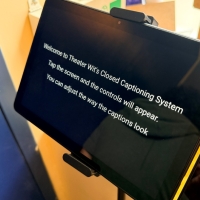
Chicago’s Theater Wit introduces new Watchword closed captioning system, dramatically improving access in all three of its theaters
07 October 2026 in Theatre BuzzChicago’s Theater Wit is now offering new, state-of-the-art closed captioning service, marking a dramatic improvement in making live theater more…

Paramount Theatre’s reimagined A Christmas Carol promises to be a dazzling new, all-ages spectacle for Chicago’s holiday theater season, November 11-January 3
07 October 2026 in Upcoming Theatre“God bless us, everyone,” because there’s a fresh, new, reimagined version of Charles Dickens’ classic tale A Christmas Carol debuting…
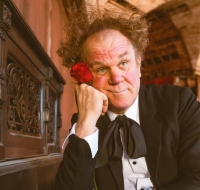
"John C. Reilly is Mister Romantic" Returns to Steppenwolf Theatre - December 10 – 13, 2026
06 October 2026 in Upcoming TheatreFollowing last year's critically acclaimed, sell-out engagement, Steppenwolf Theatre Company is pleased to announce the return of John C. Reilly…

Saint Sebastian Players Open 45th Season With A Murder Is Announced by Agatha Christie Classic Miss Marple Mystery Runs Oct. 23–Nov. 15
06 October 2026 in Upcoming TheatreThe Saint Sebastian Players open their 45th season of travels to different places with A Murder is Announced, a classic Miss Marple mystery…
Announcing "The Goodman, For Good" Campaign
06 October 2026 in Theatre BuzzToday, Goodman Theatre raises the curtain on its future as leadership and artists share a vision for its next century…

Two Edge Theater Company to stage A VIEW FROM THE BRIDGE as its inaugural Chicago production, December 4 through January 10
05 October 2026 in Upcoming TheatreTwo Edge Theater, a reincarnation of the Edge Theater Company that enjoyed eight successful seasons in the Denver, Colorado area,…
Frankenstein at Studebaker Theater adds performances for Halloween run
05 October 2026 in Upcoming TheatreChicago's historic Fine Arts Building and Studebaker Theater are thrilled to announce their Halloween co-production of Manual Cinema's acclaimed Frankenstein…
ANY REBELLION OF WILL - Trap Door Theatre - Through November 1st
05 October 2026 in Now PlayingTrap Door Theatre is thrilled to continue its 33rd season with Any Rebellion of Will, written by S.L. Daniels and…



Latest Articles
-
 “A Strange Loop” Lets the Intrusive Thoughts Win at Raven Theatre in partnership with About Face Theatre
Written by John AccroccoA musical, but it’s just the voices in your head. Sounds just crazy enough to win the 2020 Pulitzer for Drama. “A Strange Loop” by Michael R. Jackson finally makes its Chicago premiere at Raven Theatre in a co-production with…
-
 Announcing Goodman's 22nd New Stages 2026 Festival Line-Up
Written by Buzz Center StageFrom a "Kung Fu rom-com" to a witchy new musical, The Goodman's popular New Stages Festival in its 22nd year continues to offer a first glimpse at the latest works by a handful of the hottest contemporary playwrights. This year's four-play…
-
Chicago Danztheatre Ensemble Announces 2026-2027 Season
Written by Buzz Center StageChicago Danztheatre Ensemble (CDE) is pleased to announce its 2026 - 2027 season. CDE will open this artistic season with Copestic Vibrations: A Music Festival, Friday, Nov. 13 and Saturday, Nov. 14, followed by a fully staged production of For…
-
Eos Theatre Company Announces Second Production with The Thin Place
Written by Buzz Center StageEos Theatre Company is pleased to announce their second production with Lucas Hnath's horror play The Thin Place, directed by JC Clementz (Steppenwolf's Director of Casting and Artistic Operations), playing February 5 - 28, 2027 in Bramble Arts Loft's Beatrice Theater, 5545 N…


Does your theatre company want to connect with Buzz Center Stage or would you like to reach out and say "hello"? Message us through facebook or shoot us an email at This email address is being protected from spambots. You need JavaScript enabled to view it..
*This disclaimer informs readers that the views, thoughts, and opinions expressed in the text belong solely to the author, and not necessarily to Buzz Center Stage. Buzz Center Stage is a non-profit, volunteer-based platform that enables, and encourages, staff members to post their own honest thoughts on a particular production.