
Displaying items by tag: Eric Andrew Lewis
Buddy Holly’s Brilliance, Reawakened on the Drury Lane Stage
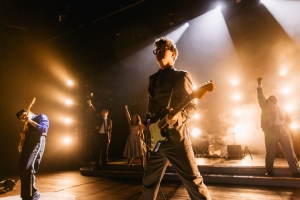
Drury Lane Theatre opens its latest musical with a warm jolt of rock ’n’ roll energy as Buddy – The Buddy Holly Story, by Alan James, returns to the stage, decades after its 1989 debut at the Plymouth Theatre Royal in England. What began as a modest jukebox biography has grown into a global crowd pleaser, and Drury Lane’s production celebrates everything that made Buddy Holly a seismic force - the sound, the swagger, and the fearless creativity of a young artist reshaping American music before the world even realized it was happening.
Buddy – The Buddy Holly Story had already shown how actor‑musician theatre could thrive, pairing a biographical narrative with dramatic scenes and a concert‑style climax that traced Holly’s artistic evolution before building to a full musical finale. Nearly two decades later, when Million Dollar Quartet premiered, the influence was unmistakable. Million Dollar Quartet distilled that approach, replacing the cradle-to-grave arc with a single-night reenactment inside Sun Studio. Instead of character development, it relied on direct address, minimal plot, and the raw electricity of live performance. The shared DNA is clear - legendary early rock played by the actors themselves - but Million Dollar Quartet takes a different approach. It’s a performance framed as a single moment in history, whereas Buddy – The Buddy Holly Story is a story‑driven musical that builds toward a showcase, ultimately shaping the theatrical vocabulary that Million Dollar Quartet would later draw from.
That lineage sets the stage for what Drury Lane achieves here. This staging traces Holly’s meteoric rise from Lubbock teenager to chart-topping innovator, capturing the joy, drive, and restless imagination that defined his short but revolutionary career. Drury Lane emphasizes so well the live-show pulse, packing the evening with hits, tight musicianship, and the infectious spirit of 1950s rock ’n’ roll. The production revisits the era beautifully and recreates the thrill of watching a new sound take flight in real time. With its high-energy ensemble and a lead performance that channels Holly’s mix of sweetness and swagger, Buddy delivers both nostalgia and immediacy, reminding audiences why his influence still reverberates through rock, pop, and musical theatre. It is a dynamic tribute to a musician who changed everything - and whose story still lands with irresistible rhythm. And as the story reaches its final stretch, the production kicks fully into showcase mode, delivering a roof-raising finish that feels less like musical theatre and more like being dropped into a live 1950s rock ’n’ roll set.
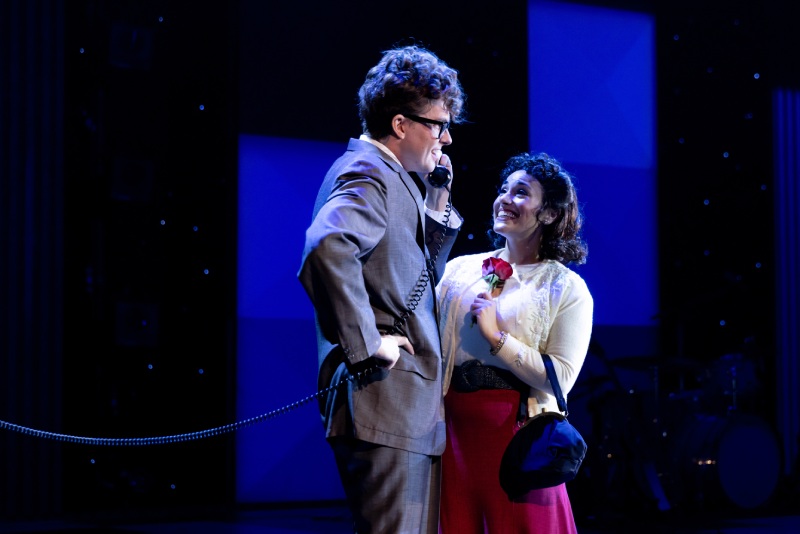
Joey Chelius as Buddy Holly and Samantha Sayah as Maria Elena Santiago Holly. All photos by Kyle Flubacker.
It is no surprise that the Drury Lane cast is top notch as always. Under the sharp direction of Matthew D. Carney and the vibrant choreography of Kenny Ingram, the ensemble delivers the kind of crisp musicianship and infectious charge this show demands. Joey Chelius makes a terrific Buddy Holly - charismatic, boyish, and fully in command of the rock ’n’ roll pioneer’s sound and spirit. He brings an easy, unaffected charm to the role, pairing Holly’s trademark vocal clarity with a grounded emotional throughline that keeps the performance from ever feeling like mere impersonation. Chelius captures the spark of a young artist discovering his own power. His playful, high-energy guitar work adds an extra lift of authenticity - the kind of spirited musicianship that makes the stage feel like a live 1950s jam session. When he locks in with the band, the stage lights up with the kind of voltage that makes you forget you are watching an actor at all. He is backed by an outstanding trio of Crickets: Alek Boggio as drummer Jerry Allison, Grant Alexander Brown as bassist Joe B. Mauldin, and Elliot Coe Esquivel as guitarist Niki Sullivan, who doubles as Richie Valens and plays the hell out of “La Bamba.” Together, they create a tight, exhilarating band that feels more like a live performance when they jam than a traditional musical number, filling the room with the kind of raw, unfiltered early rock drive that Buddy Holly himself once ignited.
As someone already familiar with Holly’s catalog, I walked away an even bigger fan - the show makes his artistry feel immediate, alive, and impossible not to resist. I was also struck by a detail I hadn’t known before seeing this production. Early in his career, Holly faced strong pressure from his record label to adopt a more conventional country‑western sound and image. The show makes clear that he flatly refused to be branded that way, holding fast to the rockabilly edge and melodic style that defined his emerging voice. Rather than reshape his music to fit a marketable country mold, he committed to the sound he believed in - a choice that ultimately set him apart and helped spark a new era in American rock ’n’ roll.
Samantha Sayah offers a gentle, grounding presence as Maria Elena Santiago Holly, anchoring the emotional stakes of Buddy’s personal life with warmth and quiet strength. She provides a steady, heartfelt counterbalance to the show’s high‑voltage musical energy, reminding us of the love and partnership that shaped Holly beyond the spotlight. She also adds a charming layer to the live music, stepping in with the band on keyboard while doubling in another role with easy versatility. Marta Bady is terrific across multiple roles, matched by Eric Andrew Lewis, who shines in a variety of roles and puts his vocal talent on full display. Together they deliver one of the night’s standout moments when they tear into “Shout” and absolutely bring the house down. Bady plays several roles throughout the show, including Marlena Madison, the smoldering and vibrant co‑host/performer at the Apollo Theater, and she’s compelling in every one of them. She brings a confident, magnetic stage presence that elevates each number she touches. Productions like this often skew male‑driven simply because of the era they depict, which places a particular weight on the women in the cast. Here, the two female performers supply all the necessary feminine energy, charisma, and sensuality that help charge the production with the same spark Buddy Holly inspired in his fans - a blend of modern edge and romantic warmth that defined his music.
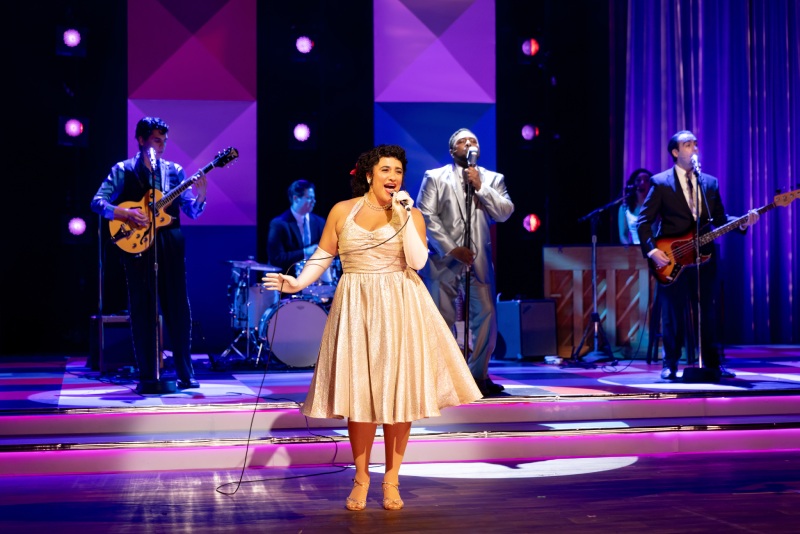
Marta Bady and cast.
Russell Mernaugh is another standout, slipping into several characters with ease, but it is his turn as The Big Bopper during Buddy’s final showcase that truly stops the show - an unforgettable moment that is off the charts good.
Beyond the performances, one of the unexpected pleasures of this production is watching Buddy Holly’s rock ’n’ roll evolution unfold as the show progresses. Drury Lane emphasizes the early chapters of his career, showing him as a shy, slightly unpolished teenager pushed toward the country genre his record label expected him to embrace. Holly’s early career also reflects a familiar music-industry pitfall: he accepted a restrictive record deal that undervalued his talent - a pattern that has continued to affect young artists from his era all the way to the present day. Those early scenes capture the tension between who he was told to be and who he was becoming - an artist quietly steering himself away from Nashville conventions and toward the raw, rhythmic spark of the new sound that felt truer, bolder, and entirely his own. As the productions unfolds, that tentative spark grows into full-fledged confidence. The shift is fascinating to watch: a young musician testing boundaries until he suddenly realizes he is creating something revolutionary.
The show’s greatest thrill comes from the music - a steady stream of Buddy Holly hits that still come alive with the invention and joy he poured into them in the late 1950s. Musical Director Chuck Mead’s fine choices amplify that spirit, shaping arrangements that feel larger than life at times without ever losing the raw simplicity that defined Holly’s sound. Drury Lane’s production treats these songs not as museum pieces but as living, breathing bursts of the raw spark of early rock, and Joey Chelius really delivers, driving each number with clarity, charm, and an effortless command of Holly’s style. Classics like “Peggy Sue,” “That’ll Be the Day,” “Everyday,” and “Oh Boy” land with fresh vitality, while the amped-up concert sequences bring the crowd to its feet. The band’s tight harmonies, crisp instrumentation, and sheer exuberance remind audiences just how groundbreaking Holly’s music was - and why these songs continue to resonate across generations.
Buddy Holly’s world comes alive so vividly thanks to the outstanding work of the design team - Lauren Nichols’ scenic design, Rachel Boylan’s period-perfect costumes, Lee Fiskness’ dynamic lighting, and Leland Plumridge’s crisp, full-bodied sound. The sets move fluidly from the intimacy of a recording studio to a series of performance stages, including a striking recreation of the famous Apollo in Harlem, NY. This core team does a fantastic job creating an atmosphere that feels authentic, immersive, and at times downright electric, giving the production its vibrant sense of place and time.
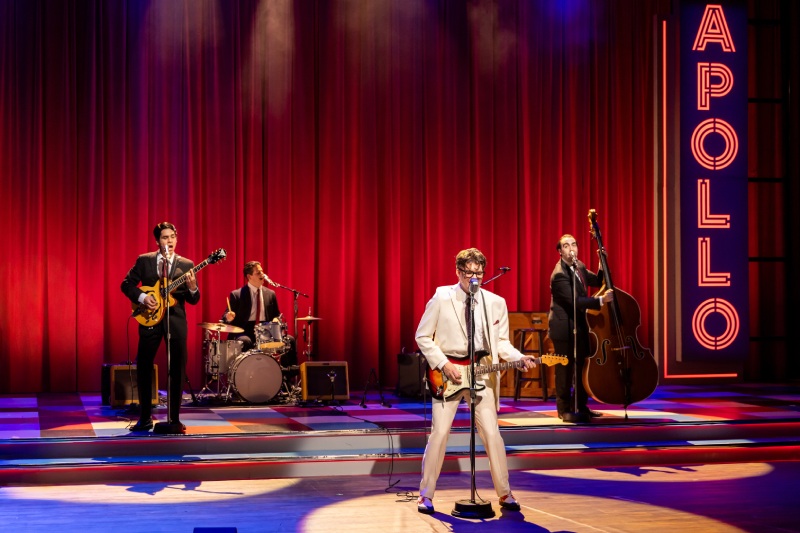
(left to right) Elliot Coe Esquivel, Alek Boggio, Joey Chelius, Grant Alexander Brown as Buddy Holly and the Crickets in Buddy – The Buddy Holly Story.
It is impossible to watch Buddy – The Buddy Holly Story without feeling the weight of how young he was when his life ended - just 22, still in the earliest stretch of a career that was already reshaping American music. The production doesn’t dwell on the tragedy, but knowing what comes after gives the final moments an undeniable ache. And because the show focuses, rightly, on celebration rather than sorrow, it’s worth briefly stepping beyond the edges of the stage to revisit the real history behind that night - not to overshadow the production, but to deepen the audience’s appreciation of what it’s honoring. Holly chartered the plane because the tour bus had broken down repeatedly, had no heat, and had already hospitalized his original drummer with frostbite - forcing a local substitute to step in. He simply wanted to get to Fargo early to rest, do laundry, and escape the miserable travel conditions.
The seats on the flight were traded for entirely practical reasons among Holly’s actual Winter Dance Party band and tour mates. J.P. Richardson (“The Big Bopper”), sick with the flu, asked current Crickets bass player Waylon Jennings for his seat, and Jennings agreed. Ritchie Valens and touring guitarist Tommy Allsup flipped a coin for the remaining spot, and Valens won. None of these decisions were driven by fear of the flight itself. The pilot, Roger Peterson, was young but licensed, and witnesses reported a normal takeoff. In reality, Holly was flying in dangerous winter weather - not a dramatic “storm warning” scenario, but conditions poor enough to make the trip risky, and they played a major role in the crash.
It’s also worth remembering that the show is, at heart, a feel-good celebration - not only of Holly, but of the three extraordinary artists who lost their lives that night. Still, for the sake of historical clarity, their deaths were the result of circumstances that never should have existed. The tour bus failures, the brutal cold, and the frostbite suffered by a band member were all consequences of a music industry unwilling to provide even basic support for the musicians it relied on. The concert they were traveling toward was not a high-stakes engagement; under safer, more humane conditions, the artists should have been given the option to delay the trip. Instead, a combination of grueling tour logistics and record-label cost-cutting placed them in harm’s way, costing the music world three bright stars.
Holly died in that crash on February 3, 1959, alongside fellow rock and roll trailblazers Ritchie Valens (just 17 years old), and J.P. “The Big Bopper” Richardson, as well as Peterson. The accident - later immortalized as “the day the music died” - cut short three rising careers in a single instant. Holly had recorded only a few years’ worth of material, yet his influence still reverberates through rock, pop, and country. And watching his world come alive so vividly onstage, you can’t help but wonder what other genius music he might have created had he been given even a little more time.
Buddy - The Buddy Holly Story is an easy show to wholeheartedly suggest - a colorful, high-energy celebration of a musical pioneer whose influence still echoes across generations. It is a fantastic homage to an incredible artist. Drury Lane Theatre’s production captures both the thrill of Holly’s sound and the poignancy of his too-short life, delivering an experience that feels as heartfelt as it is electrifying. This musical runs August 19 through October 18 at Drury Lane Theatre in Oakbrook, with a run time of 2 hours including a 20-minute intermission and comes highly recommended.
For tickets and/or more information, click here.
Do You Like To Laugh Until It Hurts? Spamilton Delivers

The hip-hop Broadway in Chicago sensation Hamilton, which, has spawned a secondary market in pricey theater tickets, has also delivered a pair of spin-offs. Shamilton, an improv riff at the Apollo, and now, notably, Spamilton, a send up of the original musical about the founding fathers of the U.S.
Is it funny if you haven’t seen the original? The short answer is yes – because following the opening sets based on Hamilton, the show quickly turns its sites on other long-time Broadway shows like Cats and Phantom of the Opera, warhorses like Camelot, and shows of more recent vintage like Wicked and Book of Mormon.
The creative force behind the show is Gerard Alessandrini, the originator of the 1982 "Forbidden Broadway," which was similar in format, and has been rewritten and updated more than a dozen times. It has played around the world, including Chicago - I’ve seen two different versions here.

For all practical purposes, Spamilton is the newest Forbidden Broadway, and on some levels it exceeds the earlier ones in appeal.
The key to the storyline is Broadway’s perpetual and desperate struggle to save itself, and to create a new vision of the big musical show. Show business has been mired in novelties like Book of Mormon and the puppet-based Avenue Q; overproduced extravaganza with no memorable songs, like Spiderman; or Sondheim light operetta that those outside the cognoscenti may find hard to sit through.
Alessandrini picks up this scent of desperation, and seizes on Broadway producers struggles with wickedly funny original song and dance numbers that sample or mash-up the originals. Clinging to revivals of Rogers & Hammerstein or Leonard Bernstein; turning over theaters to somewhat vapid Disney productions like Aladdin and Newsies, these producers become fodder for fun in Spamilton.
The show parodies this desperation with another extreme: combining previously successful shows.
A perfect example comes around 10 minutes in, as the Spamilton players switch gears and time periods to present The Lion King & I. Anna the English Governess in hoop skirts dons a Julie Traymor head set in a duet with a squawking animal character. Let’s say I chortled heartily.
The show runs at a mad-cap pace, and even if you don’t get all the references, it’s still funny. A scene of an axe wielding gentleman clad just in Fruit of the Looms is a send up of American Psycho (I think, after Googling). It was funny even though I didn’t know exactly what the reference was.
Wicked and Book of Mormon – once the pricey ‘it’ shows, now discounting tickets like any other production – get nailed pointedly, having yielded star status to Hamilton. Scenes are punctuated by a running gag: homeless ladies in rags begging for Hamilton tickets – understood to be based on true stories of famous stars desperate for seating.
A Barbra Streisand impersonation finds the aging diving singing in signature reverb, advising that when Hamilton is filmed, she wants to play a role in “The Film When It Happens.” Likewise, J-Lo and Gloria Estefan walk-on, each hoping to tap the mojo of Hamilton. Liza Minnelli appears, but runs the other direction - and asks that rap be banned on Broadway, so they can “bring back the tunes.”
The show reveals broader awareness in a number, Straight is Back, which laments the loss of gay show tunes and glitter, as productions like Hamilton skew to more manly styles.
You can get a taste of Spamilton from the original New York cast album, just released. But it pales compared to the experience of seeing this cast of amazing dancers and singers, and their great comedic timing: Donterrio Johnson, Michelle Lauto, Eric Andrew Lewis, Yando Lopez, David Robbins, and guest diva Christine Pedi (she's the Streisand character among others), with musical direction by Adam LaSalle.
While Hamilton’s original star Lin-Manuel Miranda love “laughed my brains out!" when he saw the show, during last Sunday’s production the Chicago cast of Hamilton was in the audience – and they had a blast.
Gerry McIntyre did the choreography; Dustin Cross gets Costume Design; , Fred Barton (Musical Director), and Richard Danley and Fred Barton (Musical Arrangements). "Spamilton" is produced in Chicago by John Freedson, David Zippel, Gerard Alessandrini, Margaret Cotter and Liberty Theatricals, in association with JAM Theatricals. Chuckie Benson and Arielle Richardson are the understudies the production.
"Spamilton" plays Tuesdays through Fridays at 7:30 p.m., Saturdays at 5 p.m. and 8 p.m. and Sundays at 2 p.m. and 5 p.m. at the Royal George Theater. www.spamilton.com



Latest Articles
-
 “A Strange Loop” Lets the Intrusive Thoughts Win at Raven Theatre in partnership with About Face Theatre
Written by John AccroccoA musical, but it’s just the voices in your head. Sounds just crazy enough to win the 2020 Pulitzer for Drama. “A Strange Loop” by Michael R. Jackson finally makes its Chicago premiere at Raven Theatre in a co-production with…
“A Strange Loop” Lets the Intrusive Thoughts Win at Raven Theatre in partnership with About Face Theatre
Written by John AccroccoA musical, but it’s just the voices in your head. Sounds just crazy enough to win the 2020 Pulitzer for Drama. “A Strange Loop” by Michael R. Jackson finally makes its Chicago premiere at Raven Theatre in a co-production with… -
 Announcing Goodman's 22nd New Stages 2026 Festival Line-Up
Written by Buzz Center StageFrom a "Kung Fu rom-com" to a witchy new musical, The Goodman's popular New Stages Festival in its 22nd year continues to offer a first glimpse at the latest works by a handful of the hottest contemporary playwrights. This year's four-play…
Announcing Goodman's 22nd New Stages 2026 Festival Line-Up
Written by Buzz Center StageFrom a "Kung Fu rom-com" to a witchy new musical, The Goodman's popular New Stages Festival in its 22nd year continues to offer a first glimpse at the latest works by a handful of the hottest contemporary playwrights. This year's four-play… -
Chicago Danztheatre Ensemble Announces 2026-2027 Season
Written by Buzz Center StageChicago Danztheatre Ensemble (CDE) is pleased to announce its 2026 - 2027 season. CDE will open this artistic season with Copestic Vibrations: A Music Festival, Friday, Nov. 13 and Saturday, Nov. 14, followed by a fully staged production of For…
-
Eos Theatre Company Announces Second Production with The Thin Place
Written by Buzz Center StageEos Theatre Company is pleased to announce their second production with Lucas Hnath's horror play The Thin Place, directed by JC Clementz (Steppenwolf's Director of Casting and Artistic Operations), playing February 5 - 28, 2027 in Bramble Arts Loft's Beatrice Theater, 5545 N…


Does your theatre company want to connect with Buzz Center Stage or would you like to reach out and say "hello"? Message us through facebook or shoot us an email at This email address is being protected from spambots. You need JavaScript enabled to view it..
*This disclaimer informs readers that the views, thoughts, and opinions expressed in the text belong solely to the author, and not necessarily to Buzz Center Stage. Buzz Center Stage is a non-profit, volunteer-based platform that enables, and encourages, staff members to post their own honest thoughts on a particular production.