
Displaying items by tag: Shakespeare
Chicago Shakes' Play On!: With a Syncopated Harlem Beat
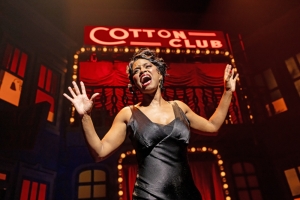
There are some productions you watch, and then there are productions that make your heart swoon and your toe tap. Sheldon Epps’ Play On! is definitely the latter. Now playing at Chicago Shakespeare Theater, this exuberant musical takes Shakespeare’s Twelfth Night, moves it to 1930s Harlem, adds the extraordinary music of Duke Ellington, and transforms the story into a celebration of love, ambition, identity and music.
The magical kingdom of Illyria becomes Harlem, where aspiring songwriter Vy (Hailee Kaleem Wright) arrives with dreams of making it in show business. To get close to the legendary bandleader known as The Duke (Edred Utomi), Vy disguises herself as a man. Complications quickly follow when Lady Liv (Krystal Joy Brown) becomes attracted to Vy's alter ego. Shakespeare's mistaken identities remain at the heart of the story, but Cheryl L. West's book gives the familiar comedy a distinctly African American cultural identity.
West's script is hot and popping, filled with rhythm, humor and personality. She understands that the language of Shakespeare can be transformed without losing the comic machinery that makes Twelfth Night work. The characters may come from Shakespeare, but they walk, talk and move to the syncopated Harlem beat of the 1930s.
And that Harlem beat is everywhere.
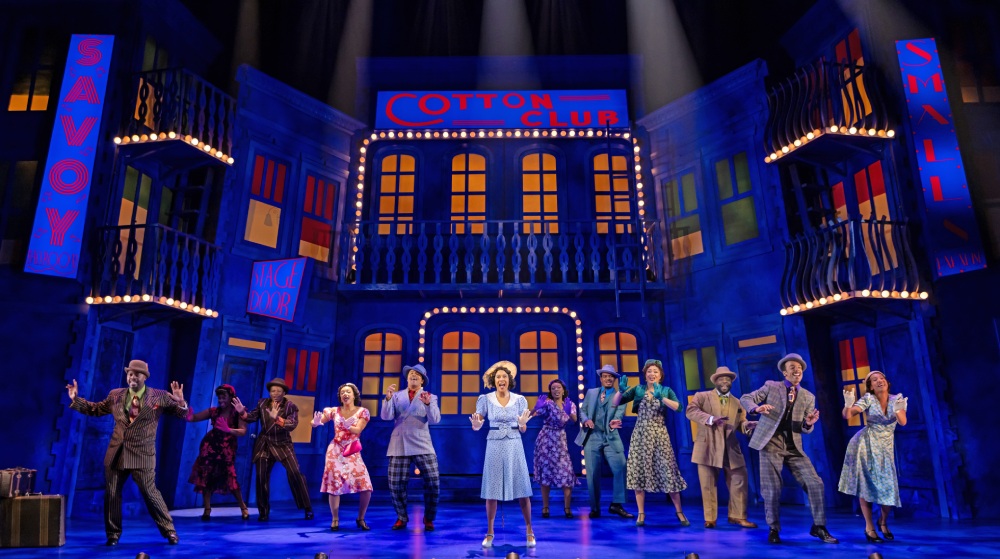
The company of Chicago Shakespeare’s production of Play On! Photo by Kyle Flubacker.
The production's exciting choreography by Edgar Godineaux captures the elegance, sophistication and exuberance of the big-band era. The ensemble - Marquez Linder, Selena Robinson, Dylan C. Smith, Joey Stone, Shelbi Voss and Danny Dwaine Wells II - keeps the stage alive with movement and energy. The choreography doesn't simply accompany the music; it becomes part of the storytelling.
The Duke Ellington score is the production's heartbeat. Under the musical direction of Theodis Rodgers Jr., with beautiful orchestrations by Luther Henderson Jr., the music has both sophistication and swing. Ellington's compositions give the characters another way to express what they sometimes cannot say in words.
For me, the Harlem setting brought back a very personal theatrical memory. Play On! reminded me of the very first show I ever worked on, Bubbling Brown Sugar by Loften Mitchell, from a concept by Rosetta LeNoire (my theatre Godmother), in New York City. That experience introduced me to the power of Black theatre, music and storytelling existing together onstage. Watching Play On! brought some of that same feeling back—the excitement of seeing Black history, Black music and Black theatrical expression become one living theatrical experience.
That connection makes Play On! particularly meaningful. This isn't simply Shakespeare with jazz added to it. It is a conversation between William Shakespeare and Duke Ellington, two artists separated by centuries but connected through their understanding of human behavior, love, comedy and the power of performance.
The cast embraces that world beautifully. James Earl Jones II brings comic energy and warmth to Sweets, while Alanna Lovely gives Miss Mary a strong and engaging presence. James Harkness brings charm and theatricality to Jester. Alan H. Green gives Rev authority and comic flair.
At the center, Wright's Vy captures the vulnerability and determination of a young artist trying to discover who she is and where she belongs. Brown's Lady Liv brings glamour and emotional power, while Utomi's Duke possesses the commanding presence of a bandleader who has created his own musical kingdom.
Epps understands that the success of Play On! depends upon allowing Shakespeare's story and Ellington's music to breathe together. The result is a production that feels celebratory without becoming superficial, and contemporary without abandoning its literary foundation.
Play On! is Shakespeare filtered through the cultural richness of 1930s Harlem, propelled by Duke Ellington's music and driven by a syncopated Harlem beat.
It is a joyous reminder that great stories can travel across centuries - and sometimes, when the right music is added, they can still make us want to dance.
Highly Recommended
When: Through Oct. 18
Where: The Yard at Chicago Shakespeare Theater on Navy Pier, 800 E. Grand Ave.
Running time: 2 hours, 20 mins.
Tickets: $55-150
312-595-5600
Bernstein’s Score Burns Bright in Music Theater Works’ West Side Story
Some musicals carry such cultural weight that every new production feels like a referendum on how well a company can honor the original while making it feel alive again. West Side Story is one of those titles - a towering achievement in American musical theatre, a work whose emotional force and artistic innovation have endured for generations. Music Theater Works has now taken on this iconic musical at the North Shore Center for the Performing Arts in Skokie, and the result is a vibrant, beautifully staged production that captures both the drive and the aching humanity at the heart of the piece.
West Side Story is a modern retelling of Shakespeare’s Romeo and Juliet, but instead of two feuding families, it confronts the racial and cultural fault lines running through 1950s New York City. The Jets, a group of white American teenagers clinging to their sense of territory, clash with the Sharks, a Puerto Rican gang fighting for dignity, safety, and the right to belong in a city that continually pushes them to the margins. Their conflict is not just about turf; it is fueled by fear, resentment, and the prejudice that shapes how each group sees the other. When Tony, a former Jet trying to build a life beyond the violence, meets Maria, the sister of Sharks leader Bernardo, their connection is immediate and transformative. What begins as a spark of hope quickly becomes a dangerous love story unfolding against a backdrop of cultural tension, territorial pride, and escalating hostility.
As the feud intensifies, the young couple’s attempts to carve out a future together collide with the realities of their world. The rumble between the Jets and Sharks sets off a tragic chain of events, leaving Tony and Maria grasping for peace in a city determined to deny it. The musical’s final moments - heartbreaking, inevitable, and deeply human - underscore the cost of hatred and the fragile possibility of reconciliation.
The production also underscores one of the musical’s most enduring truths: that the idealism Tony and Maria cling to is constantly at war with the harsher realities shaping their world.
The creative pedigree behind West Side Story remains one of the most extraordinary collaborations in theatre history. Leonard Bernstein’s sweeping, genre‑blending score, Stephen Sondheim’s razor‑sharp lyrics, Arthur Laurents’ emotionally charged book, and Jerome Robbins’ groundbreaking choreography combine to create a work that is as musically thrilling as it is dramatically devastating. Bernstein’s score - among the most challenging he ever composed and one he found deeply artistically satisfying - remains one of his most defining artistic accomplishments. It is a piece that demands precision, passion, and a deep understanding of its themes, and Music Theater Works rises to that challenge with clarity and heart.
The company’s production is superbly realized, delivering crisp choreography, rich orchestral color, and performances that honor the emotional stakes of the story. It is a staging that respects the legacy of West Side Story while making the experience feel immediate and alive for today’s audiences.
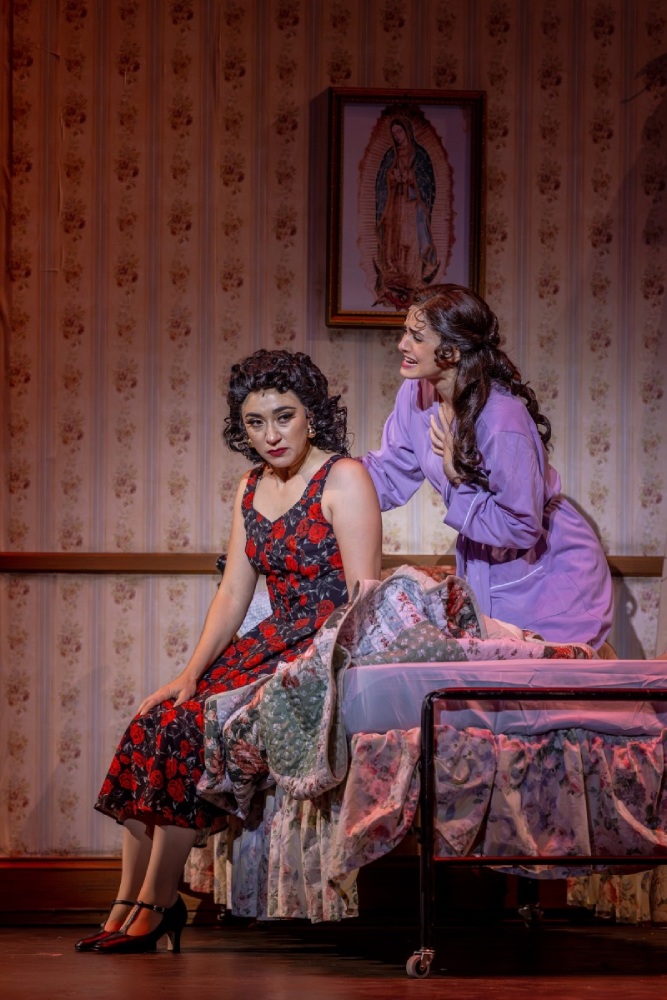
(L to R) Pauleth Jauregui as Anita and Isabella Ruano as Maria in WEST SIDE STORY from Music Theater Works.
The cast is terrific, but it is Isabella Ruano as Maria and Pauleth Jauregui as Anita who anchor the production, grounding it with performances that feel both lived‑in and emotionally urgent. Ruano’s Maria is luminous from her first entrance, her voice soaring through “Tonight” with a clearness and warmth that make the character’s hope feel newly electric. Jauregui matches her beat for beat, delivering an Anita rich with fire, humor, and heartbreak; her vibrant, sharply etched “America” is one of the evening’s defining moments. Together, they anchor the musical’s emotional arc with a confidence that elevates every scene they touch.
Offering a warm, earnest Tony is Luke Nowakowski, his ringing tenor in “Maria” and sincerity in “Something’s Coming” providing a steady, heartfelt counterpoint to the show’s rising tensions. Emmanuel Ramirez’s Bernardo contributes a controlled intensity, shaping the Sharks’ dynamic with quiet authority, while Kameron Rojas Schueneman’s Chino adds thoughtful, understated work that lands effectively in the final scenes.
Connor Ripperger brings a commanding presence as Riff, sharpening the Jets’ energy with restless physicality and crisp musical attack. His leadership in “Cool” gives the number a taut, combustible edge that sets the tone for the gang’s world.
If there’s one aspect that doesn’t land quite as strongly in this otherwise beautifully executed production, it’s the chemistry between Tony and Maria. While both Nowakowski and Ruano act with sincerity and sing with impressive range, clarity, and confidence, their scenes together occasionally feel more musically aligned than emotionally connected. The relationship lands, but at times you want a deeper spark between them - a stronger sense of shared urgency to match the vocal strength they each bring individually. And because this performance comes so early in the run, it’s easy to imagine that their connection will deepen as the actors settle further into each other’s rhythms.
That note aside, the principal cast delivers a production driven by strong voices and sharply drawn character work, with Ruano and Jauregui leading the charge.
The wider ensemble gives the production its pulse, moving with a clarity and drive that continually pushes the story forward, and Eric Desnoyers brings a welcome touch of humor as Officer Krupke, landing sharp comedic beats that lighten the show’s more chaotic moments. But above all, it is the wide-ranging, contemporary ballet-infused dance sequences that catch fire - those large, kinetic passages where movement becomes the show’s primary language. Much of the choreography folds fighting into dance, turning confrontation into something almost balletic: graceful, sculpted, and charged with tension. The company navigates these moments with remarkable control, letting the beauty of the movement coexist with the danger underneath.
In these sequences, the ensemble moves with a shared purpose, letting the choreography shape the conflict and momentum without overstating it. Their control and cohesion give the dance its impact, turning each major passage into a clear highlight that quietly but confidently lifts the production.
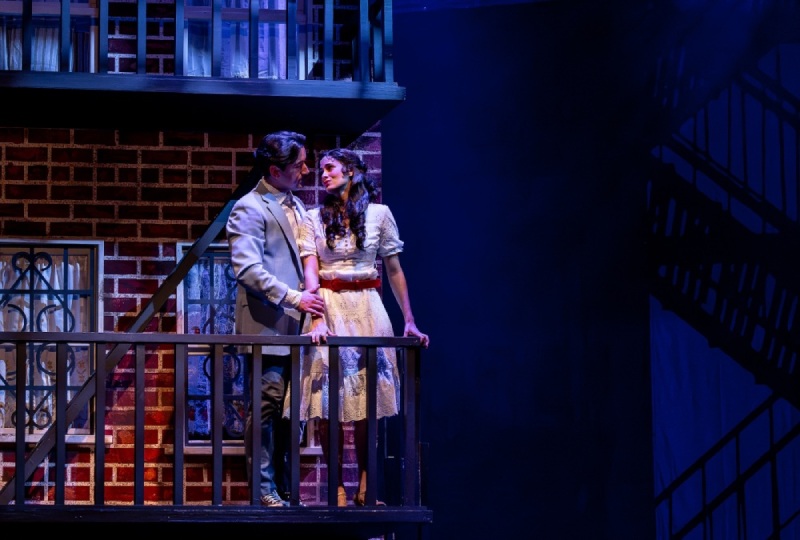
(L to R) Luke Nowakowski and Isabella Ruano in WEST SIDE STORY from Music Theater Works at North Shore Center for the Performing Arts.
Though the stage musical has always kept its original song order - and I understand the desire to preserve that structure - I’ve long hoped to see a production take a cue from the film in one particular moment. In the movie, “America” becomes a spirited debate between the Shark men and women, with Bernardo and Anita sparring over their hopes and frustrations about life in the United States. That dynamic not only brings Bernardo further into focus and deepens his relationship with Anita, it also gives the number a fuller, more energized sweep by letting a larger group of dancers drive its rhythm. The stage version’s women‑only arrangement works, but the film’s version has always struck me as the more dramatically rich and character‑revealing choice.
Beyond the choreography, the production’s artistic leadership is equally strong. The creative team brings seamless cohesion to this production. Director Sasha Gerritson guides the story with clarity and emotional focus, while co-choreographers Clayton Cross and Isa Ramirez deliver movement that honors the show’s iconic style with a fresh, contemporary lift. Linda Madonia’s musical direction keeps Bernstein’s score warm, tight, and expressive, supported by Justin Kono’s precise, sensitive conducting. The orchestra plays Bernstein’s score with crisp articulation and a full, glowing sound, letting the music’s rhythmic bite and lyrical sweep land with real impact. David Serrano’s Spanish translation adds welcome authenticity, with Spanish subtitles projected overhead during musical numbers that make the language accessible to both native speakers and those following along. The production’s most charged moments are shaped with care and impact through intimacy and violence choreography crafted by Nick Sandys.Director Sasha Gerritson guides the story with clarity and emotional focus, while co-choreographers Clayton Cross and Isa Ramirez deliver movement that honors the show’s iconic style with a fresh, contemporary lift. Linda Madonia’s musical direction keeps Bernstein’s score warm, tight, and expressive, supported by Justin Kono’s precise, sensitive conducting. The orchestra plays Bernstein’s score with crisp articulation and a full, glowing sound, letting the music’s rhythmic bite and lyrical sweep land with real impact. David Serrano’s Spanish translation adds welcome authenticity, with Spanish subtitles projected overhead during musical numbers that make the language accessible to both native speakers and those following along. The production’s most charged moments are shaped with care and impact through intimacy and violence choreography crafted by Nick Sandys.
Visually, the production is exceptionally well crafted. Bob Knuth’s scenic design and Cecilia Chan’s props work ground the story firmly in its era, giving the stage a lived-in authenticity that supports the drama without overwhelming it. The printed scenic drops hanging above and along the sides and rear of the stage - with their black windows, fire escapes, and bold red backgrounds - add a distinctive graphic layer, subtly echoing the stark lines and verticality of the 1961 movie poster designed by Joe Caroff. It is a smart visual nod that connects the production to its cinematic legacy without feeling derivative, instead offering a familiar, poster-like clarity that frames the action with understated style.
Bob Kuhn’s costumes and Kristen Brinati’s wardrobe leadership capture the period with clean, thoughtful detail, while Alice Salazar and Melanie Saso’s hair, wig, and makeup design add the finishing touches that make the Jets and Sharks feel fully appreciated. Andrew Meyers’ lighting brings sharp contrast and emotional texture to the stage, and Stephanie Farina’s sound design keeps the vocals and orchestra balanced and clear. This talented team builds an environment that feels true to the time, the place, and the heartbeat of West Side Story.
Taken together, these elements give the production a unity that extends well beyond its individual performances. The design work, staging choices, and musical precision all reinforce one another, creating a West Side Story that feels both faithful to its roots and freshly energized for a new audience. Taken together, these elements give the production a unity that extends well beyond its individual performances. The design work, staging choices, and musical precision all reinforce one another, creating a West Side Story that feels both faithful to its roots and freshly energized for a new audience. It’s a staging that understands the show’s emotional architecture and honors it with care. A staging this confident proves just how alive West Side Story can still feel.
Music Theater Works brings all of this together in a final product that feels both classic and newly urgent. Their West Side Story is a richly performed, thoughtfully designed, and confidently led production that honors the legacy of this landmark musical while giving it the vitality it deserves. Audiences can experience this outstanding staging August 13–30, 2026, and full details - including tickets - are available at www.musictheaterworks.com.
Recommended.
& Juliet Turns Shakespeare Upside Down in a Burst of Pop Brilliance
Broadway in Chicago’s latest offering at the Auditorium Theatre, & Juliet, bursts onto the stage with the kind of vibrant confidence that makes it clear this isn’t your high school Shakespeare. The production arrives as a full-throttle pop spectacle, gleefully mashing up Elizabethan trappings with late ’90s and early 2000s chart-toppers from Max Martin’s hit factory. It’s a show that knows exactly what it is: a glitter-soaked, self-aware remix of a classic that wastes no time inviting the audience into its playful rebellion against the tragic ending we’ve all been taught to accept. Since its 2019 world premiere in Manchester, & Juliet has evolved into an international hit, and this touring production carries that same electric swagger.
So, what is & Juliet? The musical tosses out the tragic final pages of Romeo and Juliet and launches into a sparkling, beat-driven alternate timeline where Juliet decides her story isn’t over. Shakespeare strides in ready to unveil his masterpiece, only to be challenged by his wife, Anne Hathaway, who argues that Juliet deserves more than a death scene. Their creative tug-of-war becomes the show’s framing device, with the couple rewriting the narrative in real time as Juliet, newly widowed, furious, and independent, sets off for Paris. Joined by the steadfast Nurse, Angélique, and May, a tender, nonbinary friend navigating their own romantic complications, Juliet begins carving out an identity that isn’t tethered to Verona’s star-crossed expectations.
Once Juliet arrives in Paris, the musical fully embraces its jukebox identity. Max Martin’s catalog - Britney Spears, Backstreet Boys, Katy Perry, Robyn, and more - becomes the emotional architecture of the plot, each anthem amplifying Juliet’s bursts of confidence, heartbreak, and rebellion. A new love interest, a handful of identity mix-ups, and the inconvenient reappearance of a very alive Romeo keep the story spinning with lively drive. Beneath the glossy sheen, the show’s core is Juliet’s reclamation of her narrative: she challenges every man, myth, and playwright who tries to script her life. Much like Greta Gerwig’s Barbie, & Juliet reframes a familiar figure by handing her the agency she was never originally given. By the final number, the musical has transformed a centuries-old tragedy into a neon-bright celebration of autonomy, reinvention, and the exhilarating freedom of choosing your own ending.
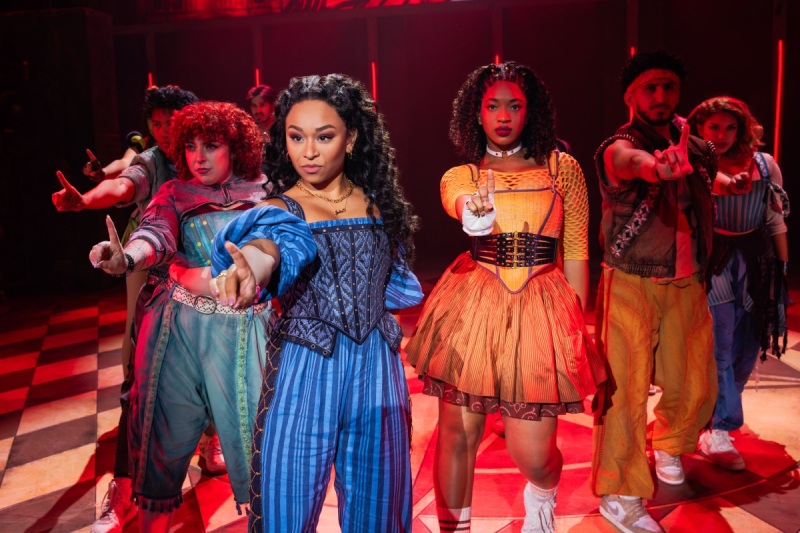
Fabiola Caraballo Quijada and the company of the North American Tour of & JULIET - Photo Credit Evan Zimmerman for MurphyMade.
Riding the show’s high-voltage spark, Joey Fatone slides into the role of Lance with an easy, self-aware charm that fits perfectly with & Juliet’s playful spirit. As a founding member of *NSYNC and a frequent Max Martin collaborator, Fatone is woven into the DNA of the musical’s soundtrack, giving his performance an extra layer of authenticity. His résumé stretches from Broadway to television to his memorable turn in My Big Fat Greek Wedding, but it’s his work here that stands out: he brings crisp, confident vocals and an easy comedic charm that consistently lifts the charge onstage. Fatone proves he’s far more than a nostalgic casting choice, emerging as one of the production’s most charismatic assets.
Fabiola Caraballo Quijada leads the company with a performance that feels like the show’s beating heart, delivering Juliet with a thrilling mix of vocal firepower and emotional nuance. She tears into Max Martin staples like “...Baby One More Time” and “Since U Been Gone” with bright, commanding vocals, then pivots into moments of vulnerability that make Juliet’s journey feel genuinely earned. Her presence centers the production, funny, fierce, and fully in control.
The supporting cast matches her drive with sharp, engaging work across the board. CJ Eldred’s Shakespeare brings a sly, lightly exasperated charm, leaning into the playwright’s ego without overplaying it, while Crystal Kellogg’s Anne Hathaway counters him with warmth, clean comic timing, and an easy wit. Together, they turn their marital back-and-forth into a steady, engaging thread that helps anchor the show’s driving rhythm and provides some of its funniest moments. Nico Ochoa’s May delivers one of the evening’s most affecting performances, especially in “I’m Not a Girl, Not Yet a Woman,” sung with disarming honesty. Joseph Torres dives gleefully into Romeo’s chaotic bravado, Noah Marlowe’s François adds irresistible comedic sparkle, and Kathryn Allison’s Angélique unleashes powerhouse vocals that stop the show in its tracks. Together, they form a tight, dynamic ensemble that amplifies Juliet’s story and keeps the production pulsing with life.
The show also finds touching emotional beats in Fatone’s Lance, whose scenes with Marlowe’s François carry a gentle, fatherly warmth that echoes the same kindness in François’s growing bond with Ochoa’s May.
Fatone and Allison’s duet on “Overprotected” is a standout, giving Lance and Angélique’s reunion a burst of humor and genuine warmth, and it’s just the start of Fatone’s musical impact throughout the night. His biggest showcase, “Teenage Dream,” becomes a warm, gently comic surprise as he embraces the Katy Perry hit with earnest, velvety vocals that give the number a sweetness you don’t see coming. Fatone may play Lance as the show’s affable comic relief, but his pop pedigree shows; every musical moment feels relaxed, lived in, and delivered with the kind of easy charisma that lifts the entire stage. It would have been nice to hear another number or two from him, especially since he proves he can still bust a move in the big ensemble dance feature “Everybody (Backstreet’s Back).”
The ensemble deserves its own praise, offering crisp harmonies, sharp choreography, and a lively spirit that keeps the show’s force surging. They match Fatone’s charisma beat for beat, creating a lively backdrop that makes each of his musical moments land even more effectively. Their collective precision and enthusiasm elevate the production, giving the score the full, joyful lift it needs.
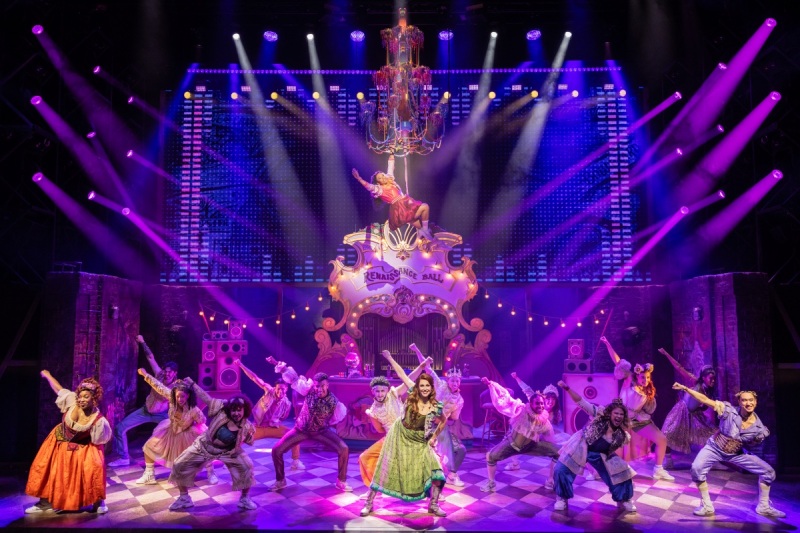
The company of the North American Tour of & JULIET (1) - Photo Credit Evan Zimmerman for MurphyMade.
If there’s anything I’d tweak, it’s that a few of the show’s narrative threads resolve a bit quickly in Act II, especially once Romeo crashes back into the story and the plot starts juggling multiple character arcs at once. The momentum never falters, but you can feel the show accelerating to tie up loose ends, which leaves certain beats landing faster than they need to. Like many jukebox musicals, a handful of emotional moments feel shaped more by the song than the situation, and a couple of supporting journeys wrap up a bit neatly compared to Juliet’s richer, more fully realized arc. These aren’t flaws so much as brief soft spots in an otherwise confident production, but they do create moments where the storytelling feels slightly compressed next to the show’s usual clarity, wit, and spark.
Even with those brief pacing dips, the production stays remarkably unified, and much of that cohesion comes from the creative team’s razor-sharp vision and assured hand. With a book by David West Read, the Emmy-winning writer behind Schitt’s Creek, the show’s humor lands with a cheerful, contemporary snap that is clever without ever feeling smug and heartfelt without tipping into sentimentality. Luke Sheppard’s direction keeps the pace brisk and the tone delightfully self-aware, guiding the audience through rapid-fire shifts between Shakespearean parody and pop-musical exuberance. Jennifer Weber’s Emmy-winning choreography is the engine that keeps the whole thing pulsing, layering crisp, high-impact movement over Max Martin’s hits in ways that feel both nostalgic and freshly inventive. Together, they shape a production that is as smart as it is spectacular, proving that & Juliet succeeds because its creative foundation is every bit as strong as its glittery, radio-hit exterior.
What I love is how much the show feels like a full-tilt party. Throughout the night, the musical keeps slipping into irresistible, disco-bright bursts of celebration - confetti, fireworks, and bouncy dance numbers - the kind that wash over the Auditorium Theatre with a buoyant, communal energy. Even the live band, tucked out of sight, delivers with such punch that the show takes on a concert-like charge at times. By the end, the audience is on its feet, cheering as if they’ve been part of the celebration all along.
The design team behind & Juliet gives this touring production its glossy, high-octane finish, each element snapping together with precision. Soutra Gilmour’s scenic design provides a playful, ever-shifting backdrop, while Howard Hudson’s lighting drenches the stage in radiant color and concert-style intensity. Paloma Young’s costumes amplify the show’s turn-of-the-millennium exuberance, blending Shakespearean silhouettes with modern pop flair to mirror the musical’s playful collision of eras, and Gareth Owen’s sound design keeps Max Martin’s hits punchy and impeccably balanced. Add Andrzej Goulding’s video and projection work, and you get a production that feels polished, cohesive, and irresistibly alive.
& Juliet continues to light up Chicago with glitter, heart, and high-voltage joy, and this touring production proves itself an outright delight. Running July 22 through August 2, 2026, the Broadway in Chicago engagement at the Auditorium Theatre delivers a vibrant, tightly crafted experience that never loses sight of its emotional core. With a knockout lead performance, a dynamic ensemble, and a creative team working at peak imagination, this tour shows exactly why & Juliet has become one of the most irresistible modern musicals. It is a jubilant, neon-bright celebration of rewriting your own story and absolutely worth catching before it dances out of the city.
Highly recommended.
All The World's a Stage and Chicago Merely The Best Player: 'As You Like It' in Chicago Parks this summer
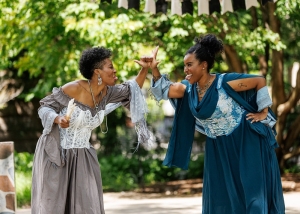
Is there anything more alluring than a summer night in Chicago? The lakefront beaches, the meandering pathways, the festivals and street foods, the hidden gardens where free art productions are staged, whatever you like, you can find it in the city during summer evenings. There is no shortage of parks to explore or cultural events to experience, thanks in part to the Mayor’s Night Out in the Parks program that partners with organizations to stage free artistic experiences in neighborhood parks all around the city. One such organization kicked off its summer series with a spectacular – and free – performance of Shakespeare’s As You Like It, now playing throughout Chicago parks through August 2nd.
Shakespeare’s As You Like It is a comedy that follows Rosalind and Orlando, two lovers who each run away from their own political and familial problems and escape into the Forest of Arden. Disguised as a shepherd boy, Rosalind finds Orlando and convinces him to woo her under the guise of curing him of his love for Rosalind. Multiple couplings occur, lessons of life and love are expounded on, and, as every Shakespeare comedy does, As You Like It ends with a wedding – four to be precise.

foreground - Thomas Russell and Connor O. Locklin. Photo by Steven Townsend, Distant Era.
As You Like It is the 2026 production of Midsommer Flight, a theatre troupe that stages high-quality, accessible performances of Shakespeare’s plays in Chicago. Directed by Producing Artistic Director Beth Wolf, this summer’s production continues to delight audiences and draw crowds, presenting free performances to Chicago communities that aim to bring people together. Midsommer Flight is an Arts Partner with Chicago Park District and a participant in the Mayor’s Night Out in the Parks initiative. They will be performing the classic Shakespeare comedy throughout the summer at different neighborhoods throughout the city, but if you think you’ve seen a Shakespeare production, (seen one, seen them all, right?) I beseech you to venture to one of the parks. At the best of times, Shakespearean stories can be difficult to follow: analogous phrasing, double entendres, prosaic old-timey insults, and slurs; it’s not always easy to follow. Midsommer Flight, however, gives the old texts modernity, witty asides, and an expressive atmosphere that makes the play easy to follow and understand. The acting is superior, and the inclusivity is a delightful and refreshing display of humanity at its finest. Talent of the Midsommer Flight cast would rival that of any Shakespearean theatre company, charging hundreds of dollars for seats, and staging productions in grand halls. And the best part? The productions are completely free to the public. The accessibility, the garden park scenery, and the flowy costuming truly provide a magical experience, embodying the spirit, humanity, and beauty of the arts.
There are many benefits to living in and around the Chicagoland area, but summertime really brings out the best and brightest Chicago has to offer. Night Out in the Parks is but one of the many incredible accessible programs bringing cultural events to neighborhoods to “amplify the artistic and cultural vibrancy of our city in every neighborhood and enhance quality of life across Chicago.” Find out more about Night Out in the Parks here. When initiatives such as this meet the grassroots talent and love shown by Midsommer Flight, magic happens. Whether you like it because it’s in your local park or you like it because it is free, there is truly something for everyone this summer in Chicago. You can truly have it just as you like it. As You Like It will be performed outdoors at six Chicago parks through August 2nd. Learn more about Midsommer Flight and its mission, and check out the list of upcoming performances at parks throughout Chicago and reserve your free space today!
Overshadowed Theatrical Productions Announces 2026-2027 Season: “Ordinary People, Extraordinary Moments”

Overshadowed Theatrical Productions announced their 2026-2027 season entitled “Ordinary People, Extraordinary Moments,” which includes five main stage productions and special events.
Kicking off the season is an original play written by Artistic Director Reba Hervas entitled “Flame of Fire.” The story is inspired by "Operation Auca," a mission to make peaceful contact with an Ecuadorian tribe. Remembering the events 70 years later, this dramatic play follows missionaries Jim Elliot, Nate Saint, Pete Fleming, Ed McCully, and Roger Youderian and their wives as they bravely prepare for what would change their lives forever. Auditions for this empowering tale will be held on Tuesday, July 28.
For the Christmas season, Overshadowed will present the beloved “It’s a Wonderful Life,” adapted by Jason LeBlanc from the film by Frank Capra. This cherished story follows George Bailey as he discovers the most precious gift thanks to some heavenly help by a quirky angel trying to earn his wings. The film turns 80 years old this year.
In January, the season continues with the family-oriented “James and the Giant Peach (TYA).” Adapted from Roald Dahl's book, this musical follows the adventures of a young boy and his strange new friends as they travel in a giant peach to New York. Book by Timothy Allen McDonald with music and lyrics by Benj Pasek and Justin Paul, known for "Dear Evan Hansen."
The spring will feature a rare Agatha Christie mystery, “The Stranger.” Considered a lost play until 2019, this intriguing tale will have audiences on the edge of their seats as a woman’s whirlwind romance takes a turn when she discovers something about her husband’s past.
The season wraps with the Tony Award-winning “Titanic” with music and lyrics by Maury Yeston and a book by Peter Stone. This beautiful musical delivers powerful emotional moments and soaring songs that bring history to life.
The season will also include the return of Shakespeare on the Grass, a partnership with the City of Itasca. “A Midsummer Night's Dream” will be presented on August 15 at 1 p.m. and 4 p.m. at 201-261 S. Walnut Street, Itasca, in the newly renovated gazebo. The event is free and will feature food and beverages for purchase from local vendors.
In February, Overshadowed will also present its annual Valentine’s Day show with a special performer to be announced at a later date.
Season subscriptions are available for purchase on Overshadowed’s website or by calling the box office at (630) 634-2100.
Production Dates:
- “Flame of Fire”: September 18 – October 10, 2026
- “It’s a Wonderful Life”: November 27 – December 19, 2026
- “James and the Giant Peach (TYA)”: January 22 – February 6, 2027
- “The Stranger”: March 12–20 and April 1–10, 2027
- “Titanic”: July 9–31, 2027
- Shakespeare on the Grass: “A Midsummer Night's Dream”: August 15, 2026 (1 p.m. & 4 p.m.)
About Overshadowed Theatrical Productions
For over 20 years, Overshadowed Theatrical Productions has provided high-quality, family-friendly theater that entertains, inspires, and promotes a Biblical message while fostering a positive community atmosphere. The company is also dedicated to training and encouraging the next generation of performers and theater technicians.
Chicago Shakespeare Theater announces 40th Anniversary Season

|
|
|
Court Theatre’s Erotic Taming of the Shrew brings the simmer to a boil

We often forget that The Taming of the Shrew is, at its core, a play within a play - a bit of theatrical mischief in which characters watch other characters pretend. Marti Lyons’s ambitious new adaptation for Court Theatre not only remembers this but revels in it. She reframes Shakespeare’s battle-of-wills as a private, immersive experience for five elite guests - figures who could easily have wandered off the set of Succession—invited to indulge in a curated world of erotica, fantasy, and power play. This is not like any production of Shrew I have ever seen. And I love it.
Lyons taps into the erotic charge embedded in Shakespeare’s text. For Lyons the struggle between Kate and Petruchio isn’t a patriarchal lesson but a provocation - an invitation to consider what people consent to in the privacy of their desires, even when those desires run counter to their public personas. In fantasy, we try on identities we might never inhabit in daylight. Could Kate, in this telling, actually be exercising her agency by consenting to a submissive role in her intimate life while fiercely maintaining her autonomy in her public life? The question lingers.
The production openly engages with bondage, discipline, dominance, submission and S&M, - not as taboo spectacle but as a consensual system built on trust, communication, and negotiated power. This is especially evident at Petruchio’s house. Instead of treating Kate’s submission as Shakespeare’s dreaded moral, Lyons reframes it as a conversation about desire and embodiment. The cast leans into this with a refreshing clarity: pleasure, not punishment, drives the story. Power is a game, and everyone in the room is choosing to play.
By foregrounding the play-within-the-play structure, Lyons opens a fertile space not only to re-engage with the text but to ask ourselves uncomfortable, thrilling questions about love and control, submission and domination, agency and desire. It is rare for a Shrew to feel so sensual and so intellectually alive.
Much of the production’s force comes from its ensemble. As Katherina, Melisa Soledad Pereyra embodies fire, humor, and hunger—a woman who knows her own body and mind. Her chemistry with Jay Whittaker’s Petruchio is the engine of the evening: two equals circling, sparring, testing limits until the battle between them becomes a dance. Netta Walker’s Bianca is no docile ingénue; she claims her place with confident wit. Samuel Taylor, Nate Santana, and Dexter Zollicoffer bring sharp comedic flavor to Hortensio, Lucentio, and Gremio, while Ryder Dean McDaniel anchors Tranio with duplicitous cunning. The supporting cast - Alex Weisman, Monica West, and others - soften and sharpen the edges of the world as needed.
The design team conjures a world where erotic imagination thrives. Jackie Fox’s scenic design refashions Court Theatre into a sensuous playground of marble black-and-white tiled floors, sculpted statues, expansive botanical murals, and imposing wooden doors. Kotryna Hilko’s costumes heighten the atmosphere with daring textures - leather for Petruchio, jewel-toned gowns for the women, jacquard damask for the aristocrats - each piece balancing revelation and restraint, structure and seduction. Every visual element underscores Lyons’s central argument: desire is a kind of performance, and every performance is a negotiation of power.
This Taming of the Shrew pulses not with brute domination but with the sensual, exacting choreography of consent. Lyons doesn’t blunt the play’s jagged edges; she sharpens them into tools of erotic inquiry. Her staging invites us to feel the heat of what is given freely, the tautness of what is deliberately withheld, and the exhilaration of boundaries tested - then mutually defined.
Court Theatre’s production doesn’t simply reinterpret Shrew; it challenges us to reinterpret ourselves. By grounding the story in erotic power exchange and consciously negotiated dynamics, Lyons’s adaptation pushes us to confront the desires we rarely articulate. What do we relinquish willingly? What pleasure do we find in surrender? And what power do we claim by choosing when—and to whom—we yield? In Lyons’s hands, the theatre becomes a chamber of self-interrogation, where the line between performance and private longing thins, and we’re invited to examine the fantasies that shape us as intimately as any script.
HIGHLY RECOMMENDED
When: through Dec 14TH
Where: Court Theatre, 5535 S. Ellis Ave.
Running Time: 2 hours, 30 minutes 15 minute intermission
Tickets: $60 - $90.00 Student, Group and military discounts available
773-753-4472
The Play's the Thing That Goes Wrong in 'Book of Will'

The true story behind Lauren Gunderson’s “The Book of Will” is compelling—the efforts of actors John Heminges (Jared Dennis) and Henry Condell (Ben Veatch), Shakespeare’s colleagues—to compile and publish a definitive collection of the Bard's works in the years soon after his death in 1616. This they did over the course of four years until it arrived in 1623, and Gunderson uses a comedic form to render the story and characters involved in the effort.
Comedy keeps the story energized, staving off the dreariness of what might have been a docudrama. And the Promethean Theatre Ensemble cast directed by Beth Wolf delivers top notch performances. Brendan Hutt in the role of Richard Burbage, the actor who originated many of Shakespeare’s most famous roles, gives real Shakespearean heft to his performance. Hutt also plays William Jaggard, a publisher who produces the definitive First Folio (several after producing a less accurate version) with 36 of Shakespeare’s plays, 18 of them published for the first time. These included "The Tempest," "The Taming of the Shrew," "Macbeth" and "Julius Caesar," an unimaginable tragedy had these been lost.
Gunderson’s script opens with Heminges and Condell (and the audience) witnessing a performance of “Hamlet” so badly rendered as to lose the playwright’s intent. We see “To Be or Not To Be,” Hamlet’s famous soliloquy (delivered by Jesús Barajas playing beautifully, stunningly wrong), the delivery even more butchered due to a distorted script, perhaps recorded from another actor’s faltering memory. It’s like watching as someone belts out a song all off key.
Galvanized by this horror, the two determined they would gather up all the most original copies of Shakespeare’s masterpieces and publish them in a book, before they were lost. Some of Shakespeare’s works were published while he was alive, but others were relegated to the haphazard storage of working theaters, marked up scripts found at playhouses even today.

Jonathan Perkins
All this is factually true, as is so much of the play. That Gunderson often leans toward almost jarring contemporary vernacular and a comedic approach may make us question whether this can all be the real story, but indeed it is, in details large and small. Most of the cast performed multiple roles, for example Jonathan Perkins in the role of a compositor at the printer and three other characters. Perkins was arresting in the quality of his performance.
“Book of Will,” to my mind, is a flawed thing. While Gunderson has the greatest intention in celebrating Shakespeare, there is very little of his work delivered. The play is based on the reasonable presumption that the audience loves Shakespeare—who else would be drawn to the heroic tale of the publication of his works? But it doesn’t present enough of it to remind us why, to stir our emotions for a moment with the real art of the celebrated subject.
Brendan Hutt convincingly offers some solid Shakespearean delivery in the role of Richard Burbage, the actor who originated many of the playwright’s most famous roles, delivers promising and skillful recitations of bits of Shakespeare. But the snippets offered us by Gunderson are too brief, and not gripping. Even worse are a couple scenes where “quotable quotes” from Shakespeare are offered, sometimes in multiple languages to reinforce his universality—but it comes off as an artfully executed but nonetheless bad “tribute” to the playwright.
One lost opportunity arises after Heminges’ wife Rebecca (Ann Sheridan Smith in an exceptional performance) passes away (I didn’t see that coming) at the beginning of Act II. Rebecca has been his rock during the four year effort to secure rights and overcome financial hurdles to publish the plays. Inconsolable, Heminges seeks solace in the theater, spending sleepless nights there reciting monologs from Shakespeare’s plays, he tells us. Could not the playwright have let Heminges deliver us even one of these, an apt monologue voiced with the passion of his grief?
In short, this is a play about people who love Shakespeare, but he isn’t tapped for what he might bring to the party. I thought James Lewis turned in a remarkable performance as Ben Johnson, Shakespeare’s rival and critic, who wrote a dedicatory poem for the First Folio. Lewis gave me the one moment I felt touched at the level of emotion that Shakespeare evokes in his works. This comes as the begrudging Ben Johnson delivers the opening lines of his dedicatory poem for the First Folio.
Nevertheless, “The Book of Will” tells an important story of the epic accomplishment of two devotees of Shakespeare, and one well worth hearing and seeing. Even as the web lulls us into believing that all knowledge and information is permanently and universally accessible, in fact we are seeing in present days the disappearance of content the “Book of Will” reminds us anew of the evanescence and fragility of the written word, and the commitment required to maintain and preserve it. "The Book of Will" runs through October 25, 2025 at The Den Theatre on Milwaukee Ave. in Chicago.
Invictus Theatre Presents Enchanting Production of The Winter’s Tale

Walking into Windy City Playhouse, audiences are immediately transported to somewhere new. Scenic Designer Kevin Rofls fills the space with trees, branches, and flowers – drawing the audience into the story as soon as they enter the space. Lighting Designer Trey Brazeal highlights the room in a mix of various shades of blue, creating a somewhat hazy atmosphere. The shadows hit the tree branches and rocks just right, also providing an air of mystery. Audiences are immersed into a space of wonder.
The Winter’s Tale is about a number of things. There’s heartbreak and betrayal. There is jealousy and trickery. There’s reconciliation and forgiveness, as well as the test of time. Surrounding all of these storylines is one of magic and love – with an exploration of how the heart can bring us to do some dangerous, but also some beautiful things. The design team creatively collaborates to draw audiences into that enchanted world – a space where anything can happen. Particularly when combined with live music, you might just find yourself leaning in as you become absorbed in the dark romance.
Written by William Shakespeare, The Winter’s Tale follows King Leontes (Michael Stejskal). When he falsely accuses his wife, Hermione (Andrea Uppling) of having an affair with his best friend, King Polixenes (Raul Alonzo), a series of unfortunate events are spurred into action. Hermione is arrested, causing their young son, Mamillius (Jennifer Agather) to die due to distress. The King and Queen’s baby girl is stolen away for safety, and Hermione barely makes it through her trial. As with so many Shakespearean stories, all turns into chaos, and the remaining heroes are eventually left to pick up the pieces and see what may be worth saving.
Directed and adapted by Charles Askenaizer, the ensemble as a whole is quite strong. The Winter’s Tale is one of Shakespeare’s pieces that does not quite fit. There is love, but it is not technically a comedy. There is death, but it is not quite a tragedy. The story moves through the highs and lows of the genre and the actors bring that to life with ease – in particular, Uppling as Hermione and Stejskal as Leontes. Shakespeare does not make it easy for these performers – with a relationship that pulls a 180 within minutes as Leontes becomes lost in jealousy and rage. However, this duo approaches the emotional complexity with grace and certainly keeps the audiences on their toes – wondering what twist or turn may be thrown into the relationship next.
As much as The Winter’s Tale handles heavy matters of tragedy, the production also carries what some might find to be much needed moments of levity. Sam Nachison’s Autolycus is a prime example - appearing early in Act 2. Autolycus steals from an unsuspecting Clown (played by Kyle Quinlivan - with a sweet, unassuming innocence), and Nachison turns this into a game with the audience. With each piece of clothing Autolycus tricks the poor man into removing, or coin purse that the Clown unknowingly hands over – Nachison throws a little wink or gesture to the adoring crowd. His performance elicited uproars of laughter, and even cheers as the thief’s tactics became increasingly over-the-top.
With a stunning design and strong ensemble, The Winter’s Tale is a night of romance and wonder.
RECOMMENDED
Run Time: 2 hours and 45 minutes, with intermission.
The Winter’s Tale runs through April 20, 2025 at Windy City Playhouse – 3014 W. Irving Park Road. For tickets and information, see the Invictus Theatre website.
*This review is also featured on https://www.theatreinchicago.com/!
Fat Ham at Goodman Theatre: Bold, Hilarious, and Heartfelt

James Ijames' Pulitzer Prize-winning play, Fat Ham, bursts onto the Goodman Theatre stage in a vibrant, deeply resonant co-production with Definition Theatre. Directed with an expert hand by Definition Theatre's Artistic Director Tyrone Phillips, this contemporary reinvention of Hamlet dazzles with humor, heart, and a profound exploration of identity, toxic masculinity, and generational burdens.
Set in a Southern backyard during a family barbecue, Fat Ham transforms Shakespeare's dark tragedy into a poignant yet hilarious meditation on living one's truth. At the center of this narrative is Juicy, played with remarkable nuance and emotional depth by Trumane Alston. Juicy's journey of self-discovery unfolds amid the ghosts—both literal and figurative—of his family's past, grappling with expectations of masculinity and the weight of inherited trauma.
Alston's performance is layered and compelling; his Juicy is introspective and tender yet brimming with an undercurrent of resilience, given time he will lean more into the character arc. His comedic timing is impeccable, delivering Ijames' sharp and incisive dialogue with a natural ease that invites the audience into his emotional world. Juicy's interactions with his spirited best friend Tio, brought to life by the dynamic Victor Musoni, provide some of the play's most humorous and thought-provoking moments. Musoni's portrayal of Tio is electric, offering a counterpoint to Juicy's introspection with boundless energy and unfiltered wisdom.
Ronald Connor impresses in the dual role of Rev and Pap, seamlessly shifting between the domineering ghost of Juicy's father and the charismatic over-sexed preacher presiding over family affairs. His presence looms large, embodying the toxic masculinity that haunts Juicy's world with an intensity that is both chilling and oddly comedic. Opposite him, Anji White as Tedra, Juicy's vivacious mother, delivers a powerhouse performance—balancing maternal warmth with an underlying desperation to escape her own past.
Ireon Roach’s Opal is a revelation, with her confidence simmering to the surface, while Sheldon Brown’s Larry, a stoic Marine grappling with his own identity, offers a poignant reflection of the play’s central themes. And no production would be complete without the powerhouse that is E. Faye Butler, whose presence on stage is nothing short of magical.
The technical elements of the production elevate the storytelling to new heights. Arnel Sancianco’s set design captures the essence of a Southern backyard with rich, lived-in detail, creating a tangible sense of place that enhances the play’s themes of home and heritage. Jos N. Banks’ costume designs are vibrant and character-driven, reflecting each individual's inner conflicts and outward personas. Jason Lynch’s lighting design cleverly shifts from naturalistic warmth to eerie supernatural hues, underscoring the play’s tonal shifts. Meanwhile, Willow James’ sound design punctuates the emotional beats with a careful blend of music and ambient sounds that ground the play’s heightened moments.
Phillips’ direction is both deft and sensitive. He embraces the play's comedic elements without undercutting its emotional weight. He crafts a production that honors Ijames’ bold vision while allowing the cast to fully explore the complexities of their characters.
Fat Ham is a triumph—an innovative, riotously funny, and ultimately moving exploration of what it means to break free from the ghosts of the past and forge an authentic future. Whether you're a Shakespeare purist or someone looking for a fresh, contemporary take on a classic story, this production offers something truly special.
With an outstanding ensemble, sharp direction, and a creative team firing on all cylinders, Fat Ham at Goodman Theatre is a must-see theatrical event that redefines what it means to inherit, to resist, and to thine own self be true.
Highly Recommended
When: Through March 2
Where: Goodman Theatre, 170 N. Dearborn St.
Tickets: $25 - $85
Info: Goodmantheatre.org/Ham




Latest Articles
-
 “A Strange Loop” Lets the Intrusive Thoughts Win at Raven Theatre in partnership with About Face Theatre
Written by John AccroccoA musical, but it’s just the voices in your head. Sounds just crazy enough to win the 2020 Pulitzer for Drama. “A Strange Loop” by Michael R. Jackson finally makes its Chicago premiere at Raven Theatre in a co-production with…
“A Strange Loop” Lets the Intrusive Thoughts Win at Raven Theatre in partnership with About Face Theatre
Written by John AccroccoA musical, but it’s just the voices in your head. Sounds just crazy enough to win the 2020 Pulitzer for Drama. “A Strange Loop” by Michael R. Jackson finally makes its Chicago premiere at Raven Theatre in a co-production with… -
 Announcing Goodman's 22nd New Stages 2026 Festival Line-Up
Written by Buzz Center StageFrom a "Kung Fu rom-com" to a witchy new musical, The Goodman's popular New Stages Festival in its 22nd year continues to offer a first glimpse at the latest works by a handful of the hottest contemporary playwrights. This year's four-play…
Announcing Goodman's 22nd New Stages 2026 Festival Line-Up
Written by Buzz Center StageFrom a "Kung Fu rom-com" to a witchy new musical, The Goodman's popular New Stages Festival in its 22nd year continues to offer a first glimpse at the latest works by a handful of the hottest contemporary playwrights. This year's four-play… -
Chicago Danztheatre Ensemble Announces 2026-2027 Season
Written by Buzz Center StageChicago Danztheatre Ensemble (CDE) is pleased to announce its 2026 - 2027 season. CDE will open this artistic season with Copestic Vibrations: A Music Festival, Friday, Nov. 13 and Saturday, Nov. 14, followed by a fully staged production of For…
-
Eos Theatre Company Announces Second Production with The Thin Place
Written by Buzz Center StageEos Theatre Company is pleased to announce their second production with Lucas Hnath's horror play The Thin Place, directed by JC Clementz (Steppenwolf's Director of Casting and Artistic Operations), playing February 5 - 28, 2027 in Bramble Arts Loft's Beatrice Theater, 5545 N…
Does your theatre company want to connect with Buzz Center Stage or would you like to reach out and say "hello"? Message us through facebook or shoot us an email at This email address is being protected from spambots. You need JavaScript enabled to view it..
*This disclaimer informs readers that the views, thoughts, and opinions expressed in the text belong solely to the author, and not necessarily to Buzz Center Stage. Buzz Center Stage is a non-profit, volunteer-based platform that enables, and encourages, staff members to post their own honest thoughts on a particular production.