
Displaying items by tag: dominique morisseau
Detroit ’67: A Basement Becomes a City on the Brink
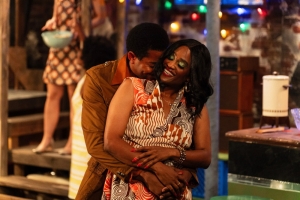
Detroit was burning in the summer of 1967, inside one basement, life was still going on.
That contrast is at the heart of Dominique Morisseau’s Detroit ’67, now being produced by Pulse Theatre Company in residence at eta Creative Arts Foundation. Directed by Pulse Executive Artistic Director Aaron Reese Boseman, with assistance from the wonderful AnJi White, the production takes us into the lives of people trying to maintain some sense of normalcy as their city moves toward upheaval.
The summer of 1967 was a year of enormous social and political upheaval. Detroit’s Black community was confronting racial discrimination, police brutality and economic inequality while the city was experiencing major changes in population, industry and employment.
Then came July 23.
A police raid on an after-hours establishment on Detroit’s 12th Street ignited five days of unrest. The uprising reflected longstanding tensions involving racial discrimination, police-community relations, economic inequality and the changing landscape of the city. Forty-three people died, hundreds were injured, thousands were arrested, and buildings throughout Detroit were destroyed or damaged.
Yet Morisseau doesn't put the uprising on display for us.
Instead, she puts us in a basement and allows us to listen to the people who have something to lose.
And what a basement it is.
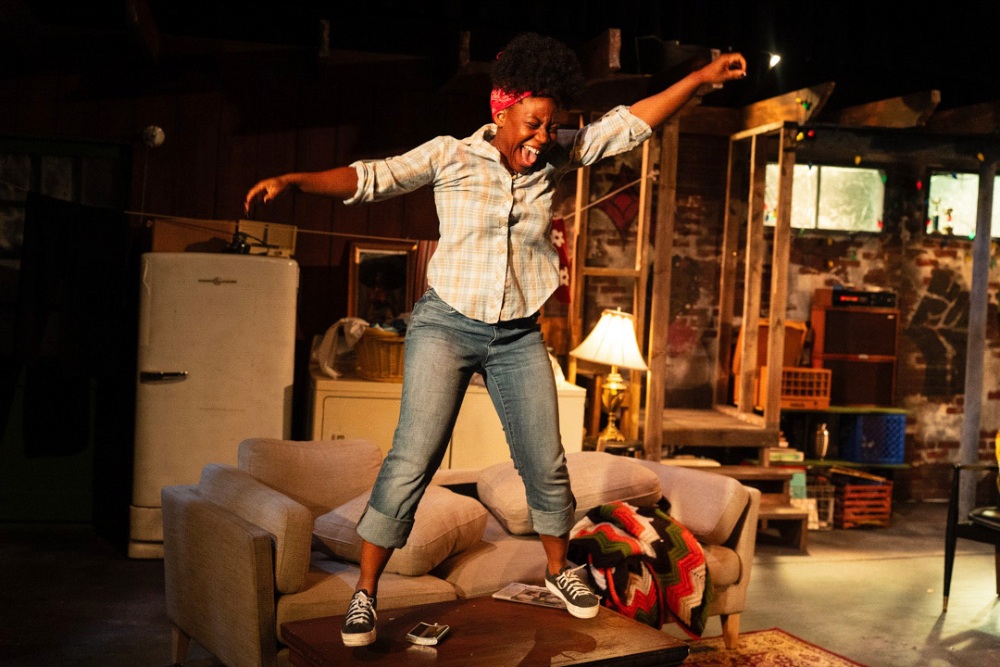
Photo Credit: Aaron Reese Boseman
Kevin M. Rolfs has created a remarkably realistic environment for this after-hours joint. An old washer and dryer, a well-used sofa, a period bar, scraps of wood and exposed beams make the space feel genuinely lived in rather than simply designed. Look around and you will find virtually everything you would expect in a 1960s Detroit basement.
Rolfs has proven himself a master designer, and this is among his best work.
Levi J. Wilkins’ lighting design is equally impressive. The basement does not exist in isolation. Light from outside constantly reminds us that another world is happening beyond those walls. The working fixtures inside, combined with changing light through the windows, establish the passage of time with remarkable precision.
Together with Warren Levon’s sound design, Terri Devine’s period-perfect costumes, and Rueben Echoles’ hair and makeup, the production creates an immersive portrait of 1967 Detroit. The design team doesn’t simply tell us we are in Detroit in 1967—they make us feel that we are there.
To say the ensemble is outstanding would be an understatement.
Shenise Danyel, whom I vividly remember as the maid in Invictus Theatre’s The House That Will Not Stand, is exceptional as Chelle, the level-headed sister whose strength anchors the household.
Tamarus Harvell another exceptional actor, plays Lank, a recent Vietnam veteran carrying dreams and the complicated weight of returning home from war. His presence reflects another reality of 1967: America was deeply immersed in Vietnam, with young men—including many Black and working-class men—being drafted into military service.
Jimiece Gilbert brings confidence and energy to Bunny, the best friend who knows exactly who she is.
Emma Jean Eastlund plays Caroline, a woman carrying secrets beneath the surface.
And then there is Dairyon Bolden as Sly.
Bolden was the biggest surprise for me. He is a genuine scene stealer, commanding every moment he occupies. That is no small accomplishment with a cast of this caliber. Bolden understands that commanding a scene does not necessarily mean being the loudest person in it. His choices are specific, confident and compelling.
Boseman’s direction brings the emotional life of Morisseau’s play to the surface without forcing it. The pacing is deliberate, and his decision to avoid blackouts between scenes works particularly well. The scenes roll smoothly into one another, creating the sense that life in this basement simply continues. There is no interruption between one emotional moment and the next. The outside world may be changing dramatically, but inside this basement, people still have to live, love, argue, dream and make decisions.
That contrast becomes one of the production’s greatest strengths.
The audience knows what is happening outside. The characters know what is happening outside. Yet the basement remains a place of refuge, business, friendship and possibility.
And that makes the history feel personal.
Detroit ’67 is ultimately about much more than an uprising. Through Morisseau’s writing, it becomes a story about people trying to hold onto one another while the world around them changes. The historical events give the play its pressure, but the characters give it its heart.
Pulse Theatre Company’s 2026–27 season is dedicated to examining Black life, family, memory and mental health across generations. Beginning with Detroit ’67, the company has established a compelling foundation for that exploration.
For Pulse Theatre Company, Detroit ’67 is not simply a production about 1967.
It is a reminder that history lives in rooms, in families, in memories—and sometimes, in a basement where the outside world is beginning to burn.
Highly Recommended
When: Through Nov. 1
Monday, Friday & Saturday 7:30pm
Saturday & Sunday 3:00pm
Where: eta Creative Arts Foundation 7558 S. Chicago Ave. Chicago, Ill.
Running time: 2 hours, 30 mins.
Tickets: $25-$40
(872)306-5734
Rich Dialog Brings to Life the Denizens of Detroit Stamping Factory as Shutdown Approaches

In Skeleton Crew, playwright Dominique Morisseau hits close to home, presenting an event that still profoundly impacts America: the 2008 economic meltdown. It is captured here in the form of an imminent Detroit car plant closure.
Our memories are still fresh from that time, and wounds to our social fabric not fully healed from a period when millions lost their homes and savings, and we careened to the brink of a global depression, nearly bankrupting U.S. auto makers.
As Skeleton Crew opens, this tumultuous crash is still unfolding and American were living through early phases of what would befall us. At the plant, management has been whittling away at the employee headcount, raising workloads for those remaining, even as rumors abound that this auto body metal stamping plant may close.
The action plays out entirely in the break room, from which massive industrial gantries and cranes are visible overhead. The clamor of the production line permeates the set as we meet Faye, a senior factory veteran and United Auto Workers Union steward (Jacqueline Williams delivers a dynamic performance); Dez, an aspiring young entrepreneur just finding his in life and work (Bernard Gilbert is excellent); and Shanita, an expectant mom who is also model employee. (AnJi White offers a richly textured performance). A supervisor, Reggie (Kelvin Rolston, Jr.) who has risen through the ranks, represents management in the unfolding drama.
I suspect these characters also stand as archetypes, symbolizing familiar types and generational shifts – each carries also a large measure of personal baggage and backstory. We learn that Reggie’s late mom was very close to Faye, and that Faye was like a second mother to him. We see Dez mapping out plans to open a small business – a car repair and restoration shop - but sense the incursions of rising crime and social dissolution. Dez is jumped by two thugs at a convenience store, and with the perspective of today's #BlackLivesMatter sensibilities, see another young black male at risk. Dez begins to carry a gun, and perhaps Morisseau means to foreshadow the tribulation of inner city violence today.
The more circumspect Shanita represents self-reliance and maturity. Perhaps just a little older than Dez, she fends off his less-than-serious amorous advances, until shifting gears when she becomes pregnant. Faye is the establishment, the UAW go-between to management negotiating secretly with Reggie over how workers will be affected by the shutdown. We learn the circumstances of her personal life are crumbling - as is the auto industry, and perhaps Morisseau is suggesting, social norms.
Morisseau’s earlier installments in her trilogy of plays, Detroit 67 (at Northlight in 2013) and Paradise Blue at Chicago’s Timeline Theatre in July 2017 – also displayed her facility for rich dialog, and an eye for character and dramatic trajectory. All three have been directed by Ron O.J Parsons (formidably well in Paradise Blue and Skeleton Crew; I missed Detroit 67). Parsons is also a frequent interpreter of August Wilson’s dramas at Court Theatre, where he is an artist in residence, and around the country. That is a fit for Morisseau, who says she aspires to give voice to Detroit (she uses the word “griot” for her role here) just as August Wilson was for Pittsburgh in his cycle of plays set there.
Northlight Theater's high production values have given a fine expression to this show, with Scott Davis (scenic design), Samantha C. Jones (costumes), Keith Parham (lighting), and Ray Nardelli (sound). Rita Vreeland is Production Stage Manager. The show is highly recommended, especially so since you are well advised to watch for revivals of the rest of Morisseau's trilogy. Skeleton Crew runs through March 3 at Northlight's home, the Northshore Center for the Performing Arts in Skokie.




Latest Articles
-
 “A Strange Loop” Lets the Intrusive Thoughts Win at Raven Theatre in partnership with About Face Theatre
Written by John AccroccoA musical, but it’s just the voices in your head. Sounds just crazy enough to win the 2020 Pulitzer for Drama. “A Strange Loop” by Michael R. Jackson finally makes its Chicago premiere at Raven Theatre in a co-production with…
-
 Announcing Goodman's 22nd New Stages 2026 Festival Line-Up
Written by Buzz Center StageFrom a "Kung Fu rom-com" to a witchy new musical, The Goodman's popular New Stages Festival in its 22nd year continues to offer a first glimpse at the latest works by a handful of the hottest contemporary playwrights. This year's four-play…
-
Chicago Danztheatre Ensemble Announces 2026-2027 Season
Written by Buzz Center StageChicago Danztheatre Ensemble (CDE) is pleased to announce its 2026 - 2027 season. CDE will open this artistic season with Copestic Vibrations: A Music Festival, Friday, Nov. 13 and Saturday, Nov. 14, followed by a fully staged production of For…
-
Eos Theatre Company Announces Second Production with The Thin Place
Written by Buzz Center StageEos Theatre Company is pleased to announce their second production with Lucas Hnath's horror play The Thin Place, directed by JC Clementz (Steppenwolf's Director of Casting and Artistic Operations), playing February 5 - 28, 2027 in Bramble Arts Loft's Beatrice Theater, 5545 N…
Does your theatre company want to connect with Buzz Center Stage or would you like to reach out and say "hello"? Message us through facebook or shoot us an email at This email address is being protected from spambots. You need JavaScript enabled to view it..
*This disclaimer informs readers that the views, thoughts, and opinions expressed in the text belong solely to the author, and not necessarily to Buzz Center Stage. Buzz Center Stage is a non-profit, volunteer-based platform that enables, and encourages, staff members to post their own honest thoughts on a particular production.