
Displaying items by tag: Joey Chelius
Buddy Holly’s Brilliance, Reawakened on the Drury Lane Stage
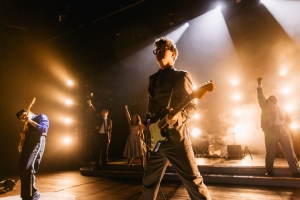
Drury Lane Theatre opens its latest musical with a warm jolt of rock ’n’ roll energy as Buddy – The Buddy Holly Story, by Alan James, returns to the stage, decades after its 1989 debut at the Plymouth Theatre Royal in England. What began as a modest jukebox biography has grown into a global crowd pleaser, and Drury Lane’s production celebrates everything that made Buddy Holly a seismic force - the sound, the swagger, and the fearless creativity of a young artist reshaping American music before the world even realized it was happening.
Buddy – The Buddy Holly Story had already shown how actor‑musician theatre could thrive, pairing a biographical narrative with dramatic scenes and a concert‑style climax that traced Holly’s artistic evolution before building to a full musical finale. Nearly two decades later, when Million Dollar Quartet premiered, the influence was unmistakable. Million Dollar Quartet distilled that approach, replacing the cradle-to-grave arc with a single-night reenactment inside Sun Studio. Instead of character development, it relied on direct address, minimal plot, and the raw electricity of live performance. The shared DNA is clear - legendary early rock played by the actors themselves - but Million Dollar Quartet takes a different approach. It’s a performance framed as a single moment in history, whereas Buddy – The Buddy Holly Story is a story‑driven musical that builds toward a showcase, ultimately shaping the theatrical vocabulary that Million Dollar Quartet would later draw from.
That lineage sets the stage for what Drury Lane achieves here. This staging traces Holly’s meteoric rise from Lubbock teenager to chart-topping innovator, capturing the joy, drive, and restless imagination that defined his short but revolutionary career. Drury Lane emphasizes so well the live-show pulse, packing the evening with hits, tight musicianship, and the infectious spirit of 1950s rock ’n’ roll. The production revisits the era beautifully and recreates the thrill of watching a new sound take flight in real time. With its high-energy ensemble and a lead performance that channels Holly’s mix of sweetness and swagger, Buddy delivers both nostalgia and immediacy, reminding audiences why his influence still reverberates through rock, pop, and musical theatre. It is a dynamic tribute to a musician who changed everything - and whose story still lands with irresistible rhythm. And as the story reaches its final stretch, the production kicks fully into showcase mode, delivering a roof-raising finish that feels less like musical theatre and more like being dropped into a live 1950s rock ’n’ roll set.
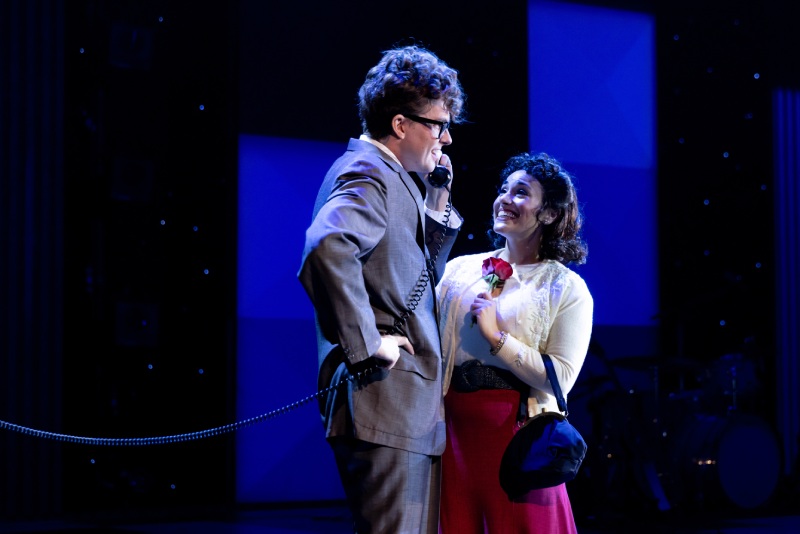
Joey Chelius as Buddy Holly and Samantha Sayah as Maria Elena Santiago Holly. All photos by Kyle Flubacker.
It is no surprise that the Drury Lane cast is top notch as always. Under the sharp direction of Matthew D. Carney and the vibrant choreography of Kenny Ingram, the ensemble delivers the kind of crisp musicianship and infectious charge this show demands. Joey Chelius makes a terrific Buddy Holly - charismatic, boyish, and fully in command of the rock ’n’ roll pioneer’s sound and spirit. He brings an easy, unaffected charm to the role, pairing Holly’s trademark vocal clarity with a grounded emotional throughline that keeps the performance from ever feeling like mere impersonation. Chelius captures the spark of a young artist discovering his own power. His playful, high-energy guitar work adds an extra lift of authenticity - the kind of spirited musicianship that makes the stage feel like a live 1950s jam session. When he locks in with the band, the stage lights up with the kind of voltage that makes you forget you are watching an actor at all. He is backed by an outstanding trio of Crickets: Alek Boggio as drummer Jerry Allison, Grant Alexander Brown as bassist Joe B. Mauldin, and Elliot Coe Esquivel as guitarist Niki Sullivan, who doubles as Richie Valens and plays the hell out of “La Bamba.” Together, they create a tight, exhilarating band that feels more like a live performance when they jam than a traditional musical number, filling the room with the kind of raw, unfiltered early rock drive that Buddy Holly himself once ignited.
As someone already familiar with Holly’s catalog, I walked away an even bigger fan - the show makes his artistry feel immediate, alive, and impossible not to resist. I was also struck by a detail I hadn’t known before seeing this production. Early in his career, Holly faced strong pressure from his record label to adopt a more conventional country‑western sound and image. The show makes clear that he flatly refused to be branded that way, holding fast to the rockabilly edge and melodic style that defined his emerging voice. Rather than reshape his music to fit a marketable country mold, he committed to the sound he believed in - a choice that ultimately set him apart and helped spark a new era in American rock ’n’ roll.
Samantha Sayah offers a gentle, grounding presence as Maria Elena Santiago Holly, anchoring the emotional stakes of Buddy’s personal life with warmth and quiet strength. She provides a steady, heartfelt counterbalance to the show’s high‑voltage musical energy, reminding us of the love and partnership that shaped Holly beyond the spotlight. She also adds a charming layer to the live music, stepping in with the band on keyboard while doubling in another role with easy versatility. Marta Bady is terrific across multiple roles, matched by Eric Andrew Lewis, who shines in a variety of roles and puts his vocal talent on full display. Together they deliver one of the night’s standout moments when they tear into “Shout” and absolutely bring the house down. Bady plays several roles throughout the show, including Marlena Madison, the smoldering and vibrant co‑host/performer at the Apollo Theater, and she’s compelling in every one of them. She brings a confident, magnetic stage presence that elevates each number she touches. Productions like this often skew male‑driven simply because of the era they depict, which places a particular weight on the women in the cast. Here, the two female performers supply all the necessary feminine energy, charisma, and sensuality that help charge the production with the same spark Buddy Holly inspired in his fans - a blend of modern edge and romantic warmth that defined his music.
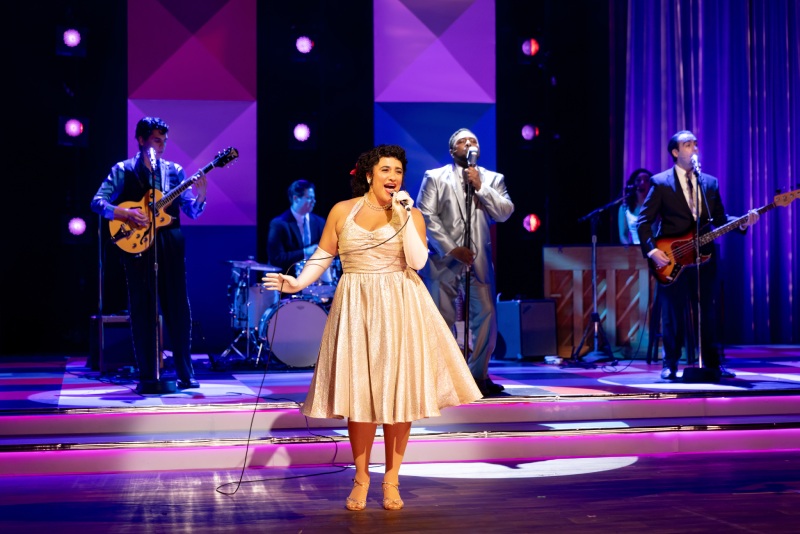
Marta Bady and cast.
Russell Mernaugh is another standout, slipping into several characters with ease, but it is his turn as The Big Bopper during Buddy’s final showcase that truly stops the show - an unforgettable moment that is off the charts good.
Beyond the performances, one of the unexpected pleasures of this production is watching Buddy Holly’s rock ’n’ roll evolution unfold as the show progresses. Drury Lane emphasizes the early chapters of his career, showing him as a shy, slightly unpolished teenager pushed toward the country genre his record label expected him to embrace. Holly’s early career also reflects a familiar music-industry pitfall: he accepted a restrictive record deal that undervalued his talent - a pattern that has continued to affect young artists from his era all the way to the present day. Those early scenes capture the tension between who he was told to be and who he was becoming - an artist quietly steering himself away from Nashville conventions and toward the raw, rhythmic spark of the new sound that felt truer, bolder, and entirely his own. As the productions unfolds, that tentative spark grows into full-fledged confidence. The shift is fascinating to watch: a young musician testing boundaries until he suddenly realizes he is creating something revolutionary.
The show’s greatest thrill comes from the music - a steady stream of Buddy Holly hits that still come alive with the invention and joy he poured into them in the late 1950s. Musical Director Chuck Mead’s fine choices amplify that spirit, shaping arrangements that feel larger than life at times without ever losing the raw simplicity that defined Holly’s sound. Drury Lane’s production treats these songs not as museum pieces but as living, breathing bursts of the raw spark of early rock, and Joey Chelius really delivers, driving each number with clarity, charm, and an effortless command of Holly’s style. Classics like “Peggy Sue,” “That’ll Be the Day,” “Everyday,” and “Oh Boy” land with fresh vitality, while the amped-up concert sequences bring the crowd to its feet. The band’s tight harmonies, crisp instrumentation, and sheer exuberance remind audiences just how groundbreaking Holly’s music was - and why these songs continue to resonate across generations.
Buddy Holly’s world comes alive so vividly thanks to the outstanding work of the design team - Lauren Nichols’ scenic design, Rachel Boylan’s period-perfect costumes, Lee Fiskness’ dynamic lighting, and Leland Plumridge’s crisp, full-bodied sound. The sets move fluidly from the intimacy of a recording studio to a series of performance stages, including a striking recreation of the famous Apollo in Harlem, NY. This core team does a fantastic job creating an atmosphere that feels authentic, immersive, and at times downright electric, giving the production its vibrant sense of place and time.
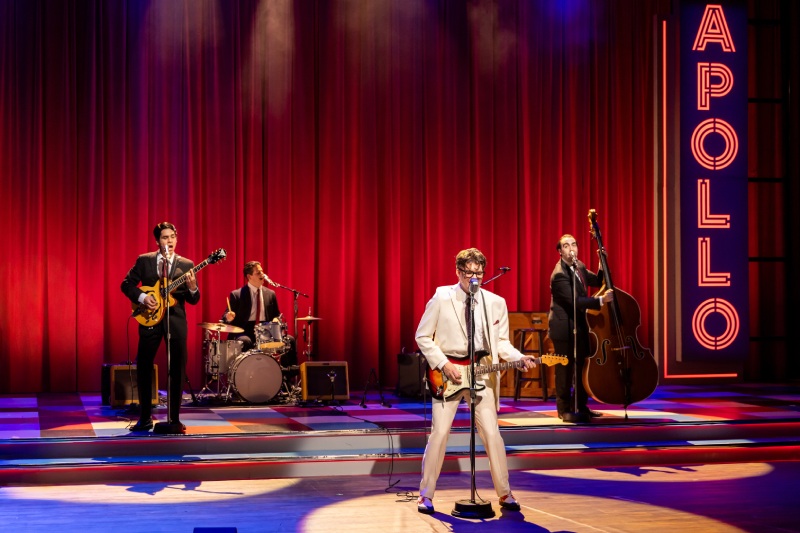
(left to right) Elliot Coe Esquivel, Alek Boggio, Joey Chelius, Grant Alexander Brown as Buddy Holly and the Crickets in Buddy – The Buddy Holly Story.
It is impossible to watch Buddy – The Buddy Holly Story without feeling the weight of how young he was when his life ended - just 22, still in the earliest stretch of a career that was already reshaping American music. The production doesn’t dwell on the tragedy, but knowing what comes after gives the final moments an undeniable ache. And because the show focuses, rightly, on celebration rather than sorrow, it’s worth briefly stepping beyond the edges of the stage to revisit the real history behind that night - not to overshadow the production, but to deepen the audience’s appreciation of what it’s honoring. Holly chartered the plane because the tour bus had broken down repeatedly, had no heat, and had already hospitalized his original drummer with frostbite - forcing a local substitute to step in. He simply wanted to get to Fargo early to rest, do laundry, and escape the miserable travel conditions.
The seats on the flight were traded for entirely practical reasons among Holly’s actual Winter Dance Party band and tour mates. J.P. Richardson (“The Big Bopper”), sick with the flu, asked current Crickets bass player Waylon Jennings for his seat, and Jennings agreed. Ritchie Valens and touring guitarist Tommy Allsup flipped a coin for the remaining spot, and Valens won. None of these decisions were driven by fear of the flight itself. The pilot, Roger Peterson, was young but licensed, and witnesses reported a normal takeoff. In reality, Holly was flying in dangerous winter weather - not a dramatic “storm warning” scenario, but conditions poor enough to make the trip risky, and they played a major role in the crash.
It’s also worth remembering that the show is, at heart, a feel-good celebration - not only of Holly, but of the three extraordinary artists who lost their lives that night. Still, for the sake of historical clarity, their deaths were the result of circumstances that never should have existed. The tour bus failures, the brutal cold, and the frostbite suffered by a band member were all consequences of a music industry unwilling to provide even basic support for the musicians it relied on. The concert they were traveling toward was not a high-stakes engagement; under safer, more humane conditions, the artists should have been given the option to delay the trip. Instead, a combination of grueling tour logistics and record-label cost-cutting placed them in harm’s way, costing the music world three bright stars.
Holly died in that crash on February 3, 1959, alongside fellow rock and roll trailblazers Ritchie Valens (just 17 years old), and J.P. “The Big Bopper” Richardson, as well as Peterson. The accident - later immortalized as “the day the music died” - cut short three rising careers in a single instant. Holly had recorded only a few years’ worth of material, yet his influence still reverberates through rock, pop, and country. And watching his world come alive so vividly onstage, you can’t help but wonder what other genius music he might have created had he been given even a little more time.
Buddy - The Buddy Holly Story is an easy show to wholeheartedly suggest - a colorful, high-energy celebration of a musical pioneer whose influence still echoes across generations. It is a fantastic homage to an incredible artist. Drury Lane Theatre’s production captures both the thrill of Holly’s sound and the poignancy of his too-short life, delivering an experience that feels as heartfelt as it is electrifying. This musical runs August 19 through October 18 at Drury Lane Theatre in Oakbrook, with a run time of 2 hours including a 20-minute intermission and comes highly recommended.
For tickets and/or more information, click here.
MadKap's 'Hair' at Skokie Theatre - Peace Love and Very Highly Recommended!

Whenever I review a theatre company for the first time I get a bit of "first date nerves", especially when a suburban company (unabashed City snob, c’est moi) is doing such an iconic show. The stakes were even higher cos this was my first time seeing HAIR – I was a little too young in 1968 and somehow never got a chance in the intervening years (never mind how many).
Skokie Theatre Company proved I was in good hands. The cast members greeting guests on the street set the mood, and I was charmed when Woof (Sam Hook) blew me a kiss from the stage. And then Dionne (Niki-Charisse Franco) began to croon the opening bars of ‘Aquarius’ and I relaxed. I knew I could sit back and enjoy the show.
HAIR includes copious profanity, overt drug use and full-frontal nudity, but there was so much MORE to love! Let’s start with the music: several of the songs, from ‘Easy to be Hard’ and ‘Good Morning Starshine’ to the iconic title song are still around today, but I hadn’t realized how very many songs are in Hair: 27 in Act One alone, and all wonderful: ‘Donna’, ‘Hashish’, ‘Colored Spade’, ‘Air’, and the fabulous ‘Initials’. And who knew HAIR had an actual plot? The cast was enormous: nine principals plus five in The Tribe – and each better than the last.
I could say HAIR was flawless, but that would set you wondering just how much of the Kool-Aid I drank; besides, there were a couple of teensy flaws. Sound Designer Chris Cook needs to make some small adjustments with the microphones -- for the most part the soloists came through, but I missed much of Crissy’s (Bridgett Martinez) solo. Mind, this sort of readjustment is routine for first-weekend performances, and my sitting in the front row may have been part of the problem.

Scenic Designer Scott Richardson and Props/Set Decorator Barry Norton wisely kept it simple: the tie-dye background effectively recalled the era, and multiple levels gave Director Derek Van Barham (with Asst. Directors Miranda Coble and Brennan Urbi) plenty of options for staging. Urbi, as Movement Asst, did a hell of a job with nearly continuous dancing and cavorting; good job he had the aisles to expand into. Beth Laske-Miller’s costumes were spot-on, evoking the flower-child tie-dyed-hippie-freak symbols of protest. She accentuated the principals just enough to distinguish them without dissociating them from the Tribe as a whole. And I loved the pansexual vibe that Intimacy Director Christa Retka achieved. Overall, the mood was effervescent, unselfconsciously joyous and totally infectious: we were all drawn into the Tribe.
I love seeing shows with this companion cos I learn so much from them. In one of my early I reviews I asked them, “Just what does a Stage Manager do?” Their reply: “Make certain every person and every prop is in exactly the right place at precisely the right time.” Their guidance let me appreciate what a phenomenal job Stage Manager Amanda Coble did with HAIR. Keeping a cast of 14 on cue through every moment of a 90-minute first act (and the 2nd act as well); staging, with Musical Director Jeremy Ramey, a total of forty songs, at least 36 of them ensemble pieces … she pulled it off without a bobble.
My companion’s standard for Light Design is ‘if you notice the lighting, they’re doing it wrong.’ Lighting Designer Pat Henderson met, even surpassed this standard with a basic kit used to full advantage. She utilized every possible source of illumination, stage lights, house lights and spotlights, using one particular center-stage spot super-effectively. I loved Musical Director/Conductor Jeremy Ramey’s brilliant idea of placing Shraga Wasserman (Berger) and Joey Chelius (Claude) in the band during Sheila’s (Alexandria Neyhart) solo ‘Easy to be Hard’, bringing the men into the scene and the song without choreography or lines.
Okay, what am I forgetting? Director … stage manager … music … intimacy … aha! The cast!
In a word, ridiculously talented. Okay, that’s two words, and they aren’t mine but Julie Peterson’s (Jeanie), but I’m totally with her on this, for both cast and crew. There was not one single weak voice in the cast, not one. I saw Shraga D Wasserman play Roger in RENT and, though I wrote a ‘Highly Recommended’ review, I remember that Wasserman’s talent outshone the rest of the cast, making for a slightly unbalanced production. No such problem here! Wasserman’s Berger was as good or better than their Roger in RENT, but the cast of HAIR was so stellar that their genius fit in seamlessly. That face of theirs! like living Silly Putty, so incredibly mobile.
I already mentioned that Sam Hook (Woof) stole my heart when he threw me a kiss, and my infatuation grew with his every appearance on stage. It’s hard to believe he’s still a student; I hope he stays in Chicago so I can follow his career.
Claude (Joey Chelius) had perhaps the heaviest dramatic role and his acting was most definitely up to it during the hallucination sequence and the finale. Hud (Justice Largin) was gorgeous and ‘I’m Black’ was a brilliant piece. I already mentioned that Niki-Charisse Franco as Dionne wowed me with her opening performance of ‘Aquarius’, singing with near-operatic potency. The other three principal women, Sheila (Alexandria Neyhart), Jeannie (Julie Peterson), and Crissy (Bridgett Martinez) had equally powerful voices. Ben Isabel was absolutely hilarious as Margaret Meade.
Which leaves The Tribe: Jonah Cochin, Jack Chylinski, Cristian Moreno, Chevy Dixon Saul, and Hannah Silverman. I reiterate: there was not a single weak performer! Jonah Cochin stood out for his delightfully bawdy contribution to ‘Black Boys’.
HAIR revived a lot of old memories for me, both good (dyeing my own love beads) and not-so-great (nightly body counts on TV). The rebellions of the 60’s/70’s shaped what American culture is to this day, and HAIR captured it all: peace and protest, music and drugs, love and fury. In 1969 HAIR was the counterculture’s manifesto. Today it’s a documentary, and a must-see!
MadKap Production's HAIR is being performed at Skokie Theatre through July 30th. For tickets and/or more information, click here.



Latest Articles
-
 Music Theater Works Pours a Beachy Cocktail with Escape to Margaritaville
Written by Kimberly KatzA gentle, tide‑easy current settles in right from the start, immediately signaling the kind of story this musical wants to tell. Rather than relying on big, splashy moments, it settles into a warm, beach-side rhythm, inviting the audience into a…
Music Theater Works Pours a Beachy Cocktail with Escape to Margaritaville
Written by Kimberly KatzA gentle, tide‑easy current settles in right from the start, immediately signaling the kind of story this musical wants to tell. Rather than relying on big, splashy moments, it settles into a warm, beach-side rhythm, inviting the audience into a… -
 Chicago Shakespeare Makes Winter’s Tale a Story Worth Telling
Written by Angelo CamposChicago Shakespeare Theater’s production of The Winter’s Tale delivers a compelling evening of theater, showcasing an exceptional company of actors working at the top of their craft. Under the direction of Artistic Director Edward Hall, this staging marks an exciting…
Chicago Shakespeare Makes Winter’s Tale a Story Worth Telling
Written by Angelo CamposChicago Shakespeare Theater’s production of The Winter’s Tale delivers a compelling evening of theater, showcasing an exceptional company of actors working at the top of their craft. Under the direction of Artistic Director Edward Hall, this staging marks an exciting… -
 A Joe & Melanie Thing Theatre Company announces The Hanukkah Humbug at Greenhouse Theater Center - December 3-6
Written by Buzz Center StageThe world premiere of The Hanukkah Humbug brings ghosts, history, tradition, and a whole lot of family fun to the Greenhouse Theater Center just in time for the holidays, Melanie Ann Apel promises a lively, family-friendly experience with this new…
A Joe & Melanie Thing Theatre Company announces The Hanukkah Humbug at Greenhouse Theater Center - December 3-6
Written by Buzz Center StageThe world premiere of The Hanukkah Humbug brings ghosts, history, tradition, and a whole lot of family fun to the Greenhouse Theater Center just in time for the holidays, Melanie Ann Apel promises a lively, family-friendly experience with this new… -
 Remy Bumppo’s Mud Row: A Family Haunted by the Past
Written by Wesley DavidRemy Bumppo opens its 30th anniversary season with Mud Row, a play by Tony Award nominee and MacArthur “Genius” Grant recipient Dominique Morisseau. Expertly directed by Malkia Stampley, this production is a sublime examination of family, inheritance, and the difficult…
Remy Bumppo’s Mud Row: A Family Haunted by the Past
Written by Wesley DavidRemy Bumppo opens its 30th anniversary season with Mud Row, a play by Tony Award nominee and MacArthur “Genius” Grant recipient Dominique Morisseau. Expertly directed by Malkia Stampley, this production is a sublime examination of family, inheritance, and the difficult…
Does your theatre company want to connect with Buzz Center Stage or would you like to reach out and say "hello"? Message us through facebook or shoot us an email at This email address is being protected from spambots. You need JavaScript enabled to view it..
*This disclaimer informs readers that the views, thoughts, and opinions expressed in the text belong solely to the author, and not necessarily to Buzz Center Stage. Buzz Center Stage is a non-profit, volunteer-based platform that enables, and encourages, staff members to post their own honest thoughts on a particular production.