
Displaying items by tag: Netta Walker
The Gift Theatre's Hayward: A Floridian-Style Shiva
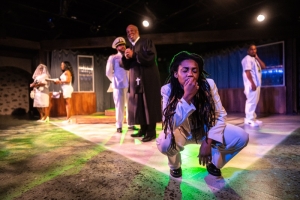
There are funerals where grief brings a family together, and then there are funerals where grief opens the door to everything a family has spent years trying to keep buried. In Hayward, playwright Netta Walker turns a father’s funeral into a reckoning with family secrets, unresolved pain, and the ghosts that refuse to stay in the past.
Given a bold world-premiere production by The Gift Theatre, presented at Steppenwolf’s 1700 Theater, Hayward, directed by AmBer Montgomery, reimagines elements of Hamlet and Electra through the eyes of Luna, the youngest daughter in a deeply complicated family. On the day of her father’s funeral, Luna announces that his ghost has come to visit her. What follows is part family drama, part dark comedy, and part haunting exploration of the emotional inheritance passed from one generation to the next.
The play opens with a funeral, and from the moment the family enters, it is clear that this will be no ordinary farewell.
Luna (Ireon Roach), her father’s favorite child, is overwhelmed by grief as she stands at the podium to deliver his eulogy. Her siblings seem considerably less interested in mourning. Eric (Victor Musoni), dressed in a white memorial T-shirt and sagging pants, and Leila (Sydney Charles), wearing a white dress that seems decidedly inappropriate for the occasion, give the impression they would rather be anywhere else. Their oldest brother, AJ (Gregory Fenner), a military man, stands rigidly at attention, as though guarding the proceedings at a state funeral.
Seated apart from the chaos is Maria (Shanesia Davis), the family matriarch, dressed in white, her face veiled and a white handkerchief close at hand. She carries herself with the solemnity of a woman accustomed to holding a family together, even when its members threaten to tear one another apart.
(from left) Alfred Wilson, Gregory Fenner, Shanesia Davis and Ireon Roach in The Gift Theatre's presentation of Hayward at Steppenwolf’s 1700 Theater. Photo by Joe Mazza / Brave Lux.
During the service, Luna sees her deceased father, Tony (Watson Swift). Her vision is quickly dismissed, but the encounter signals that something deeper is happening within this family. At the gravesite, the arrival of Uncle Johnson (Alfred Wilson), who is also a pastor, adds another layer of tension. There is little pastoral comfort in Johnson’s approach. He berates the family, directing particular hostility toward Luna because of who she is.
Religion, family expectations, and personal identity collide, and the resulting arguments reveal a household where love and resentment have become inseparable. The siblings fight, challenge one another, and expose old wounds, yet beneath their dysfunction is a recognizable bond. They may not know how to care for one another gracefully, but the connection remains.
At the center is Luna, whose grief is both the most visible and the most unsettling. Her father’s visits are not simply a supernatural manifestation of mourning; he has a request for her that reaches beyond the grave. As the family’s history unfolds, we learn that Tony served in the military during the Gulf War and returned carrying psychological wounds. The play suggests that the trauma he experienced did not end with him. His children, particularly Luna, may have inherited some of the emotional consequences without fully understanding their origins.
Walker’s most compelling achievement is her creation of characters who feel genuinely complicated. These are not tidy theatrical portraits of a dysfunctional family. They are people whose behavior can be outrageous, infuriating, and unexpectedly tender, sometimes within the same scene. The comedy emerges naturally from their interactions, offering relief without entirely diminishing the pain beneath the laughter.
Montgomery has assembled a strong ensemble and directs the actors with a clear sense of purpose. One of the production’s funniest moments comes when Maria sits center stage and her children gradually gather around her, one by one, as if seeking the comfort of the family’s center. When the last child arrives, Maria simply gets up and leaves them together. The gesture is hilarious, revealing, and familiar to anyone who has watched a family matriarch reach the limits of her patience. It is a moment best experienced rather than explained.
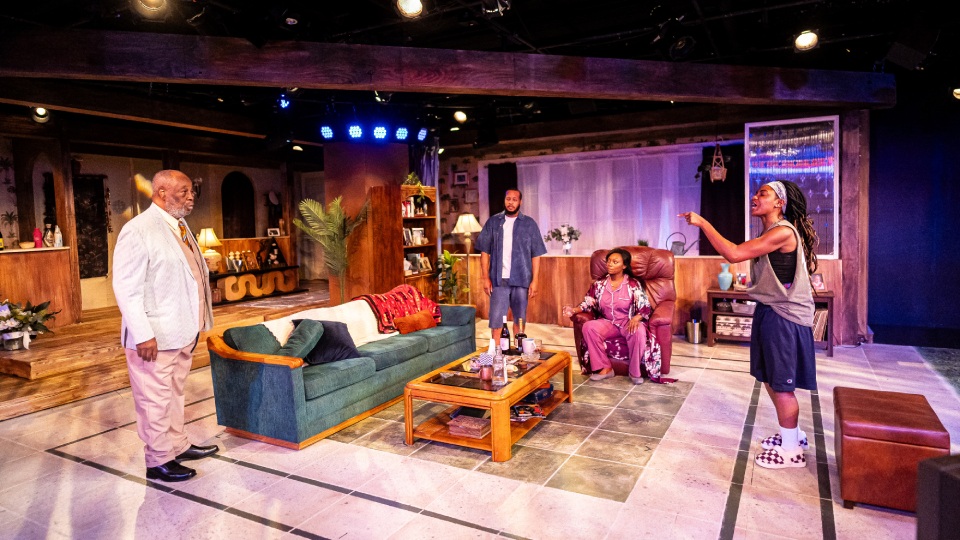
The scenic design is another notable achievement. The stage transforms from a church to a gravesite and eventually into the family’s living room. The final home setting is impressively detailed, providing a convincing domestic space in which the family’s conflicts can continue to unfold. My reservation is the time required to complete the transformation. Although the finished environment is effective, the process of getting there interrupts the production’s momentum.
Ultimately, Hayward is an entertaining and ambitious work that uses humor, supernatural elements, and family conflict to examine the lasting effects of trauma. Walker’s play is interested in the emotional territory families occupy: the memories they avoid, the wounds they pass along, and the love that survives even when they struggle to express it.
Still, the play would benefit from sharpening its central argument about mental health. Tony’s military service and the suggestion of inherited trauma offer fertile ground, but the relationship between psychological injury, family behavior, and Luna’s experiences could be developed with greater clarity. The subject deserves more than implication, particularly when the play so effectively demonstrates how one person’s unresolved pain can shape an entire household.
With its memorable characters, dark humor, and committed performances, Hayward offers a lively and often moving portrait of a family trying to find its way through grief. Like a Floridian-style shiva, the gathering is noisy, irreverent, and emotionally unpredictable. The dead may have been laid to rest, but in this family, the past is very much alive.
RECOMMENDED
When: Through Nov. 15
Where: Steppenwolf’s 1700 Theatre 1700 N. Halsted St. Chicago
Tickets: $45 - $50
Court Theatre’s Erotic Taming of the Shrew brings the simmer to a boil

We often forget that The Taming of the Shrew is, at its core, a play within a play - a bit of theatrical mischief in which characters watch other characters pretend. Marti Lyons’s ambitious new adaptation for Court Theatre not only remembers this but revels in it. She reframes Shakespeare’s battle-of-wills as a private, immersive experience for five elite guests - figures who could easily have wandered off the set of Succession—invited to indulge in a curated world of erotica, fantasy, and power play. This is not like any production of Shrew I have ever seen. And I love it.
Lyons taps into the erotic charge embedded in Shakespeare’s text. For Lyons the struggle between Kate and Petruchio isn’t a patriarchal lesson but a provocation - an invitation to consider what people consent to in the privacy of their desires, even when those desires run counter to their public personas. In fantasy, we try on identities we might never inhabit in daylight. Could Kate, in this telling, actually be exercising her agency by consenting to a submissive role in her intimate life while fiercely maintaining her autonomy in her public life? The question lingers.
The production openly engages with bondage, discipline, dominance, submission and S&M, - not as taboo spectacle but as a consensual system built on trust, communication, and negotiated power. This is especially evident at Petruchio’s house. Instead of treating Kate’s submission as Shakespeare’s dreaded moral, Lyons reframes it as a conversation about desire and embodiment. The cast leans into this with a refreshing clarity: pleasure, not punishment, drives the story. Power is a game, and everyone in the room is choosing to play.
By foregrounding the play-within-the-play structure, Lyons opens a fertile space not only to re-engage with the text but to ask ourselves uncomfortable, thrilling questions about love and control, submission and domination, agency and desire. It is rare for a Shrew to feel so sensual and so intellectually alive.
Much of the production’s force comes from its ensemble. As Katherina, Melisa Soledad Pereyra embodies fire, humor, and hunger—a woman who knows her own body and mind. Her chemistry with Jay Whittaker’s Petruchio is the engine of the evening: two equals circling, sparring, testing limits until the battle between them becomes a dance. Netta Walker’s Bianca is no docile ingénue; she claims her place with confident wit. Samuel Taylor, Nate Santana, and Dexter Zollicoffer bring sharp comedic flavor to Hortensio, Lucentio, and Gremio, while Ryder Dean McDaniel anchors Tranio with duplicitous cunning. The supporting cast - Alex Weisman, Monica West, and others - soften and sharpen the edges of the world as needed.
The design team conjures a world where erotic imagination thrives. Jackie Fox’s scenic design refashions Court Theatre into a sensuous playground of marble black-and-white tiled floors, sculpted statues, expansive botanical murals, and imposing wooden doors. Kotryna Hilko’s costumes heighten the atmosphere with daring textures - leather for Petruchio, jewel-toned gowns for the women, jacquard damask for the aristocrats - each piece balancing revelation and restraint, structure and seduction. Every visual element underscores Lyons’s central argument: desire is a kind of performance, and every performance is a negotiation of power.
This Taming of the Shrew pulses not with brute domination but with the sensual, exacting choreography of consent. Lyons doesn’t blunt the play’s jagged edges; she sharpens them into tools of erotic inquiry. Her staging invites us to feel the heat of what is given freely, the tautness of what is deliberately withheld, and the exhilaration of boundaries tested - then mutually defined.
Court Theatre’s production doesn’t simply reinterpret Shrew; it challenges us to reinterpret ourselves. By grounding the story in erotic power exchange and consciously negotiated dynamics, Lyons’s adaptation pushes us to confront the desires we rarely articulate. What do we relinquish willingly? What pleasure do we find in surrender? And what power do we claim by choosing when—and to whom—we yield? In Lyons’s hands, the theatre becomes a chamber of self-interrogation, where the line between performance and private longing thins, and we’re invited to examine the fantasies that shape us as intimately as any script.
HIGHLY RECOMMENDED
When: through Dec 14TH
Where: Court Theatre, 5535 S. Ellis Ave.
Running Time: 2 hours, 30 minutes 15 minute intermission
Tickets: $60 - $90.00 Student, Group and military discounts available
773-753-4472
Hamlet with Smart Phones and a Good Measure of Verve

The tiny Gift Theatre, occupancy 50, has bitten off a big challenge with its determination to present Hamlet. Featuring Daniel Kyri in the title role of Shakespeare’s classic, director Monty Cole has hewed to the melodious Elizabethan English of the script.
The production has contemporary touches that largely respect the genius of the playwright, while delivering a show that the author would recognize, and which conveys the crucial dramatic conflicts. And, a mark of a serious production, Cole and cast examine anew the mysteries that will ever surround the motives and actions of the characters.
In a nutshell, young prince Hamlet suspects his mother Gertrude and uncle Claudius are complicit in the recent death of his father, King Hamlet. The two have married, and for the rest of the play Hamlet works through his feelings of anger and guilt, goaded by ghostly appearances of his father. Hamlet’s girlfriend Ophelia, her brother Laertes and their dad Polonius are killed in the fallout. Likewise for Claudius and Gertrude.
Producing any play requires envisioning and mastering the drama, psyching out characters and motivation, getting the script down. With Shakespeare, you also must account for the specific challenge of a language in iambic pentameter, and at times florid or obscure.
So Shakespearean acting is its own special skill. The cast has largely nailed the motivation and inculcated it to their roles on stage, delivering moving performances with conviction. But, alas, the language suffers a few slings and arrows along the way – though there are bright spots – including a rap version of one monolog that was very successful.
From the moment she appears, silently regal, completely in touch with the Gertrude, Shanesia Davis shows how it’s done. Her every line is immediately clear, even when we are uncertain of an archaic word or phrase – we totally understand her. Davis acting background makes it clear why – she has a lot of experience with Shakespearean roles.
Daniel Kyri has captured young Hamlet, and we ride with him through his internal turmoil. But Kyri is still working through what is one of theatre’s most demanding roles. Of those seven famous Hamlet soliloquies, I felt he did best with the fifth (“Tis now the very witching time of night, When churchyards yawn, and hell itself breathes out”) and the sixth (“Now might I do it pat now he is praying, And now I'll do it, and so he goes to heaven.”)
Netta Walker’s performance as Ophelia was balanced and well done. Martel Manning as actor Guildenstern and the very funny Grave Digger, had a magnetic presence on stage. Gregory Fenner as Laertes has all the passion and constrined fury required. Alexander Lane carries a military strength and sinister swagger in his three roles as Fortinbras, Valteman and Marcellus.
Not everything works, though most things do. Cole, who spent a year in the development of the show, keeps the play in its historic setting, but the production is unconstrained by period dress. Several younger characters have smart phones, and somehow, these make sense. They are used as flashlights in some scenes, and Ophelia sings along with her earbuds in. Smart phones are now a normal human appendage, like eyeglasses, and are almost invisible in their roles in the show.
The set was nice – a classic paneled plaster hallway illuminated by sconces with decaying carpeting on the floor, the edges lined by weeds and smashed beer cans. William Boles did scenic design, but I do quibble with whoever made the decision to encase the stage in a box of acrylic sheets, so the actors play behind a “glass.” This muted the sound and an effort to mic the space was unsuccessful.





Latest Articles
-
 THEATER UNSPEAKABLE ANNOUNCES MIME OR NOTHING, FEBRUARY 5 - 28, 2027
Written by Buzz Center StageTheater Unspeakable is proud to announce the cast and creative team for the Midwest Premiere of Mime or Nothing, February 5 - 28, 2027 at Theater Wit, 1229 W. Belmont Ave. Mime or Nothing is written by and starring Marc…
-
 'Oh, Buddy' a Lighthearted Absurdist Look at Transgender Issues in the Workplace
Written by Bill EslerLeave it to Trap Door Theatre to find an absurdist play, their milieu, that’s a funny, fresh take on office culture and a trans sex change surgery of a key employee, New Guy (Jack Bowes is excellent). Hal Cosentino’s Oh,…
-
Filament Theatre announces 2026/27 Season With returning interactive family favorites: Fort-building fun with FORTS and performance installation for babies RAIN
Written by Buzz Center StageFilament Theatre (4041 N. Milwaukee Avenue in Portage Park), the Northwest Side’s premier theater for young audiences, is delighted to announce the upcoming programs and plays in its 2026/27 Season. The popular immersive fort-building play experience for families, FORTS, returns…
-
VAPE! THE GREASE PARODY CELEBRATES HOMECOMING WITH SPECIAL THEMED PERFORMANCES THIS WEEKEND
Written by Buzz Center StageCHICAGO, Homecoming just got a whole lot greasier. With friends, family and college classmates making their way back to Chicago ahead of Thanksgiving. Vape! The Grease Parody is kicking off a special Homecoming Weekend from November 20–22 at the Apollo…
Does your theatre company want to connect with Buzz Center Stage or would you like to reach out and say "hello"? Message us through facebook or shoot us an email at This email address is being protected from spambots. You need JavaScript enabled to view it..
*This disclaimer informs readers that the views, thoughts, and opinions expressed in the text belong solely to the author, and not necessarily to Buzz Center Stage. Buzz Center Stage is a non-profit, volunteer-based platform that enables, and encourages, staff members to post their own honest thoughts on a particular production.