

Bill Esler
'Oh, Buddy' a Lighthearted Absurdist Look at Transgender Issues in the Workplace
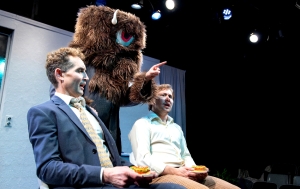
Leave it to Trap Door Theatre to find an absurdist play, their milieu, that’s a funny, fresh take on office culture and a trans sex change surgery of a key employee, New Guy (Jack Bowes is excellent). Hal Cosentino’s Oh, Buddy, in its world premier, is loaded with laughs, amid the serious business at its heart. And it delves into a secondary concern for a woman on the rise, Lady. Mackenzie Jones as Lady is a comic actor of the first order. You can see Tina Fey when you look at her Lady, who has had surgery on her own privates.
The draw for me was director Jeremy Ohringer, whose previous productions of Eelpout at Theater Wit and A Devil Comes to Town at Trap Door have made me a big fan. Oh, Buddy shows his deft hand once again. Cosentino’s script is parceled out in quick scenes centered on the office, with elevator and a men’s room communal urinal (discreetly shown from the back) as two centers of action. The uniformly great performances and comedic timing show Ohringer at work.
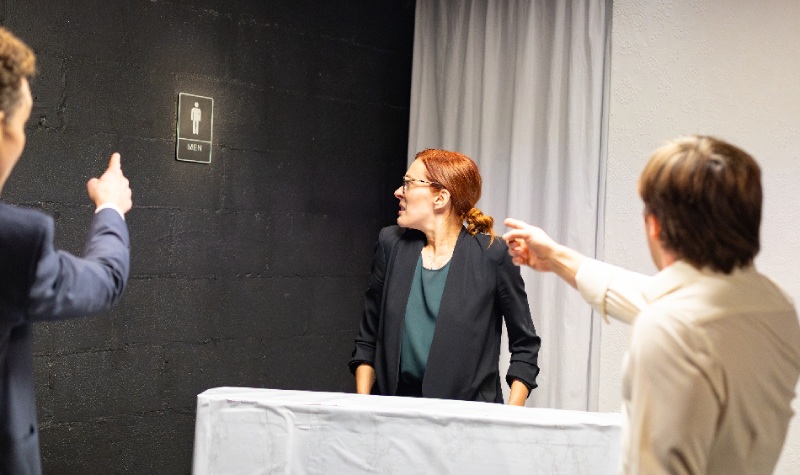
No ladies allowed! Dustin Valenta (left) and Jack Bowes point out the obvious to Mackenzie Jones in Oh, Buddy at Trap Door Theatre.
The central conceit is the discretion traditionally accorded surgery on one’s privates, especially at work, where rights to privacy regarding medical issues is buttressed by legal protections administered by the human resources department. The core of the action is New Guy’s “situation,” which is not described but inferred, but it clearly involves something related to a sex transition.
We know this because of conversations between the boss, Buddy (Shail Modi is over the top good) and Dude (Dustin Valenta is perfect in the role) regarding correct polity and proper demeanor of talking about New Guy’s procedure as he returns to the office from medical leave.
Buddy is a quintessential bro, and he speaks “bro” parlance deftly. He also happens to be the boss. Incidentally, Buddy is dressed as a large furry bull-like character in a suit, which is remarkably right on, and perfectly apt as a manifestation of male-dominated workplace power. Important and lengthy conversations take place between Buddy and Dude at the urinal, which is funny in its own right, but also remarkably true.
Dude is the go-between, a guy who gets along with everyone. He can talk bro talk with Buddy, while he’s also sufficiently emotionally sensitive to meet New Guy and Lady where they are at. All this is setting for the action of the play: a promotion will be conferred Friday on a yet-to-be-named individual, and New Guy and Lady are ambitious and in the running.
So how does a patriarchal office power structure deal with a choice between a woman and a trans person? That’s the fun of Cosentino’s work, which is one of over 70,000 scripts at the New Play Exchange, where dramaturgs, literary managers, producers, and directorslike Ohringer hunt for material. New Guy has advantages, as he can behave more guy-like and bond about sports, though half-heartedly. Lady is all business, her strong suit, though New Guy is competitive on that front, too. As New Guy keeps up this professional face at work, he also confides in his friend, a gender fluid character, Emery (Haven Crawley), who remains placidly above the fray. The performance of Crawley as Emery is flawless, on a par with the other players.
Eventually upper management arrives and the action is resolved, with lots of absurdity in how things work out. Oh, Buddy is highly recommended in part because it can be enjoyed on so many levels. Oh, Buddy runs through December 19, 2026 at Trap Door Theatre on Cortland Avenue in Chicago.
The Latest 'Dante 360' Leads to Paradise, Particularly for Dante-philes
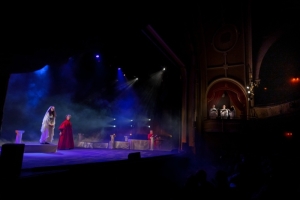
Dante 360 Virgil Edition is the latest iteration of a performance work first launched in 2021. Directed by Peggy Garvey, the recurring presentations are billed as an education program, aimed to illuminate 14th century Italian poet Dante Alighieri’s three-part Divine Comedy, which traces an imagined journey through hell (The Inferno); purgatory (the Purgatorio) and heaven (the Paradiso). Written by Elizabeth Lev, an art historian (and scholarly guide during the show) each version focuses on a perspective of a different historical character who figures in Dante’s poem.
The production includes famous artwork inspired by the Divine Comedy, Botticelli through William Blake, dance, Dante’s poetry, and recordings of both ancient and classic musical, as well original works scored by Michael Alan Anderson. Singers of the Schola Antiqua Ensemble perform live, quite hauntingly.
The show opens with Lev at a lectern, a vibrant and animated speaker who stirs excitement and anticipation for the show to follow. Lev has a PhD in art history from the University of Bologna, and she resides in Italy with her family. With a TED Talk online with 1.6 million views, Lev is both credible and inspiring, and reappears at welcome intervals delivering context for the slices of Dante’s poem that we will see visualized on stage. She tells a powerful personal story of being moved to baptize her children, inspired by Dante’s descriptions of unbaptized souls trapped in purgatory, including the great Roman poet Virgil (played by Mike Rogalski), Dante’s escort in the poem and on stage. Lev also lets us know Dante’s writing was the first great work written in vernacular Italian. At times, Lev tells us, when existing words were inadequate to his vision of the afterlife, he created new ones.
When Lev finishes, an Elder Dante (Curtis Powell) launches into lines from the opening of the Divine Comedy. Seated at a wooden writing desk, Elder Dante speaks first in Italian, then English in the translation by John Ciardi. This is what we came for. On stage a younger Dante (Alex Schultz) enacts scenes, usually wordlessly, and the host of actors join him at various points. Tall banners serve as screens for patterns and representations of the artworks, beautifully set in motion. (Nicholas Taboni is Projection Designer and Media Designer; Mike Goebel is Technical Director and Lighting Designer.)
A host of actors bring to life the characters from Dante’s poetry selected for this view of his masterwork. Beatrice (Rae Lindenberg), the unrequited love of his life who died, speaks at various moments, and serves periodically as Dante’s coach and inspiration, and his guide into paradise, where the poet imagines her soul lives on.
One memorable scene in hell finds lovers Francesca (Katie Wasserman) and Paolo Maletesta (Hayden Lane-Davies), killed during an adulterous affair, condemned in Dante’s mind to toss in winds to and fro, seeing each other in passing but never able to embrace. He is able to stop them for a moment to question them before they return to their perpetual suffering. They stop just for a moment, separately, to converse with Dante, then are picked up again by the continuous winds to which they are condemned for eternity.
All this sounds pretty good, but as an audience member, past these memorable moments at the outset, it grinds on and becomes tedious. There are high points borne of the imaginative Dante, such as Thomas Aquinas (James Turano is excellent) singing the praises of Francis of Assisi. But Rogalaski’s recitation of Dante’s verse didn’t seem lyrical, making it less compelling, for me, anyway.
What we get is an expression of the conviction and passion that Lev has for Dante’s Divine Comedy. That comes across. I wish I had heard more of her throughout the two hour and thirty minutes (one intermission). Somewhat recommended, Dante 360 Virgil Edition runs through November 15, 2026 at the Athenaeum Center in Chicago.
An Incredibly Good Snapshot of Our Social Discourse in 'Heroes of the Fourth Turning'
Settling in for A Red Orchid Theatre’s Heroes of the Fourth Turning, I knew next to nothing, having no familiarity with the playwright Will Arbery. Partly by design, I avoid preconceived notions and try to listen to the play itself, and watch the performers as I review. Even with so-called “canon” plays like Chekov or Miller.
With Heroes of the Fourth Turning, I soon learned why this script was a 2020 Pulitzer finalist, and won accolades on Broadway (an Obie award among others). It’s the writing. (Shout out to dramaturg Michele Uy; you can get a taste of Arbery’s style on Netflix in his 2025 film, Sacrifice, a satire with Anya Taylor-Joy, Chris Evans and John Malkovich.)
The production at A Red Orchid is smashingly good—tightly directed by the estimable dado with a first rate cast that has mastered this challenging, wonderfully wordy work. (The title refers to a fourth stage of an 80-year cycle in which American history resets itself, tears down the old order and forces a rebirth.)
Unaware of any of this, just listening to its two-plus hours of non-stop dialog set on a back porch near the campus of the small liberal arts college, I can say Abery’s script is remarkable, capturing the tenor of our social discourse in the period culminating in the first term of Donald Trump’s presidency. Arbery has delivered a public service that historians will treasure for centuries. For he has captured with precision the tenor of the conversations, debates, the arguments we currently undertake, rendering faithfully the language, the reasoning, the syntax, the syllogisms, and replete with logical fallacies that permeate so much of what we dispute.
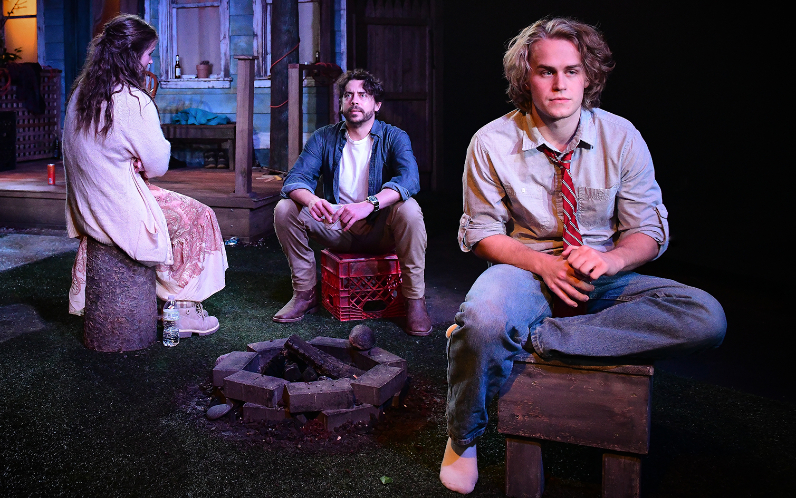
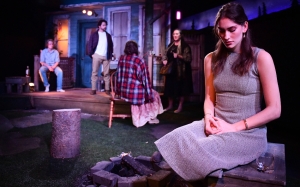
Magdalena Dalzell, Nate Santana and Beck Nolan (right). Photo by Evan Hanover.
Heroes of the Fourth Turning takes place on the back porch and garden of a white clapboard house where four graduates of the small Catholic liberal arts Transfiguration College in Wyoming have gathered. All are a few years into their work and life, and a bit inebriated from a party inside, perhaps in anticipation of an imminent solar eclipse. But for these four, the more significant occasion is to celebrate the appointment of their beloved educator and mentor Gina (Kirsten Fitzgerald) to head the school. But Gina doesn’t appear for hours into the play. So the four have plenty of time to talk amongst themselves. Talk they do, as we listen in.
We learn their paths of life have begun to form, though not solidified. To a greater extent their belief systems, and their approach to life, are firming up. The powerful performers in this show are admirably harnessed by director dado, whose excellent work was seen in A Red Orchid’s Six Men Dressed As Stalin.
We first meet Justin (Nate Santana captures the role impeccably), who was an older student and is more mature. We’re at his house in Wyoming. In the opening scene he grabs a rifle and shoots a deer far off in the distance. Back at the porch, he attempts to slaughter his wounded quarry, but his hand trembles as he holds the knife. “I guess I had too much time alone,” Justin tells himself.
In scenes following the rest of this excellent cast arrives: Emily (Magdalena Dalzell) escapes from the party inside to the porch. Emily is gentle, a woman of sorrow and perpetual suffering, both from the duress of counselling pregnant clients considering abortions, and emotionally from the mean-spirited war of words that puts her friends at each other's throats.
Soon we meet Kevin (Beck Nolan) with long blonde locks and a load of longing for love, who works at a Catholic publishing firm in Oklahoma. Eventually Teresa (Isa Grofsorean perfectly carries the role) appears, also escaping the now waning festivities. Teresa is clearly different: coiffed and manicured, and wearing a designer frock with off the bias hem, while the rest are grunge and denim (costumes by Madeleine Shows). Theresa’s polished presentation foreshadows what we’ll learn about her worldview.
The playwright arranges pairings of characters, and we see the disconsolate, love-starved and quite drunk Kevin beseeching her for attention. This is where Theresa, who is engaged, lets him have it. “It’s nice to see you feel responsible to perform your self loathing,” she tells Kevin, branding him weak and not in her league. “Talk to me about adult things,” and “I want to have a normal conversation like adults.” Kevin tells her, “It’s so messed up, it will lead to a four hour conversation,” then drunkenly to Theresa, “I love your brain.”
When Kevin is alone with Emily, he wears his neediness on his arm, but Emily is kinder in her rejection of this puppy at her feet.
All this establishes the characters rather quickly before the serious discussions begin. Anyone who has witnessed a convo among millennials will recognize the endless “chewing of the cud” such conversations entail. Like the mesmerizing drone of “Sienfeld,” (the show about nothing) one surrenders to a miasma of discursion when folks are fired up to converse.
But this conversation is on a topic all will find of interest, as it touches on the survival of the Republic, or of Western Civilization, depending on where you’re coming from.
By anchoring these four young adults in a Catholic college, playwright Arbery narrows the range of conversation to the spectrum of conservatism. So when they talk about topics central to the MAGA crowd, such as abortion or gender, viewpoints range from hardened doctrinaire Theresa, a fan of Steve Bannon, who recommends hanging for the reluctant mothers; through Justin, who seems more stoical than vindictive; to Emily who empathizes with suffering; to Kevin, who can hear what is compelling for pro-choice advocates. These subjects drive Theresa into a rage.
“The lepers need to be healed, not championed for their leprosy,” she says, skewering liberal identity politics. “Otherwise, what are we? A throbbing mass of genderless narcissists. There’s no ‘thisness’ in the liberal future.” Theresa sees the proper political position as bound up with her vision of Christian nationalism that will preserve Western civilization. “What’s really radical is sacrifice. Painful particularity is what we need. Otherwise we’re culturally lobotomized. We’ll be force-fed brand new oppressed identities every year and we’ll bow to the tyranny of rights.”
By excluding voices from the liberal side of the spectrum, Arbery gives us a chance to hear the conservative arguments without the dissonant clash of culture. These characters debate the Virgin Mary’s role in their spiritual life, speak freely of attending weekday mass, and live uninhibitedly Catholic lives. They are all on the same page, but interpret the text differently. Emily, for instance, while against abortion, professes to love the benighted pro-choicers regardless.
Each character has one or more lengthy monologues and these are delivered with a skillfulness one associates with those sometimes unhinged flights in Steppenwolf shows. Early on, Justin shares with the group a children’s story he has composed, a rather lengthy “The Grateful Acre.” Both beautiful and alarming, its repetitive refrain is hypnotic, especially in its delivery in Nate Santana’s rich baritone. I searched around for the origin of this basically environmental saga of stoic indomitability of the natural world, and found that Arbery crafted it just for this play.
When Gina finally does arrive, she sizes up her students as they test her mettle. It’s a combustible scene, and draws the play to a satisfying close. Highly recommended, Heroes of the Fourth Turning runs through December 6, 2026 at A Red Orchid Theatre on Wells St. in Chicago.
Remarkable Production Makes 'The Royale" a Knockout Show
Writers Theatre scores a knockout production with Marco Ramirez’s 2013 play, The Royale. Under the direction of Tyrone Phillips, we see this widely-produced script (it played New York’s Lincoln Center a decade ago) executed to perfection. Centered on boxing legend Jack Johnson, it follows a fictionalized version of his story. In 1910 Johnson became the first Black world heavyweight champion by besting James Jeffries, the reigning heavyweight, who was white.
The show opens with a mesmerizing percussive scene. For this production, the Writers Theatre stage is floored with rough hewn boards to make a boxing arena, the building’s back wall exposed with faded painted bricks. A punching bag hangs at the back of the set and as lights come up, a lone boxer is pummeling it. (Lauren Nichols is Scenic Designer.)
Soon another boxer enters the stage and the two begin a wordless, precisely choreographed percussive dance centered on the bag, their footfalls resounding loudly, reaching a crescendo at the culmination, a scene that draws applause for its sheer inspired beauty. (Rasell Holt is Movement Director.) The audience knows it is in for something big in The Royale.
Ramirez, a well-established Netflix writer (Orange is the New Black, Daredevil) keeps the tale rooted in the true story. Our fictional heavyweight star Jay is played superbly by Broadway star La’Tevin Alexander. And man, he is good!
When Alexander takes the stage, his sculpted body is arresting and he is handsome in a Michael B. Jordan way. But as he begins to deliver his lines, he soon has us in his thrall, a larger than life force, like Muhammed Ali, supreme in his confidence and aiming at the top. Yet Jay is also warm and magnetic. We can’t help getting behind him.
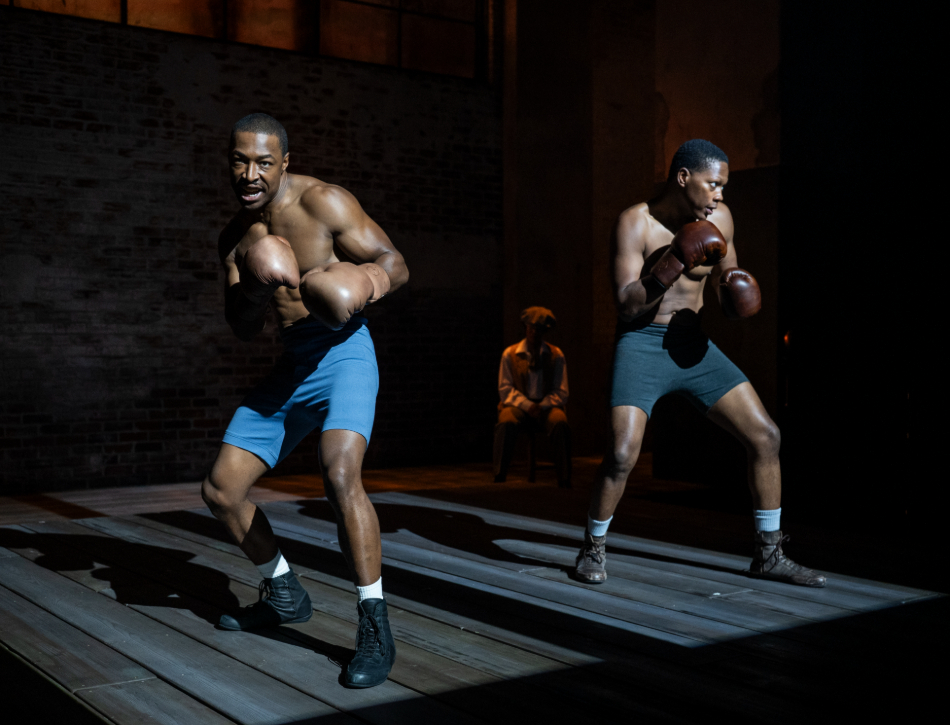
La’Tevin Alexander as Jay (left) and Ajax Dontavius as Fish, in a bout as trainer Wynton (James Vincent Meredith) looks on. Photo by Michael Brosilow.
Entering a spar with a visibly frightened first-time boxer Fish (Ajax Dontavius), Jay works the audience. “How many rounds you want me to give you?” he asks us, all calm and confident. The presentation of the match is inventive: the two stand at angles and shoulder to shoulder, then punch or receive hits toward the seated crowd, stomping their feet to sound the impacts. Particularly inspired is the lighting, which heightens the drama and delineates regions of the stage, such as the boxing ring, rectangles of light narrowing as bouts draw to a close. (Jason Lynch is Lighting Designer.)
After Round 4, Jay prances, feigning boredom perhaps. “How you all doing?” he asks us spectators, adding lightheartedly, “I heard tell there was a fight here tonight.” After he vanquishes Fish, who survives and even lands some blows that surprised his adversary, Jay hires him as his sparring partner.
After the knockout, Jay dons a suit and reveals his ambition to his promoter Max (Scott Aielio): to take on the retired white championship boxer, Bigsby. (In real life, Jack Johnson coaxed James Jeffries out of retirement to take him on.) When Black people box each other, Jay says, their boxing stories only make the inside pages of the newspapers. But if he battles a white champion, Jay will make the front page, where even non-readers will register his fame.
“Bixby’s never fought a Negro. No one ever has,” Jay says of his white counterparts.
“The paper says Bixby would disgrace his legacy by stepping into the ring with you,” Max tells him. Such was the tenor of the times of Jim Crow. Nevertheless Jay drives his reluctant manager to negotiate a fight for him with Bixby, and Max scores an offer, albeit one-sided. Bixby wants 90 percent of the ticket sales.
Another character inhabits many scenes, Jay’s trainer Wynton (James Vincent Meredith). Limping and dispensing advice judiciously, Wynton triggers the description of a racist entertainment called “battle royales” (from which the play takes its name) in which a crowded ring of blindfold Black boxers battled until only one was left standing.
Wynton also bears witness to Jay’s braggadocio, and toward the end, the aftermath of the boxer’s encounter with his sister Nina (AnJi White). She shows up like a deus ex machina to add gravity to Jay’s quest, just hours before the match. Jay is already struggling with nerves, having learned of multiple armed threats against his life, knowledge Wynton did not share with him.
As Nina and Jay explore their shared past, Nina serves to reveal Jay’s deeper motives in his quest: to right wrongs where young Black women didn’t see themselves reflected in ideals of beauty, even maiming themselves with dangerous hair straightening chemical and hot iron treatments.
Nina warns Jay of a potential consequence if he bests Bixby: Black people will be punished by whites angered in reaction to his success, should he win. In the dramatic structure, this added pressure suddenly summoned into the script so close to the end seems unnaturally crammed in, almost melodramatic in its effect. In my mind it detracted from the seriousness of the concern itself.
In fact Nina was proven right. In real life, race riots were ignited by Jack Johnson’s victory over Jeffries, documented in a huge newspaper front page unfurled at the final moment of the show.
Two scenes I relished: Fish has given away his seat, and plans to listen to the fight on a radio in a bar, which will lead to another tragic event. Dontavius gives us Fish’s ecstatic joy over the imminent fight, which he showers obliviously on a deeply distressed Jay. The other scene is Scott Aielio’s soliloquy as Max on his dedication to Jay’s career, and the challenges it has presented for him as a white man steering Jay protectively as the boxer all the while flaunts the evil restrictions of Jim Crow. Max argues compellingly not to win gratitude, but to convince Jay that he has been and is truly dedicated to him.
The Royale is highly recommended as a theatrical experience, and a worthy revelation of history less present today. It runs through November 29, 2026 at Writers Theatre in Glencoe, IL.
'Sanctuary Stories' Ventures Into Emotional Drama Behind the News on Immigration

Sanctuary Stories plumbs the line between theater and journalism, and the powerful human dramas both can depict. Funded by a Northwestern Medill School of Journalism grant to create a verbatim-based theatrical documentary, it is produced, directed and narrated by Craig Duff, a professor there. Duff’s background as a video journalist includes CNN, The New York Times, and Time magazine. Sanctuary Stories premiered for a limited run at Northwestern’s McCormick Foundation Center in November 2025, reappeared for a limited run at Windy City Playhouse in Chicago in January 2026, was presented at John F. Kennedy High School in April, during the Printer’s Row Lit Fest in June, and now has a return run at The Athenaeum Center for Thought and Culture through October 18.
Conventional journalism has its limits, as intensely emotional events are reduced to a factual presentation. In the stories surrounding current immigration crackdowns in Chicago, there is a risk that individuals will have no voice. And that the constraints of style, word counts and approach can leave out the story-behind-the-story, the real lives of the immigrants and their supporters.
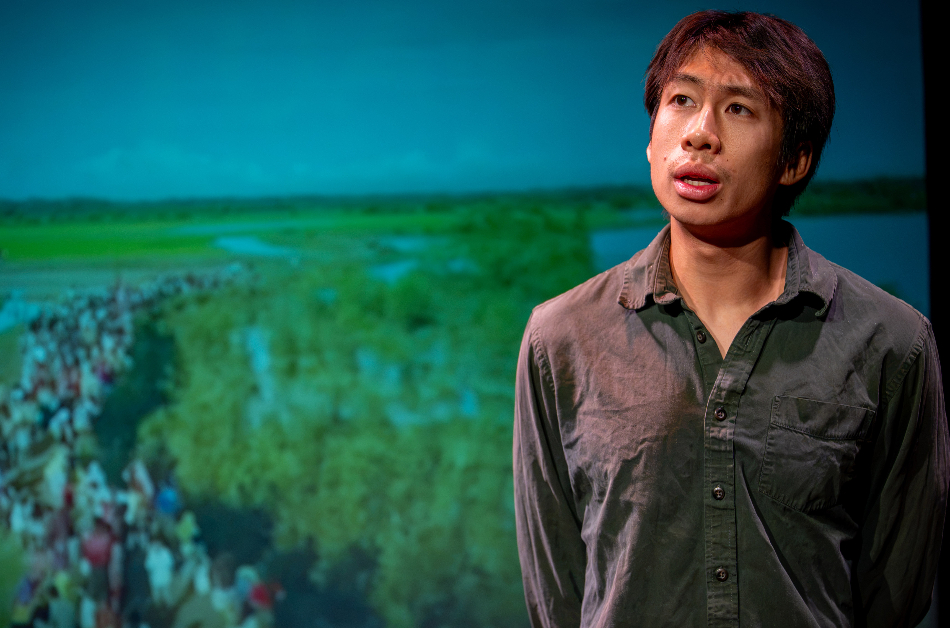
Caonguyen Vu plays Rohingya immigrant, The Citizen. Photo ©Amy Boyle Photography
How are journalists affected by hearing these stories and witnessing the news they cover?
“It’s a question we grapple with at Medill and in our careers,” Duff told Buzz Center Stage. “I think it’s similar to the last line of the Pastor Beth Brown piece (she is played by Amber Dow), where she says, ‘And part of the stress is you become a holder of the stories. You know, you are a container for the stories in some ways. And I'm fortunate in that I've been a pastor for long enough that I've developed some tools for how to be that container."
Sanctuary Stories tries to break the boundaries of standard journalism, going beyond the words to include a wealth of graphics, framing videos, and live musical interludes. It is also drawn from verbatim stories as told to Borderless Magazine writer Stephen Franklin, who conducted some 70 interviews for the effort. These were distilled into a set of verbatim monologues for individual characters, including three immigrants—The Businesswoman (Gabriela Barrios), The Dreamer (Lori Navarrate), and Rohingya immigrant The Citizen (Caonguyen Vu)—composite characters.
Other real-life characters include Rev. Dr. Beth Brown, lead pastor at the Lincoln Park Presbyterian Church (Dow), Father Brendan Curran (George Dougherty), 91-year-old Sister JoAnn Persch (Jean Marie Koon), and Evanston Mayor Daniel Biss (Matt Specht). Specht also plays a composite immigration judge who resigns in the throes of Trump administration changes to the roles of judges, and Federal actions at the Broadview, IL ICE holding facility.
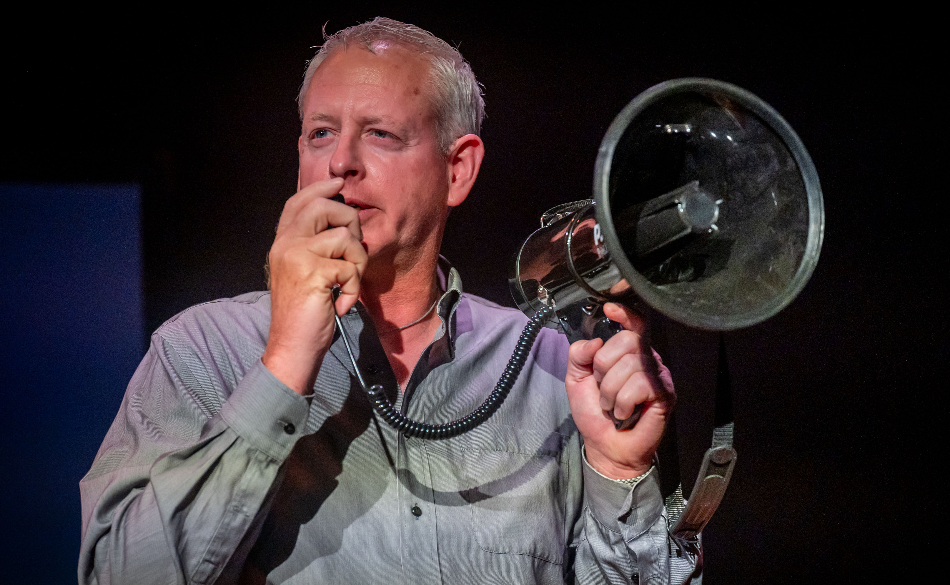
George Doughtery performs a monologue made from a verbatim interview with Father Brendan Curran, a Dominican friar and Catholic priest. Photo ©Amy Boyle Photography
“My reporting partner Steve Franklin has covered a lot of traumatic events as a foreign correspondent,” Duff says. “And I’ve seen my fair share in places like Iraq and Lebanon.” Franklin and Duff did a series together for MSNBC about gun violence in Chicago.
“We have developed similar tools to Pastor Beth's. You have to have empathy as a reporter, but you also need to compartmentalize the emotion and trauma that you witness. Often, under deadline pressure, you don’t live with the material very long because you move on to the next story the next day. On a longer form piece like a documentary, you are spending months with the material, and you sit with it more. For Sanctuary Stories, I am feeling it more deeply because we’re working with the words and rehearsing and then watching the stories unfold each night. And allowing myself to be an artist as well as a journalist allows me to bring more of my full self to the storytelling, and be more affected by it.”
Chicago has a hallowed history of welcoming immigrants. The city began codifying legal sanctuary protection in 1985, as Reagan-era Federal crackdowns increased on undocumented immigrants seeking asylum after feeling violence in Central America.
Duff says Sanctuary Stories is his way of experimenting with new ways of presenting journalism. The project was inspired by a number of things.
“First and foremost, it was a desire to connect in person and not via screens/TV/phones,” Duff says. He plays The Narrator in the show, a continuous presence through the performance, and singing and playing in the opening song.
“A few years back I re-emerged as a performing artist after 35 years away from theater,” Duff says. “My first role was as the Duke in a raucous production of Measure for Measure, and the audience was on fire—roaring with laughter and then gasping at the cruelest moments—and I knew then that I wanted to bring my visual journalism work into that kind of room. There is great power in hearing these stories presented live and in person. It’s not that the stories weren’t getting out. Father Brendan appears on TV regularly, and Sisters JoAnn and Pat were once interviewed on Samantha Bee’s TBS show. But combining the actor’s performance with real footage of events (I tried to show the real people with my camera when we could name and reveal them) and letting the actors present the ‘truth’ of the emotion, allows for a more connected — and affecting — experience.‘’
The script for Sanctuary Stories is dynamic, changing with each set of performances. Though the eight verbatim stories remain the same, different casts of actors have performed them. “I rewrite the narration so that it remains current,” Duff says. “I was rewriting up until our preview last Thursday." A new bit was added to the middle of the script for this run— interviews Duff did with photojournalists who’ve been covering the immigration beat. This placeholder section of the script was designed to be updated, with different journalists performing live interviews in that space.
As a reviewer, the show was certainly compelling, though I came to it with expectations of the more familiar dramatic arc. The actors were uniformly good, while the journalistic-styled script let the facts stand in for ordinary drama. The multi-media aspects of the show (Peter Wahlbäck is sound designer; Riley Bulson is stage manager) includes original songs by Flo Estes—“They Don’t Even Know it” written especially for the show—the whole really bringing home experiences such as the melee around the Broadview, IL ICE facility a vivid, emotional encounter, nothing like we see in the news. The story of the Rohingya immigrant, The Citizen, delivered in a restrained monologue by Caonguyen Vu, was incredibly striking. We are reminded of this displaced people—unwanted by the Myanmar and driven from their homes, taken advantage of by immigrant traffickers and sold into and endless loop of immigration.
Since Northwestern also has a rather notable Theatre Department, it would be interesting to see them incorporated in future development of this journalism foray on stage. Recomended and running through October 18, 2026, get tickets here to Sanctuary Stories at Chicago's Athenaeum Center.
'I’m Going to Marry You Tobey Maguire,' Full of Laughs, Ends With a Fizzle
Here’s a play that should be really good, based on its reputation alone. Written by Chicago comedy writer Samantha Hurley, I’m Going to Marry You Tobey Maguire premiered off Broadway at The Cell Theater in 2023. Now Refracted Theatre Company has mounted it at The Den Theatre in Chicago, bringing its original off Broadway director Tyler Struble on board. Under Struble’s experienced hands, we get a vital, lively production of a retro piece, circa 2005.
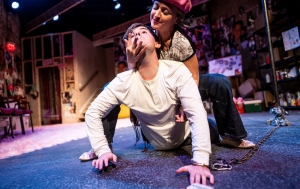
As the title suggests, the play centers on Spider-Man actor Tobey Maguire (Jasper Johnson is just right for the role) who has become the fixation of a precocious and deranged eight-grade girl, Shelby Hinckley (an over-the-top good performance by Alex O’Shea). Hinckley, who leads her local chapter of the Tobey Maguire fan club, plots to capture Maguire, and successfully entraps him in her family basement. There she plans to marry him.
When we meet Shelby Hinckley, she is playing with dolls in an adjacent room, enacting scenes from the romance she imagines with Toby Maquire, who is just coming back to consciousness following a car crash engineered by Hinckley. The crazy premise included stuffing him into an oversized duffle bag. With the help of a friend she has maneuvered him into her basement, then chained him to a pipe. The room is a shrine to Maguire, plastered with posters and magazine images of him.
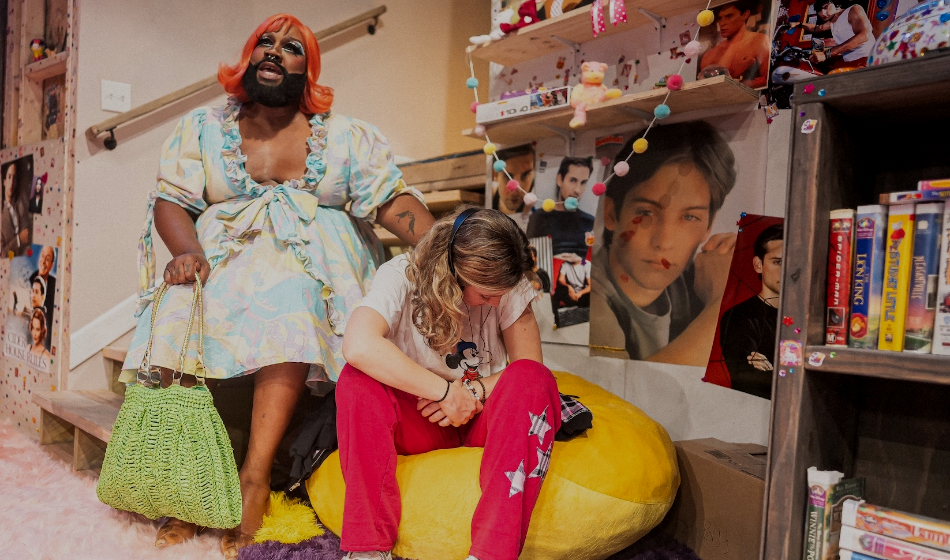
Lucey Stoole aka Ty Huey (left) and Alex O'shea
As he revives, Maguire imagines this must be some elaborate practical joke his agent has engineered, and begins shouting to him and bargaining for release. But no, Shelby arrives and explains his predicament is her doing. Unseen, Shelby’s Mom (Lucey Stoole aka Ty Huey) shouts barks down the stairs for Shelby to turn down the television, and never comes down to investigate, despite Maguire’s calls for help. Stool - Huey plays multiple roles in an imaginative performance as variously a real estate agent, paparazzi, and Maguire’s alter-ego embodied in a poster of him.
What Shelby hadn’t anticipated is that Maguire, the actual human being, is a cigarette smoker, a drunk and an addict, which is true from real life as well by Maguire's own admissions. Unwilling as he is to marry this 14-year-old girl (she figured he’d succumb to Stockholm Syndrome and fall for her), he resorts to sniffing spray paint fumes as his only available outlet for a high. Maguire is characterized as competing for roles with Jake Gyllenhaal (in real life it was Leonardo DiCaprio that was his competitive frenemy).
The play runs 105 minutes with no intermission, and we witness scenes of psychosis from Shelby and Maguire. The television screen, central to much of the action, transmogrifies artfully at one point and we see Maguire issue forth from it (ala the film Videodrome), a scene carried off well.
But the plot ultimately runs out of steam (Steven King’s like-minded Misery gets a shout-out by Shelby) though the play runs on without it. The charm wore off for me, though all three performers make the best of it and the show elicits plenty of laughs. All in all, it comes somewhat recommended. Refracted Theatre's I’m Going to Marry You Toby Maguire runs through Oct. 31 at The Den Theatre in Chicago.
Funny ‘Prayer Circle’ Is Loaded With Laughs
Erik Gernand is resident playwright at Redtwist Theatre, and his Prayer Circle is absolutely laugh-out-loud funny. The strength of this script is the characters—who are clearly defined and familiar types—and the performances, directed by Dusty Brown, are uniformly outstanding.
Set in the cramped loft of a church (with stained glass and roof vaults dominating a well-detailed set by Jeff Bain), we will meet the five members of the Prayer Circle (they call themselves “prayer warriors” for reasons that later become apparent) as they gather one by one for their spiritual endeavor. Doug (Kevin Waters) is already there when the lights come up, at the piano, singing carefully, spiritually (a snippet of the hymn "Blessed Assurance" I believe) with a beauty and intensity that suggests the conviction of the group we are to meet.
Waters’ singing is so good, conveying that his character Doug is intensely immersed in this vocal invocation. So much so he is caught off guard by the arrival of the irreverent Addy (Andi Muriel), who also happens to be his high school student in daily life.
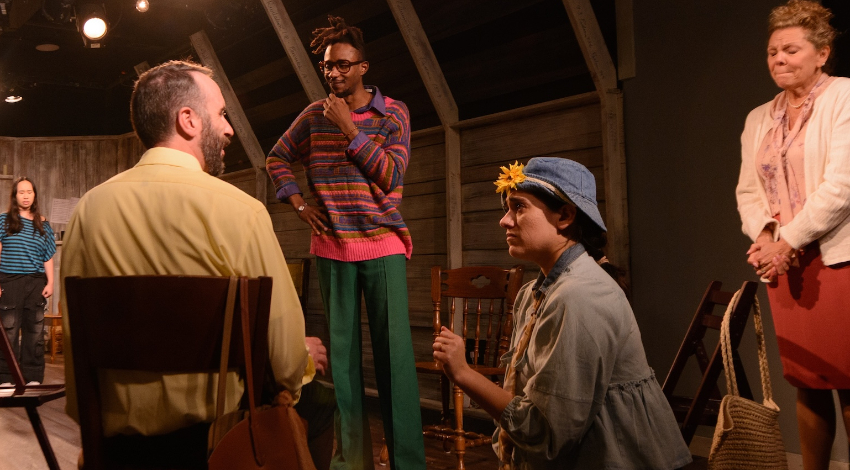
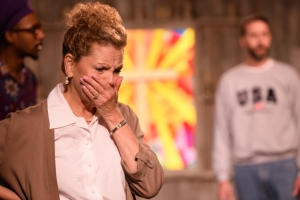
From left: Andi Muriel, Phillip C. Matthews, Kevin Waters, Macaria Chaparro Martinez, and Jaqueline Grandt in Redtwist Theare's Prayer Circle.
Muriel is a very good comedic actor, and her Addy dispels the possibility of too much seriousness as she conveys the quick-witted slapdash humor that can spring forth when young people have discovered the absurdity of the adults governing them. We also meet Carol (Macaria Chaparro Martinez), a 30-something enveloped in a cloud of earnestness: “You can call me Bible lady just don’t call me late for prayer circle.”
Soon enough Marilyn (Jaqueline Grandt) lands, that familiar church matron who is far more powerful than she should be, perfectly coiffed and clad with a designer bag. There is still one seat vacant, a result of the tragic death by cancer of a young mother DeeDee, who we learn was the wife of Pastor Evans (Phillip C. Matthews).
Marilyn is all in a dither, because the president declared a war last night in a televised speech. Marilyn tells the circle that she has summoned Pastor Evens to address the matter with the prayer circle, calling him from his bereavement leave, and the care of his motherless children. What could possess her to do such a thing?
We soon discover this prayer circle wields unusual powers with its prayers and hopes to enlist the involvement of the pastor in its spiritual work. Gernand’s script stumbles a bit in its structure, with a tad more procrastination in the plot reveals than a screwball comedy like this warrants.
We also don’t see the moral analysis that the playwright seems to want to make the characters face. The playwright seems uncertain about how seriously we are to consider morality when he brushes against serious concerns encountered by these faithful.
Nevertheless, the tremendous comic performances, especially by Jaqueline Grandt and Andi Muriel, make this a show worth seeing. Prayer Circle, running through November 8, 2026 at Chicago's Redtwist Theatre, comes recommended.
Gwydion Theatre Delivers More than a Satire in Lynn Nottage’s Por’ Knockers
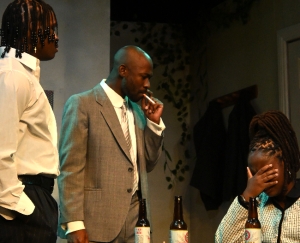
Lynn Nottage is a skilled playwright, and prolific especially considering the high quality of her works: Pulitzer winners Ruined and Sweat. Or the remarkable By the Way, Meet Vera Stark, a kind of All About Eve with the starlet’s Black maid in the Eve role. And then Intimate Apparel, which won wide and very deserved praise. While her scripts vary widely in storyline, they are loaded with very real, authentic characters.
So getting a chance to see an early Nottage work—Gwydion Theatre’s production of Por’ Knockers (1995)—has an especial appeal. It is Nottage’s second play, and it had a turbulent life after premiering Off Broadway in New York at The Vineyard Theatre. Then it went to London. After its London run was cut short, Nottage told The Guardian, “I still remember an audience member ripping up their programme into tiny shreds and throwing it like confetti, saying: ‘I am cancelling my subscription to the theatre!’”
It’s not that the play is bad. In fact it is very good. It was the subject that caused problems: five activists of the imaginary People's Diasporatic Party blow up an FBI building to protest the treatment of African-Americans in the U.S. The play centers on the tension and anxiety within that band of conspirators before and after their destructive venture.
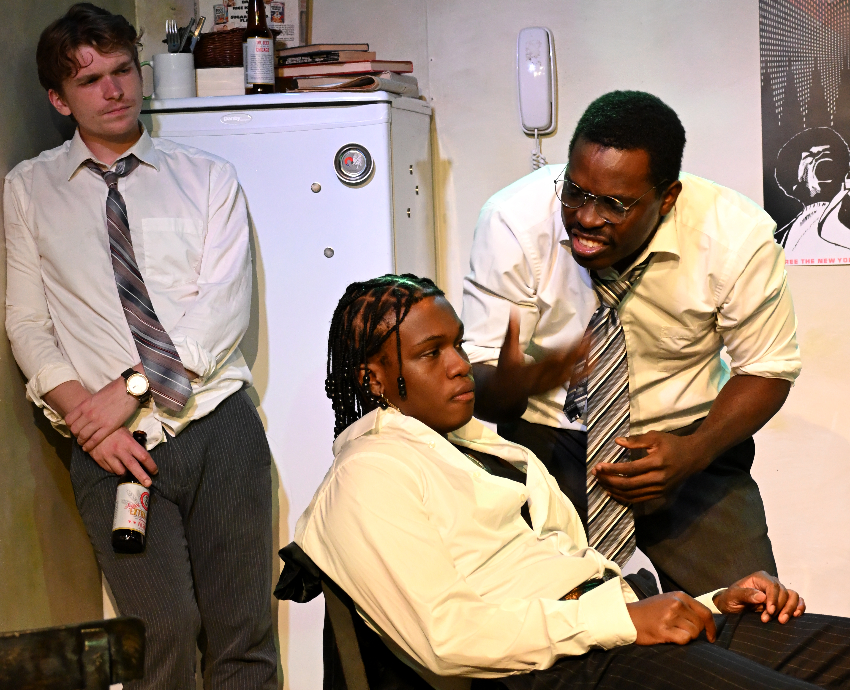
Grayson Kennedy (l-r), Joseph Percy and Dontaye Albert.
Por’ Knockers (the name refers to Guyanese gold panners) was having a successful and well-received run in London until Timothy McVeigh carried out a similar bombing of the FBI building in Oklahoma City. And so the script has been shelved since. Until Gwydion Theatre in Chicago succeeded in mounting this production at Greenhouse Theater.
“This play is so special to us at Gwydion,” says Grayson Kennedy, who is Gwydion Theatre’s Artistic Director. “It was a show that we have wanted to do since our first season.” (Kennedy acts in the show as well.)
Directed for Gwydion Theatre by Makari Robinson-McNeese, Por’ Knockers is widely regarded as a political satire, almost a parody of a “people’s revolutionary army.” But Nottage gives it a level of depth, with five fully-realized characters, each with different backgrounds and motives for the bombing.
In the opening scene of the one act, Nottage establishes the who's who: the mature, grounded Kwami (Kevin Aoussou is astoundingly good); the hyper-kinetic paranoid James (Dontaye Albert is remarkable); a thuggish Ahmed (Joseph Percy); the lone woman in the group, the academic Tamara (Justice Ford); and the lone vacillating white guy, Lewis (Grayson Kennedy is excellent). And then there is this oddly magical entry, Lance (Jimmie Roger III), a machete wielding Guyanese gold prospector visible only to Kwami, whose character happens to be Guyanese-American.
The group’s anxiety is palpable, each expressing it uniquely according to the personalities Nottage has drawn for us. Tempers flare, violence seems to bubble just under the surface as the characters play out their fears. As they leave the apartment for this carefully planned rendezvous with destruction, it is Kwami who exits last, straightening the furniture and quietly telegraphing to the audience a disdain for his fellows.
The passage of time throughout the show is registered by the subtly changing hues of daylight filtering through the window blinds. (Lighting Designer Emma Berry deserves praise for this subtle but important element.)
When they return, hours later, they are filled with excitement over the bombing, and soon enough trepidation builds about what will follow. Tamara offers words of reassurance. “We succeeded,” she says. But only four have returned. That hyper-kinetic paranoid James is nowhere to be seen, further heightening the anxiety in the room. He hasn’t followed the plan. When James does return, having ridden the train to the end of the line and back—“I wanted to make sure I wasn’t followed,” he tells them—he also delivers shocking news: the building was unexpectedly occupied, by children.
A portable radio that was to keep them up to date is malfunctioning because of bad batteries. Lewis delivers a “white man” pronouncement and orders Ahmed to get decent replacement batteries. This doesn’t go down well and violence threatens. Kwami, feeling internal pressure to be the patriarch and the decider on strategy, resists the role, then reluctantly takes it.
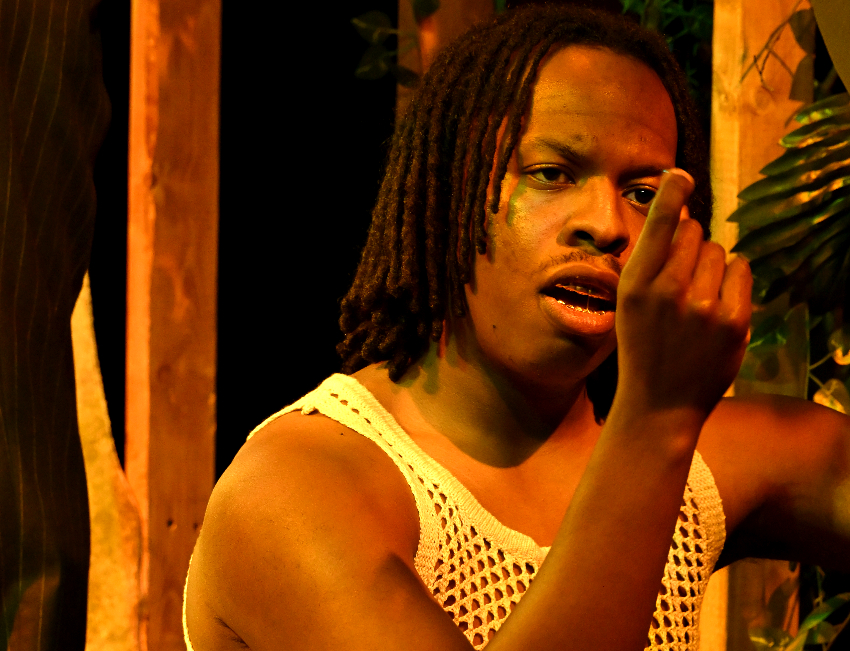
Jimmie Roger III
At this point, the play makes a departure. It remains a parody and these activists do seem inept, but they are also caught in an existential quandary. This takes shape in the lone land line on the wall, a 1990s touch tone wall phone, which will be their means to call the FBI and take claim for the bombing, and make a statement of their motives.
Over the remainder of the play, this brigade of the People's Diasporatic Party swings between ruminations on the morality of their action, or attacking each other. Percy’s Ahmed phrases his sense of their predicament, “I ain't afraid of death. I’m afraid of nobody noticing it. I want my death to be a defining event.”
That phone sits on the wall, a mute expression of the culmination of their destructive act: taking credit for it. Between the tense discussion, the five each take a turn at calling in, when the pressure of the moment drives them to the phone. Yet there is one constraint after another that inhibits them from successfully completing the call: first, they don’t have the number; then they are reluctant to pay 75 cents to “the system” to get directory assistance; after they tear the number from the phone book Lewis calls, and realizes he doesn’t know what to say and hangs up. Tamara calls, but becomes mired in voice mails and transfers and gives up.
Ford’s Tamara seems the most tormented by moral issues of having killed children. Notably, whenever Kwami wants to rally the group, he addresses them as “brothers” then throws in a lagging “and sister,” a low-key running joke for the audience, though not the characters on stage. Eventually the phone call gets through in a resolution of that conceit, which Nottage has used effectively to put each personality on display.
Early works by writers arrive unfettered by reputation and uncontaminated by any self-consciousness with which acclaim may impart. It is my feeling that early writing by authors of any medium allows us a window into that unbridled creative energy.
In Por’ Knockers Nottage inserts that sixth character, the silent, machete wielding Lance, who appears periodically, visible only to Kwami. He prowls the stage front during these brief magical interludes, humming or singing softly. When the other four see Kwami drifting away, he self-consciously explains he is channeling ancestors.
Nottage’s success has not diminished her work, but only affirmed her remarkability. Two subsequent plays like Ruined (its 2008 world premier was at the Goodman, where it returns as part of the next season) and Sweat both won Pulitzers, a first for a woman playwright. Nottage also wrote the book for two Broadway musicals: MJ and The Secret Life of Bees.
Por’ Knockers, which comes recommended, runs through October 4, 2026 at The Greenhouse Theatre.
Gabriel Garcia Marquez's Dark Children’s Tale Translates to Stellar Show in ’The Man Who Fell with the Rain’
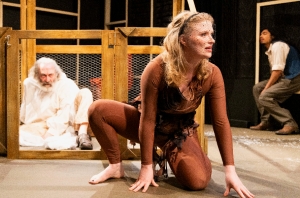
An exceptionally good show is now on stage at Chicago’s Trap Door Theatre. This wonder—The Man Who Fell with the Rain— has been translated through three languages on its way to the footlights in its U.S. premiere, right here on the tiny stage on Cortland Ave.
Originating in Spanish as a children’s tale by Columbian Nobel Laureate Gabriel Garcia Marquez, it was turned into a script by Andrei Kureichik, a Belorussian playwright, then translated to English by John Freedman. All that before being adapted and directed by Kay Martinovich for a perfect and very cogent rendering by the Trap Door players in its U.S. premiere.
The Man Who Fell with the Rain hews closely to Marquez’s original short work, “A Very Old Man With Enormous Wings: A Tale For Children,” while playwright Kureichik has unpacked the important details touched only lightly in the original. It becomes truly theatrical as we watch the story unfold that Marquez charted.
The script brings us an Old Man With Enormous Wings (Richard Cotovsky) who is discovered unconscious in the backyard of the Husband (Dan Cobbler) and the Wife (Laura Nelson). The couple also happen to have a two-week-old baby in their house, and a nosy know-it-all Neighbor Woman (Emily Lotspeich) is certain the winged creature is an aging angel who was intending on taking the baby. Her advice: beat him to death with a cudgel.
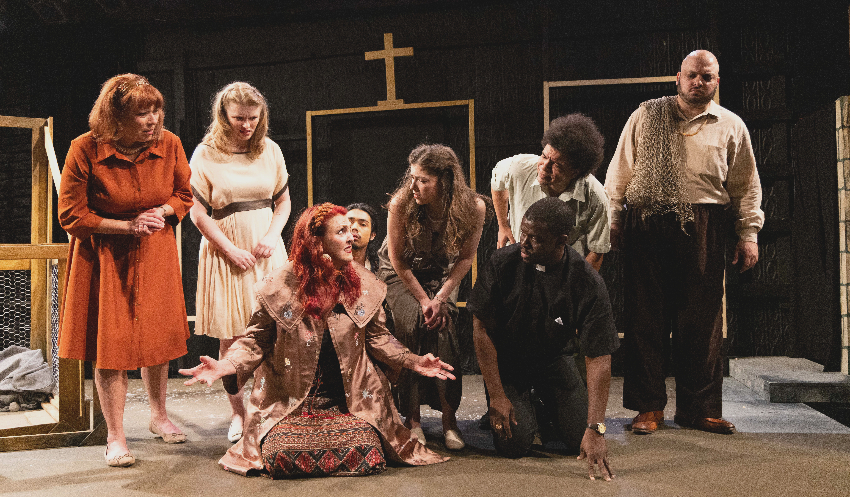
The cast of The Man Who Fell with the Rain at Trap Door Theatre through September 26, 20206
The couple take pity on the Old Man, and instead place him in their chicken coop, intending to keep his presence a secret. But word gets out and neighbors, and then spectators descend on their abode. The Old Man has regained consciousness and the couple try communicating—but he speaks only his own unknown tongue. Neighbors speculate on what to do with him, suggesting vriously to put him over the military and end wars; or make him a governmental magistrate; perhaps put him out to stud to generate a winged human master race.
The local Priest (Keith Surney) is called in, since the Old Man seems perhaps to be an angel, but there is nothing in the doctrinal books that explains the possibility of an aged, injured angel. So he writes his bishop, who writes his primate, who will then write the Pope for guidance. As this lengthy process continues, and the crowds grow, the couple decides to charge admission for a look at the Old Man.
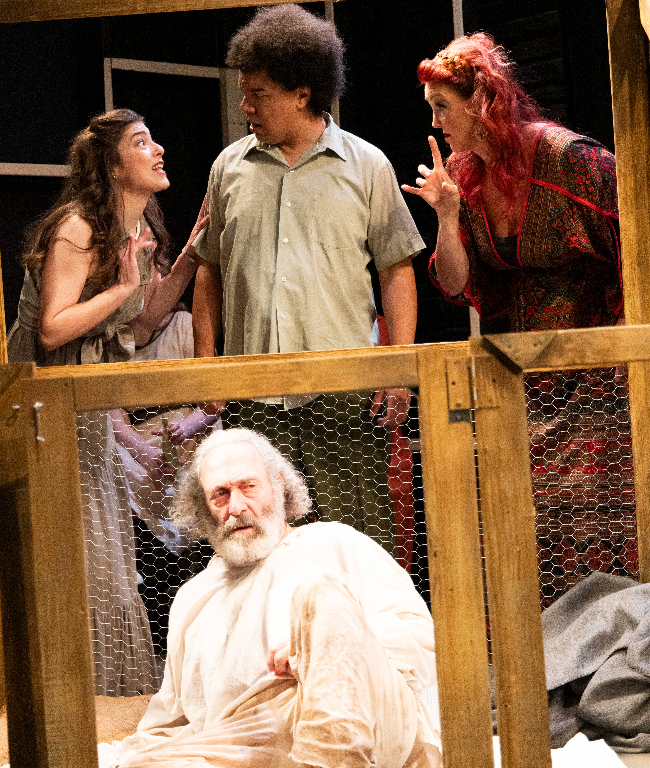
Laura Nelson, Dan Cobbler, Emily Lotspeich, and (foreground) Richard Cotovsky in The Man Who Fell with the Rain.
Marquez and the playwright Kureichik provide us a scenic display of society, and the human comedy that so readily arises in its waters. The convoluted religious hierarchical pronouncements delivered by the Priest extend the fun of this strange state of affairs. Other characters arrive, including a girl who has become a Spider Woman (Gracie Wallace), all natural to the magical realism that is Marquez’s stock in trade.
Yet this show is not played for broad comedy. The story line and gradual revelations unfold with restraint. And it is the performances that director Martinovich has drawn from these performers that make this show stratospherically good.
Most memorable for me are two performances: Richard Cotovsky’s Old Man, whose mostly silent acting is magnetic as he quietly gets his bearings and increasingly engages the neighbors and spectators. And Emily Lotspeich’s Neighbor Woman, who is so perfectly recognizable from life. She moves from one certainty to another and always speaks authoritatively, even as her previous pronouncements have proven false. She knows, for example, that this Old Man should be fed a dangerous chemical which she supplies for $50—”Angel food is not cheap!” she declares.
When the Old Man goes dormant and the couple thinks he has died, she advises on his burial: cut off his wings, fold them over him, place a ring of 49 candles around him, then burn him. Despite her certitude, they decide to use a hot branding iron on the Old Man, and he immediately rises and flaps his wings. For his part, the Priest brings only questions, not answers, from the church. They are adsked if the Old Man has a navel, for example, to determine if he is human rather than angelic.
Yes it is a rather dark children’s tale. The Brothers Grimm are also dark, in the original text. What a fairy tale can do is describe to children (and grown-ups) the inexplicable behavior of adults. And the resolution of the play is positive and very satisfying. The townspeople are left as the Old Man found them, and we expect nothing changes, no one learns anything—just like real life.
Highly recommended, advanced ticket sales had driven an extension of the run of The Man Who Fell with the Rain even before opening night, but make haste. The extended run ends September 26, 2026 at Trap Door Theatre at 1655 W. Corland in Chicago.
Standing Room Only Crowd for Chicago’s Leading Theater Artistic Directors
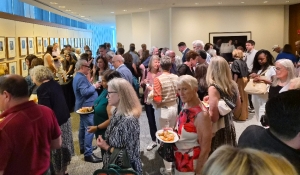
It must have been heavenly for the creative leaders of Goodman, Steppenwolf, Chicago Shakespeare and Court, Chicago’s top regional theaters, to be greeted by a standing room only crowd. But there they were, on a panel moderated by the eminent Chicago Tribune theater critic Chris Jones. The program was introduced by Marla Mendelson, MD, then by her daughter, Tova Wolff, who also happens to be artistic director at Refracted Theatre Company.
Held on the 6th floor of the airy University of Chicago Gleacher Center overlooking the Columbus Drive bridge at the Chicago River, the event was part of the Evening Inquiry Series founded by Mendelson and her husband Stephen Wolff, and arriving on the heels of a landmark report from the Arts Alliance Illinois that shows the creative sector is the sixth largest business sector in the state. In Chicago, where nearly half (47.5%) of the overall state’s direct creative economy output takes place, the sector supports 212,875 jobs, generates $50 billion in output, and generates $5.7 billion in tax revenue. It is Chicago’s 3rd largest industry (11.3%), larger than educational services (10.2%), retail (8.3%), and manufacturing (7.9%).
Citing that as a backdrop, moderator Chris Jones led the panelists through the discussion.
Also referencing the report, Edward Hall, artistic director at Chicago Shakespeare Theater noted, “This city has a very powerful, strong cultural economy as well, which I think feeds social and cultural life, but also it's an economic driver. And you haven't even begun to count the trickle-down effect of people's secondary spending when they fly into town and see Iceboy, or they see Lord of the Rings, whatever they come and see. They're taking cabs. They're going to hotels. They're spending money.”
Jones's questions led to the perhaps surprising revelation: subscriptions to theaters have dwindled. Audrey Francis, artistic director for Steppenwolf, said that at its height, Steppenwolf had 25,000 season subscription holders. “And now we have 5,000,” she said, which was the number when she started her tenure at the theater.
“It's challenged me as an artist to say, ‘Okay, this is the game,’” said Francis. “And it's not about, for us, necessarily what's popular. It's about how are we being our best to make sure that when you come dance with us, we're the best dance partner you have.” According to Francis, “Being challenged to evolve and to keep up and to say, ‘Okay, we can't keep doing the same thing. The rules are changing, and everybody's getting better, and how do we keep up?’”
Budget-wise, ticket revenue overall covers just half the operations of any of these theaters.What that means for theater operators is audience preferences and marketability to individual ticket buyers is a key driving force in the creative selection of scripts to be produced at larger Chicago theaters. Given that, how do artistic directors determine the roster of shows for each season?
What came up in the course of the panel is that there is serious tension (as might be expected) between including the established “canon” of playwrights—Eugene O’Neil, Ibsen, Chekov, Shakespeare, Shaw, etc.—and new works from rising talents around the country. Over recent years new works have risen in prominence, while the number of scripts from the old guard have diminished.
The event was preceded with an open bar reception and generous array of hor d'oeuvres, during which the audience mingled. There were actors, creatives from theater companies, and the regulars who attend these Evening Inquiries sessions at the University of Chicago’s Gleacher Center. As a theater critic for Buzz Center Stage, I recognized a number of publicists from theatrical groups and agencies that specialize in communications for this marketplace.
One woman I spoke to was the spouse of an actor. I also met a man who was a retired professor of drama from Bates College in Lewiston, ME, who complained heartily of the numerous new works in seasons just announced by the panelists’ theaters, to the exclusion of Shaw and other traditional canonical works. “What’s the best thing you’ve seen in the last year?” he asked me, his voice ripe with challenge. I answered unequivocally: “The Devil Comes to Town at Trap Door Theater.” (It was adapted and directed by Jeremy Ohringer who is also on the faculty at DePaul University.)
This was a perfect lead-in to the discussion of seasons filled with newer works, discovered through careful dramaturgy of who and what is trending around the country, which may be unfamiliar to Chicago audiences. There is risk attached to trying such unknown works as part of a mission for exposing audiences to what the theaters think they might or should like.
“If you go back to that origin statement about serious, mission-driven work, fully fifty percent of your annual income is box office dependent,” said Susan Booth, artistic director at Goodman Theatre. Producers can no longer rely on subscription ticket holders to weather through whatever they’re given in a season. “That box office number is a reality in our day-to-day life,” Booth said. “And I would love to hear from my colleagues on the panel about the challenge of selling mission-driven work versus selling popular work.”
Chicago Shakespeare’s Hall noted that theater lives in a perpetual recession. “There has never been a moment when I've heard any of my colleagues say, ‘What do we do with all this excess money?’ And theater has always been striving to do mission-driven work. And the idea that if you go popular, it's easy,” Hall said, “it's a lie, actually.” (Though the exception proving the rule perhaps are the lavish productions at Paramount Theatre in Aurora, generously underwritten by its neighboring casino profits.)
Avery Hoffman, who was named artistic director just last November at Court Theatre at the University of Chicago, described her theater’s audiences as many layered: the students and faculty on campus, individuals throughout the surrounding Hyde Park area, and the entire south side of Chicago, the city at large and the region. “This knowledge of your audiences is really, really important to that collective thinking, certainly to my collective thinking,” Hoffman said. “It means that our seasons maybe take a little bit longer to come to fruition. But then at the end of the day, you have a collective agreement about what your mission is, what shows that you're doing that serve that mission, and an audience that knows that mission and is there to support [it].”
A lengthy discussion covered the shifting role of these big regional theater companies from gatekeepers of what should be seen by audiences, to collaborative facilitators of what audiences want—even if that means bringing them unfamiliar scripts that meet their latent interests. Francis noted that the ensemble-powered company of Steppenwolf has long meant that the establishment of each season's offerings is the product of intense creative conflict, in the best sense of those words.
Best Question of the Night
After 30 minutes, Jones entertained a few questions from the audience, and the first out-of-the-gate came from a long-haired young man who cited the recent transfer of the a cappella musical Octet from Raven Theatre’s space on Clark St. to extend its run at the Goodman’s Owen Theater for three weeks this summer.
Goodman’s Booth responded that she had an immediate reaction when she saw Octet at Raven: “I thought the ceilings are just too low for these great voices.” And so it happened, but that is a rarity in Chicago. “The big theaters are often dark,” the questioner pointed out, and these successful storefront shows need to be able to get to bigger venues in order to extend their runs, rather than simply close to accommodate a subsequent planned production from their own season. "All of us are keenly aware that we benefit from the ecosystem," Booth said, referring to Chicago's many storefront and small theaters.
Of course, this is the natural ecosystem in New York, where Off Off Broadway shows frequently transfer to Off Broadway and sometimes on to Broadway—usually driven by proven audience demand. Why couldn’t that happen more frequently in Chicago? This led to an intriguing proposition from Chicago Shakespeare's Hall for a separate non-profit theatrical entity that might serve as a development center for co-producing shows, lef by Chicago's regional theaters.
Three cheers to University of Chicago and Mendelson's Evening Inquiry series for putting this remarkable discussion of theater on stage.



Latest Articles
-
 THEATER UNSPEAKABLE ANNOUNCES MIME OR NOTHING, FEBRUARY 5 - 28, 2027
Written by Buzz Center StageTheater Unspeakable is proud to announce the cast and creative team for the Midwest Premiere of Mime or Nothing, February 5 - 28, 2027 at Theater Wit, 1229 W. Belmont Ave. Mime or Nothing is written by and starring Marc…
-
'Oh, Buddy' a Lighthearted Absurdist Look at Transgender Issues in the Workplace
Written by Bill EslerLeave it to Trap Door Theatre to find an absurdist play, their milieu, that’s a funny, fresh take on office culture and a trans sex change surgery of a key employee, New Guy (Jack Bowes is excellent). Hal Cosentino’s Oh,…
-
Filament Theatre announces 2026/27 Season With returning interactive family favorites: Fort-building fun with FORTS and performance installation for babies RAIN
Written by Buzz Center StageFilament Theatre (4041 N. Milwaukee Avenue in Portage Park), the Northwest Side’s premier theater for young audiences, is delighted to announce the upcoming programs and plays in its 2026/27 Season. The popular immersive fort-building play experience for families, FORTS, returns…
-
VAPE! THE GREASE PARODY CELEBRATES HOMECOMING WITH SPECIAL THEMED PERFORMANCES THIS WEEKEND
Written by Buzz Center StageCHICAGO, Homecoming just got a whole lot greasier. With friends, family and college classmates making their way back to Chicago ahead of Thanksgiving. Vape! The Grease Parody is kicking off a special Homecoming Weekend from November 20–22 at the Apollo…
Does your theatre company want to connect with Buzz Center Stage or would you like to reach out and say "hello"? Message us through facebook or shoot us an email at This email address is being protected from spambots. You need JavaScript enabled to view it..
*This disclaimer informs readers that the views, thoughts, and opinions expressed in the text belong solely to the author, and not necessarily to Buzz Center Stage. Buzz Center Stage is a non-profit, volunteer-based platform that enables, and encourages, staff members to post their own honest thoughts on a particular production.