

Ken Payne
BrightSide’s Addams Family Musical Revives the Wonderfully Weird World of the Addams Clan
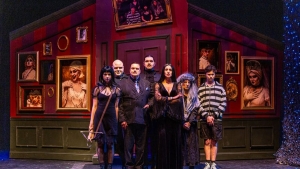
They're creepy and they're kooky, Mysterious and spooky, They're altogether ooky, The Addams Family.
Yes, ooky.
BrightSide Theatre’s production of The Addams Family Musical at the Theater at Meiley Swallow Hall feels like stepping back into the wonderfully odd world of a family we’ve all grown up with. There’s an immediate charm in seeing Gomez and Morticia - the passionately devoted, darkly elegant heads of the Addams clan - presiding over their spooky, loving household with the same theatrical flair that made them iconic. With a book by Marshall Brickman and Rick Elice and music and lyrics by Andrew Lippa, the show’s blend of gothic quirk, musical comedy warmth, and big-hearted family chaos lands with a personal, familiar joy that makes this staging especially inviting. And right at the center is Wednesday Addams, their sharp tongued, deadpan daughter whose unexpected leap into romance sets everything spiraling.
In this musical comedy, Wednesday has fallen in love with Lucas Beineke, a sweet, decidedly “normal” young man from Ohio. Determined to prove she’s ready for something real, she asks her parents to host a dinner so the two families can meet - but she also begs Gomez to keep her engagement a secret from Morticia. That single request throws Gomez into a hilarious moral crisis, while Morticia senses something is off and the rest of the Addams household prepares for an evening guaranteed to go sideways. When the straight-laced Beinekes arrive, their collision with the gloriously eccentric Addamses sparks a night of confessions, misunderstandings, unexpected alliances, and more than a few supernatural surprises. What unfolds is a heartfelt, funny, and delightfully macabre exploration of love, loyalty, and the beautifully strange ways families learn to accept one another - quirks and all.
BrightSide’s production thrives on the strength of its performers, and this cast brings the Addams world to life with personality, precision, and a magnificently off-center spirit.
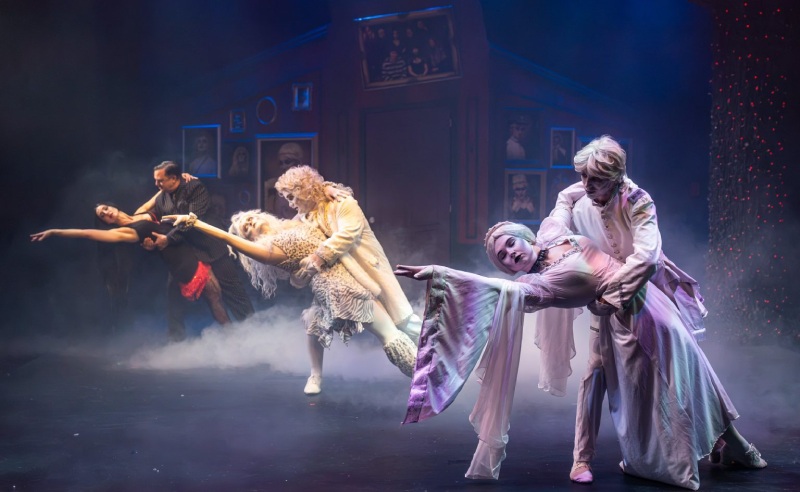
Scott Kelley and Samatha Keret (rear) as Gomez and Morticia and Ancestors in Brightside Theatre’s The Addams Family Musical. Photos by CM Stage Photography.
At the center of the production are Scott Kelley’s Gomez Addams and Samantha Keret’s Morticia Addams, who anchor the show with an easy chemistry that makes their partnership feel lived in and genuinely affectionate. Their banter and romantic interactions are fantastic - playful, sharp, and full of the kind of idiosyncratic mutual understanding that makes their marriage the emotional core of the evening. Kelley gives Gomez a warm, slightly frantic presence, the kind of theatrical bravado that feels both funny and sincere. Keret, with her beautiful voice and cool, elegant presence, matches him beat for beat, creating a dynamic that feels both grounded and pleasantly heightened. Together, they knock their roles out of the ballpark.
The ensemble - from the Addams clan to the buttoned-up Beinekes, along with the ghostly Ancestors who linger in the house until Wednesday’s journey toward love sets them free - brings strong energy and cohesion to the production, giving the show a vibrant foundation for some standout performances.
Lauren Mathews’ Wednesday Addams is terrific, offering a Wednesday who is smart, guarded, and brimming with the dry, deadpan wit audiences expect - but also carrying the emotional uncertainty of someone stepping into adulthood faster than she planned. Her performance captures a teenager caught between loyalty to her wonderfully strange family and the terrifying possibility of real change. Because the story ultimately revolves around love - romantic, familial, and everything in between - Mathews becomes the hinge of the entire narrative, and she handles that responsibility with clarity and confidence.
Collin Borisenko’s Uncle Fester adds a welcome dose of sweetness and eccentricity, leaning into Fester’s gentle oddball nature without tipping into caricature, while Amy Arbizzani’s Alice Beineke provides some of the evening’s biggest laughs as a tightly wound suburban mom whose unraveling becomes a comedic highlight. Arbizzani’s timing - and her ability to really belt when the moment calls for it - turns her musical outbursts into genuine showstoppers.
BrightSide’s creative team shapes this production with care and a clear affection for the material. Under De Haddad’s direction, the musical moves with clear, unfussy ease, balancing the story’s humor and heart while keeping the unconventional Addams world feeling cohesive and inviting. Shane Brown’s choreography adds light, well placed movement that supports the storytelling without crowding the stage, giving each number a clear, character focused lift. Phil Videckis leads the music with steady assurance, keeping the score’s personality and emotional beats aligned with the action. Cheryl Newman’s costumes offer a thoughtful blend of familiar Addams silhouettes and clean, stage ready designs, while Kurt Ottinger’s lighting brings subtle shifts in mood and color with just enough theatrical shadow to frame the world effectively. The production’s scenic design, crafted by Ariel Mozes, provides a space that feels both spooky and welcoming - a home that fits the Addams tribe and the story unfolding within it. One of the production’s most engaging details is the way the Ancestors drift in and out of the family portraits, turning the walls of the Addams home into a living gallery that observes the action as it unfolds.
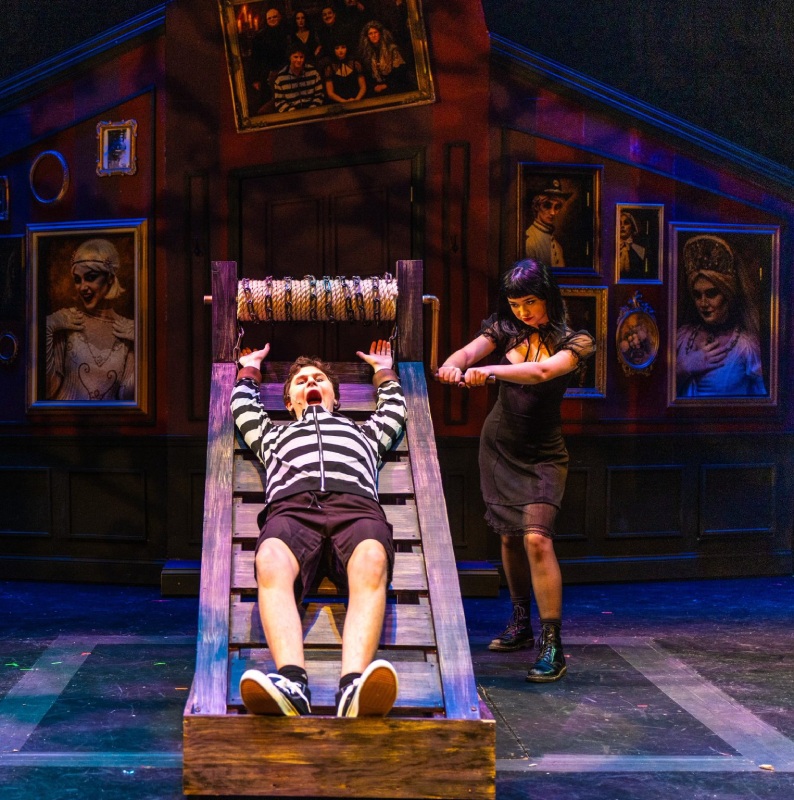
Pugsley and Wednesday Addams (Carson Kelley and Lauren Mathews) in Brightside Theatre’s The Addams Family Musical.
This is a funny show that is all about love, and BrightSide delivers that humor with a light, playful touch that keeps the audience laughing. And even when some of the jokes are predictable, they still land, because the delivery, timing, and sheer Addams‑style absurdity make the familiar feel fun rather than tired. I did wonder whether comedy born sixty years ago would still resonate with today’s crowd, but the production blends the classic Addams deadpan with a few modern winks - including some sly innuendo and contemporary asides - that make the jokes feel fresh without betraying the spirit of the original. The crowd was a mix of longtime Addams fans and newer generations, something made instantly clear when the familiar theme kicked in - a handful snapped right on cue while others clapped along. It was a fun blend of reactions, and the overall effect showed that the humor lands for everyone.
Big musical moments like When You’re an Addams burst with playful choreography and gothic silliness, setting the tone right from the start. Later, Full Disclosure turns a family dinner into a brilliantly chaotic spectacle, layering jokes, reveals, and ensemble energy in a way that feels both sharp and amusingly messy. Morticia’s Just Around the Corner is another highlight - a charming bit of dark humor built around her cheerful pun that “death is just around the coroner… get it?” delivered with exactly the kind of melodramatic glint the character thrives on.
For so many of us, The Addams Family began in grainy black and white reruns on TV - the kind you’d stumble upon on a quiet afternoon, or watch curled up on the couch, instantly pulled into that wonderfully odd little world. Those episodes became part of childhood in a way that sticks, shaping our sense of humor and giving us characters who felt strange, sweet, and strangely familiar all at once. Seeing the Addamses still make people smile today - onstage, in full color, with all their offbeat charm intact - is a reminder of how enduring they are. Decades later, they’re still beautifully weird, still welcoming, and still capable of bringing out that same simple, shared joy.
BrightSide Theatre’s The Addams Family Musical is recommended, offering a spirited, nostalgic, and thoroughly enjoyable night out for audiences of all ages. The production runs October 2–18, 2026 at the Theater at Meiley Swallow Hall at North Central College, located at 31 S. Ellsworth St. in Naperville. With an estimated running time of 2 hours and 30 minutes, including intermission, it’s an evening that delivers plenty of laughs, charm, and quirky family fun - a welcome return to the wonderfully weird world of the Addams clan.
Chicago City Opera Delivers a Rare Operatic Haunting with Der Vampyr
With Halloween creeping closer, there’s something fitting about revisiting one of opera’s earliest flirtations with macabre horror - especially in a production presented and performed by Chicago City Opera (COT). Der Vampyr may not enjoy the mainstream familiarity of later supernatural works, but its mix of moonlit superstition, doomed romance, and aristocratic menace makes it an ideal October offering. As audiences lean into the season’s appetite for the eerie, Marschner’s opera emerges as a surprisingly modern ancestor to everything from Victorian melodrama to contemporary horror musicals.
Though often treated as a standalone curiosity, Der Vampyr has a lineage that begins well outside the opera house. The story originates with John Polidori’s 1819 prose tale The Vampyre, one of the first works to codify the seductive, aristocratic vampire archetype. Polidori’s narrative was adapted into a German stage play by Heinrich Ludwig Ritter, whose dramatization became the direct source for Wilhelm August Wohlbrück’s libretto. Heinrich Marschner’s 1828 opera builds on Ritter’s theatrical version, shaping the material into a darkly romantic, musically driven narrative that blends early Romantic lyricism with gothic theatrics. In short: Polidori’s story inspired Ritter’s play, and Ritter’s play became the foundation for Marschner’s opera.
Set in early 19th century Scotland, the opera follows Lord Ruthven, a charismatic nobleman cursed with vampirism and bound to claim new victims before dawn or face eternal damnation. After surviving a near fatal attack, the young hero Edgar becomes unknowingly entangled in Ruthven’s hunt. Ruthven first targets the innocent Janthe, luring her to a ruined castle under the guise of seduction, and later sets his sights on Malwina, Edgar’s beloved, whose wedding night becomes his final opportunity to fulfill his deadly pact. As Edgar pieces together the truth, the opera accelerates toward a frantic race against sunrise: Ruthven’s identity is exposed, his supernatural bargain collapses, and the community rallies to save Malwina as the vampire is ultimately destroyed. What remains is a blend of gothic suspense, romantic rescue, and early Romantic moral drama - a seasonally perfect slice of operatic horror as Halloween approaches.
Jeremiah Strickler commands the evening as Lord Ruthven, delivering a performance that blends aristocratic charm with a chilling, predatory stillness. His presence anchors the production - vocally assured, theatrically magnetic, and always in control of the opera’s gothic pulse. Opposite him, Jordan Loyd brings a clear, earnest intensity to Edgar Aubry, shaping the role with a bright tenor and a palpable sense of moral urgency. Loyd had some of the most spectacular and heartfelt vocal moments of the evening, particularly toward the end of Act II as he reflects on his past love. Jessie Lyons’ Malwina adds welcome tenderness, her lyrical phrasing and grounded sincerity adding to the opera’s romantic core. Ariel Emma’s Janthe provides one of the night’s most striking early moments, her brief arc handled with vivid color and fearless commitment, and some of the notes she held were genuinely astounding - the kind that stop the room for a beat. Keaton Payne’s Humphrey von Davenaut provides a sturdy, authoritative counterweight, shaped by both his assured delivery and his expressive, sharply drawn presence. Meanwhile, Molly Clementz (also the production’s graphic designer) brings Emmy Perth to life with bright energy and an impressive finesse that lifts every moment she’s given, adding flashes of warmth, wit, and a polished musicality - especially in the way she shapes and sustains her notes with such control and clarity.
Bat Collazo’s George Dibdin and Kevin Wheatle’s John Berkley round out the ensemble with crisp, well-shaped character work that keeps the world of the opera humming with specificity.
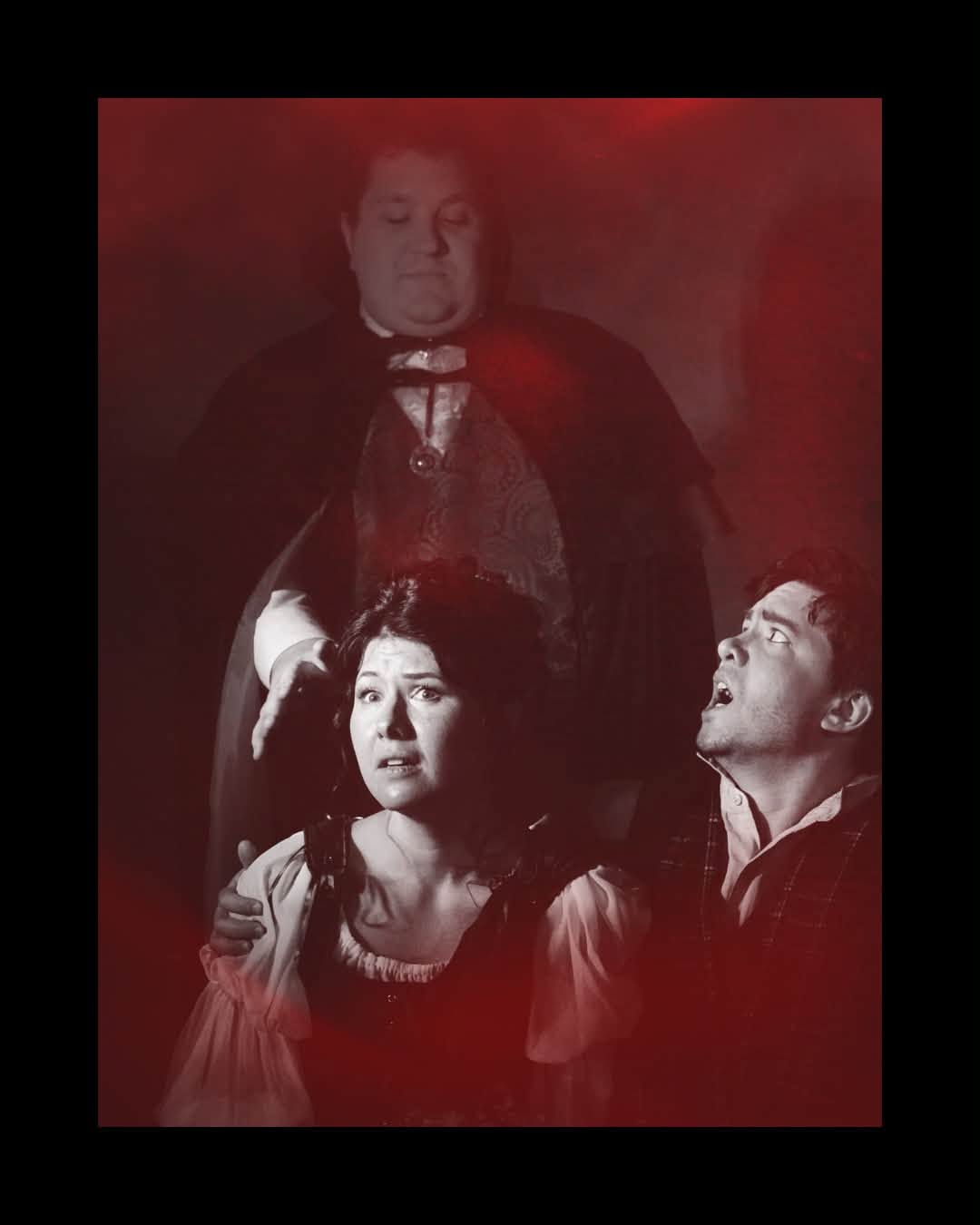
Jerimiah Strickler (rear) Molly Clemenntz (left) and Bat Collazo in Chicago City Opera's Der Vampyr.
One of the unexpected pleasures of the evening was simply hearing each singer on their own - every voice carrying its own color, character, and emotional weight. But when paired, those timbres intertwined with a striking naturalness, and in the moments when all eight sang off one another at once, the result was nothing short of exquisite. The ensemble sound had a richness and immediacy that felt almost architectural, each voice reinforcing the next until the room seemed to vibrate with a unified, resonant force. It was a reminder of how thrilling Marschner’s writing can be when performed by artists who listen as intently as they sing.
Behind the scenes, Alexis Enyart conducts with sharp dramatic instinct, shaping Marschner’s score with clarity and momentum. SarahAnn Sutter’s direction deepens the production’s impact, treating Der Vampyr not merely as gothic spectacle but as a living, breathing psychological drama. She embraces the opera’s supernatural flair with confidence - the shadows, the proximity, the sudden shifts in tone - yet she never lets the human stakes slip away. Sutter has a keen sense for spatial storytelling, using the venue’s architecture to heighten tension and intimacy; she sends performers through the aisles and along the home’s sweeping historic staircase, activating much of the house as part of the dramatic landscape. Her staging choices reveal a director who understands how early Romantic horror works best: not through excess, but through precision, ambience, and emotional clarity. Supported by Jordan Crice’s deft piano work and Adam Nicholson’s distinctive set design, the result is a production where every element feels intentionally placed and dramatically charged. Thanks to this talented cast and creative team, Chicago City Opera builds a world where early Romantic horror feels both stylish and surprisingly immediate.
Although Der Vampyr travels through a handful Chicago area venues during its run, the performance I attended on opening night unfolded inside the storied Colvin House - a location that feels almost predestined for this opera. Colvin House, beautifully placed across the street from Lake Michigan on the corner of Thorndale Avenue and Sheridan Road, proves to be an inspired setting for Der Vampyr, its historic architecture and intimate, richly textured rooms amplifying the opera’s gothic mood in ways a traditional proscenium simply can’t match. The building’s carved woodwork, shadow friendly corners, period furnishings, and old-world elegance create a natural sense of suspense and closeness, allowing the audience to feel almost inside the drama rather than observing it from a distance. The scale of the space heightens the tension - Ruthven’s entrances feel more dangerous, Janthe’s fate more immediate, Malwina’s peril more personal. Colvin House becomes a living extension of the opera’s supernatural world and a perfect match for Marschner’s early Romantic horror.
Despite all its strengths, the evening wasn’t without a minor but noticeable drawback. Although brief stretches of dialogue were exchanged in English, the opera itself is sung in its original German, making the surtitles essential for most. Unfortunately, the monitor displaying those subtitles sat off to the front side and too low to be easily seen by much of the audience; only those in the unobstructed front section had a consistently clear view. Sitting in the third row opposite the monitor side, I was able to catch most of the surtitles when first‑row head movement allowed, but many around me – and further back - were blocked entirely. I’m no set designer, but raising the monitor and centering it - even if it encroached slightly into the stage picture - would make the surtitles far more accessible, a small trade off that would greatly improve audience experience. In the meantime, I strongly recommend that attendees read the Act I and Act II synopsis in the program before the performance begins; with that context in hand, most will have a solid grasp of the unfolding drama even if the surtitles prove difficult to see.
Regardless of that small hiccup, the opera itself remained a beautiful, wonderfully performed experience - rich in mood, artistry, and musical power.
Der Vampyr is recommended as a rare and atmospheric experience - the kind of intimate, site specific opera that feels tailor made for October. For audiences looking to embrace the season with something truly unique, this production offers a gothic thrill you won’t find anywhere else. Upcoming performances include Wednesday, October 7 at Colvin House (7pm), Friday, October 9 at Fulton Street Art Center (7pm), and Sunday, October 11 at Skokie Theatre (3pm).
- Chicago City Opera
- Der Vampyr
- Heinrich Marschner
- John Polidori
- The Vampyre
- Heinrich Ludwig Ritter
- Vampire
- Jeremiah Strickler
- Jordan Loyd
- Jessie Lyons
- Ariel Emma
- Keaton Payne
- Molly Clementz
- Bat Collazo
- Kevin Wheatle
- Alexis Enyart
- SarahAnn Sutter
- Jordan Crice
- Opera
- Halloween
- Chicago events
- Chicago opera
- live theatre
- live opera
- on stage
- Colvin House
- Fulton Street Art Center
- Skokie Theatre
Dial M for Mastery: Oil Lamp’s Thriller Tightens the Screws
As a lifelong Hitchcock fan, Dial M for Murder has always been one of my comfort film thrillers - the kind of tightly wound mystery where every glance, every pause, and every seemingly harmless detail becomes a loaded clue. I’m a sucker for a well-crafted whodunnit, especially the kind that balances elegance with danger and wit with dread. That’s why October feels like a gift for mystery lovers: a chance to watch Frederick Knott’s classic story step off the screen and onto the stage in Glenview, where its suspense sharpens and its twists land with fresh immediacy.
Although Hitchcock’s 1954 film remains the most widely known version of the story - with Ray Milland’s suave menace, Grace Kelly’s cool radiance, and John Williams’ unforgettable turn as Inspector Hubbard - Dial M for Murder began its life onstage. Knott’s play premiered in 1952 at London’s Westminster Theatre before transferring to Broadway later that year, where its tight structure and chamber thriller design quickly earned acclaim. It’s easy to forget that Knott’s play came first, but remembering its theatrical origins makes Oil Lamp Theater’s staging feel like a return to the story’s true form rather than just a nod to the famous film.
Oil Lamp Theater’s production of Dial M for Murder, adapted by Jeffrey Hatcher and sharply directed by Daniel King, taps into into that live wire energy. The plot remains deliciously tense - Tony Wendice’s meticulous plan to murder his wife Margot, the hired killer who fumbles the job, and the spiraling cover up that follows - but Hatcher’s adaptation trades Hitchcock’s cool, camera-controlled precision for something more intimate and kinetic. Without the film’s polished detachment, the danger unfolds mere feet away, every shift in tone or tactic happening in real time. Character motivations sharpen, pacing tightens, and the unraveling of Tony’s scheme feels more visceral, more human, and far less theoretical than it does on screen.
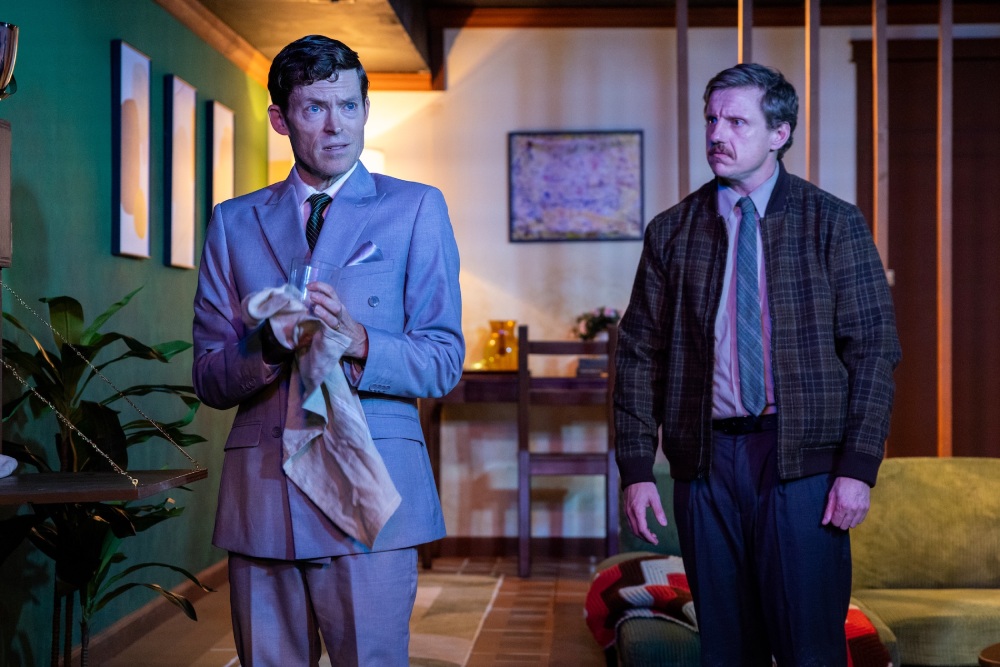
(L to R) John Chambers and Robert Austin Love in Dial M for Murder at Oil Lamp Theater.
The result is a sleek, modernized thriller that honors Knott’s original structure while embracing the momentum and immediacy only theatre can deliver. Oil Lamp Theater transforms a familiar classic into an edge of your seat experience - one that rewards Hitchcock devotees, satisfies whodunnit purists, and proves that some mysteries are even better when you can feel the strain in the room. It’s outstanding.
This is a dialogue driven thriller, and the ensemble handles its quick witted, fast paced exchanges with remarkable ease, building off one another so fluidly that the charge and rhythm feel almost effortless. The production finds its center of gravity in the icy cool poise and controlled calculation of Tony Wendice, played with crisp precision by John Chambers – Roger Moore-esque charm and all. His performance has an almost surgical sharpness - every pivot, every adjustment in tone feels intentional - making Tony’s manipulations both believable and unsettling. Chambers gives the show its spine, grounding the thriller in a performance that’s quietly dangerous and consistently compelling.
Margot Wendice emerges as far more than a plot device thanks to Paige Klopfenstein, who brings emotional clarity and a welcome sense of agency to the role. Her Margot is vulnerable without ever seeming fragile, and Klopfenstein’s grounded presence deepens the stakes of Tony’s scheme. The unease in her scenes feels lived in, giving the unraveling mystery a human pulse.
Adding a modern spark, Charlotte Foster’s Maxine Hadley offers wit, intelligence, and a refreshing directness. Foster leans into the character’s independence, making Maxine feel like a genuine complication in Tony’s carefully engineered world rather than a narrative accessory. Her scenes crackle with contemporary energy that complements Hatcher’s adaptation. Hatcher’s decision to gender swap the film’s Mark Halliday into Maxine shifts the dynamic in a fresh, contemporary way, transforming the romantic outsider into a sharper, more dynamic presence without altering the story’s core tension.
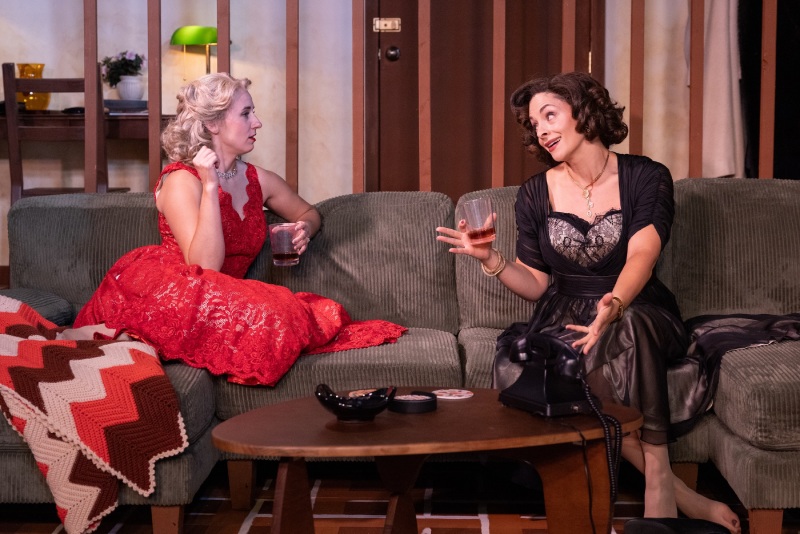
(L to R) Paige Klopfenstein and Charlotte Foster in Dial M for Murder. Production Photos by Gosia Matuszewska/Gosia Photography.
Robert Austin Love’s Lesgate brings grit and unease to the production. He captures the desperation of a man who knows he’s in over his head but can’t resist the lure of Tony’s offer. There’s a standout moment when what begins as an innocent visit to purchase an automobile suddenly twists into a realization that he’s being backed into a treacherous corner, and Love plays that shift with gripping precision. His tense exchanges with Chambers are among the show’s most suspenseful moments, adding texture to the thriller’s middle stretch.
And then there’s Inspector Hubbard - perhaps my favorite character to watch throughout - played with warm, grounded intelligence by James Sparling. It’s a role forever associated with John Williams’ cool, amused detachment in Hitchcock’s film, but Sparling wisely avoids imitation. Instead, he offers a more human, quietly charismatic take that suits the intimacy of Oil Lamp Theater. His Hubbard is observant, methodical, and confident without showiness, proving the character can be just as brilliant without echoing the film’s iconic performance.
The mid-century modern set design instantly establishes the play’s refined, high-stakes ambience, transforming the theater’s cozy space into a stylish apartment in one of London’s ritziest neighborhoods. Scenic designer Spencer Donovan leans into clean lines, warm woods, and period perfect décor to create a room that feels both elegant and quietly confining - an ideal environment for a thriller that unfolds entirely within this single space. Rachel D. Hemm’s lighting sculpts the atmosphere with strategic shadows and crisp highlights, guiding the audience through every shift in power, while Taylor Pfenning’s costumes reinforce the era’s sophistication with subtle, character driven detail. Rick Reid’s sound design is spot on, adding just the right atmospheric touches to heighten suspense without ever overwhelming the room. Ellen Markus’ meticulous props complete the illusion, grounding the world in tactile authenticity. The design team crafts a mid-century setting that not only sets the mood but becomes an active part of the unfolding drama. Oil Lamp’s finely scaled space is a perfect match for this particular thriller.
Mystery lovers and Hitchcock devotees should make a point of catching this production while it’s still onstage. Dial M for Murder at Oil Lamp Theater delivers all the elegance, tension, and twisty satisfaction of the classic story, but with the added thrill of watching the entire scheme unfold in an intimate space where every glance and shift in strategy feels immediate. It’s a rare chance to experience a whodunnit not from the safe distance of a screen, but right in the room as the danger tightens around the characters. Playing through November 1st, this is exactly the kind of smart, tightly crafted thriller that makes you grateful to see the story come alive just a few feet away.
Highly recommended - one of my personal standout productions of the year, driven by a stellar cast, precise direction, pitch‑perfect design, and pacing that keeps you on your toes from start to finish.
For tickets and/or more information, visit https://www.oillamptheater.org/mainstage-productions/dial-m-for-murder.
Now Boarding: Bonnie’s Last Flight, a Sky‑High Comedy with Real Heart
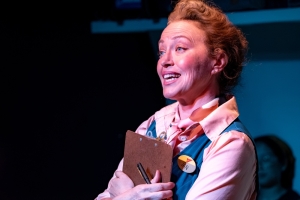
Rivendell Theatre Ensemble closes its milestone 30th season with Bonnie’s Last Flight, a sly, sky‑high comedy set during a flight attendant’s final day on the job - a blend of sharp satire and warm, traditional character comedy that’s genuinely, disarmingly funny. Jan has always carried a quiet love for writing, and now she’s earned a spot in an elite program - a dream she’s never fully allowed herself to chase. Handing over her wings means more than leaving the airline; it means finally giving herself permission to focus, to create, and to figure out who she is when she’s no longer defined by the job that shaped her life. But instead of treating her retirement as a tidy celebration, the play leans into the strange limbo that comes when a long‑held identity is about to disappear. Jan isn’t just stepping off a plane - she’s stepping out of the role that has shaped her routines, her friendships, and the way she moves through the world. That kind of transition can feel exhilarating, but it can also feel like freefall: What happens when the structure you’ve relied on for decades suddenly dissolves? Who are you when the uniform comes off?
Around her, the cabin is filled with a wonderfully mismatched crew navigating their own turbulence. Greig, her closest colleague - and one of the few people Jan truly considers family - is somehow the only person on board who doesn’t realize this is her final flight. While Jan quietly braces for the unknown, Greig clings to nostalgia – reminiscing about the 70s and 80s when people flew with style and grace, which in turn translated to proper behavior as passengers. LeeAnne, the rookie attendant, is still wobbling her way through the basics and is convinced the rest of the crew resents her simply for being young. Meanwhile, the Captain - who relies a little too heavily on mid‑air “comforts” - and the Co‑Pilot form an offbeat duo doing their best to keep the ride smooth and the mood light, even as everything around them threatens to veer off course. And then there’s Mark Twain – Jan’s guiding light and inspiration - drifting through the cabin like a sardonic travel spirit, adding an off‑kilter, almost dreamlike layer to the already unpredictable atmosphere. At any given moment, he might toss out a Twain‑ish zinger like, “Don’t argue with stupid people - they’ll drag you down to their level and beat you with experience.”
And yes - the title Bonnie’s Last Flight does mean something specific. The play waits to share it, and it’s worth letting that moment land on its own.
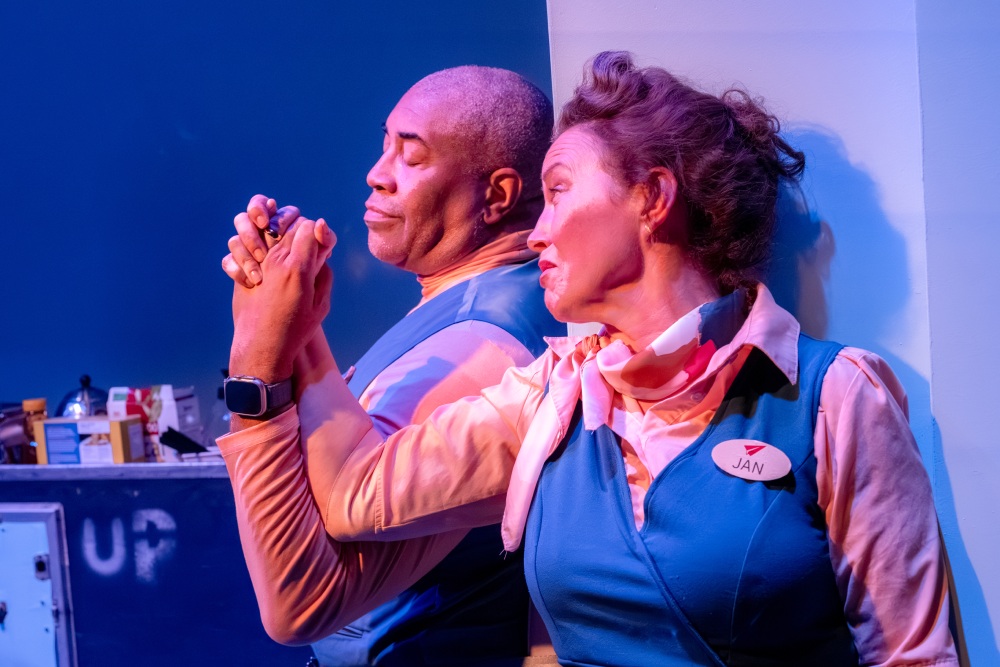
Paul Oakley Stovall as Greig and Rebecca Spence as Jan. Photos by Jenn Udoni.
Rivendell’s latest offering finds sharp, playful humor in every recognizable quirk of air travel - from the ritual of cramming bags into overhead bins to the exaggerated seatbelt pantomime, from the sad little routines of in‑flight food service to the collective sigh of a delayed takeoff, and even the inevitable moment when the Boingo internet keeps going down. Playwright Eliza Bent (The Regulars, Karen, I Said) threads these details together with wit and oddball charm - comic gold, really - especially in the way she captures the crew’s half‑coded, half‑conspiratorial communication style. Director Devon de Mayo amplifies that energy by staging the entire piece as an 85‑minute real‑time passage through the air on the gloriously scrappy Smelta Airlines, traveling from “use your imagination” to Chicago. Audience members are assigned boarding groups before entering, and once inside, the immersion never breaks - we are the passengers, and the cast treats us as such. In Rivendell’s intimate 40–50 seat house, the action unfolds close enough to feel immediate, with scenes playing out just a few feet away and often surrounding you entirely. Surprise song‑and‑dance numbers erupt out of nowhere and are executed with precision that feels almost impossible in such close quarters. As someone who now dreads flying, I thoroughly enjoyed being on this airborne adventure.
On top of the cleverly crafted script and fine‑tuned direction, the cast’s blend of Rivendell regulars with notable newcomers is the last flourish that makes the whole thing take off. Rebecca Spence, a longtime Rivendell ensemble member fresh off her appearance in Chicago Shakespeare Theater’s Fault directed by Jason Alexander and her screen work on Taylor Sheridan’s The Madison, returns with a commanding presence as Jan, grounding the production with a performance that moves effortlessly between wry humor and quiet emotional depth. Up close, we see what a truly talented actor she is - we feel every beat of her internal calculus, the uncertainty, the flickers of excitement, the moments of reflection, and even the disappointments, all delivered with a subtlety that makes her journey resonate long after the plane arrives in Chicago.
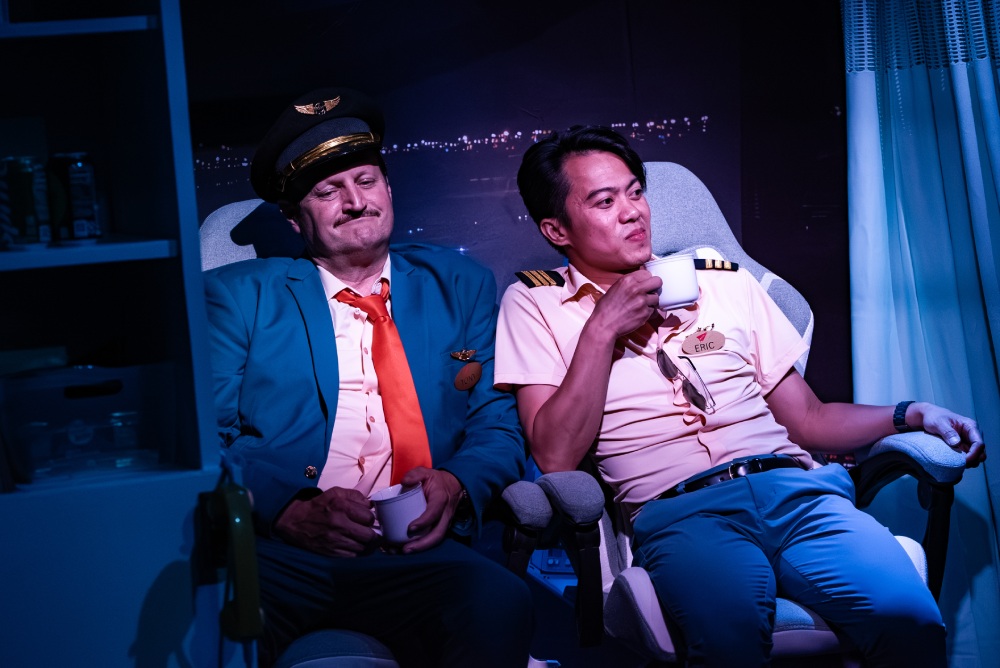
Eric Slater (left) as Pilot and Glenn Obrero as Co-Pilot in Bonnie's Last Flight.
Spence is joined by fellow Rivendell ensemble members Jessica Ervin, Eric Slater, and Glenn Obrero, each bringing sharp timing, confident comic instincts, and just the right touch of vulnerability when the moment calls for it, with Paul Oakley Stovall and LaKecia Harris rounding out the cast as fantastic additions who elevate the ensemble’s already cohesive dynamic.
Eric Slater’s dry‑witted Captain/Pilot lands every beat with understated precision, while Jessica Ervin’s off‑balance LeeAnne provides a wonderfully unpredictable charge that never feels forced. Glenn Obrero’s earnest Co‑Pilot (“Jesus,” as the Captain likes to refer to him), brings a lovable silliness along with genuine warmth, a combination that gives the show extra bounce. Paul Oakley Stovall, a standout as Greig, draws on his wide‑ranging stage experience to deliver a performance full of nuance, comic assurance, and centered emotional presence that adds unexpected depth to the production. The ensemble’s cohesion is further strengthened by LaKecia Harris, whose turn as Mark Twain brings a sly, confident rhythm that meshes seamlessly with the group’s comic fabric. Together, they’re dynamite - fully in tune with one another and performing with the cohesion of a team that’s been flying together for years.
At its core, Bonnie’s Last Flight is less about airline chaos and more about the uneasy moment when a person realizes the next chapter of life doesn’t come with a boarding pass. Jan is standing at the edge of retirement, a place where excitement and dread blur together. Leaving a long‑standing job can feel like stepping off a moving walkway: suddenly the rhythm that shaped your days disappears, and you’re left wondering who you are without the role that once defined you. While Jan wrestles with that quiet panic, the rest of the cabin spirals in their own directions - LeeAnne dodging emotional landmines, the Captain leaning too hard on liquid courage, and Erik trying to squeeze a thought into the noise. Beneath the jokes and mishaps, the play nudges at something more human: the fear of losing purpose, the hope of reinvention, and the strange freedom that comes when life forces you to start over.
This design team gives us the feel of being inside an airplane, creating an environment that gently echoes the experience of settling into a cabin. Scenic designer Regina García shapes Rivendell’s intimate space into a compact aircraft interior, complete with a cockpit, a small lavatory, a food‑and‑drink station, and lighted walkways that recall the soft glow of aisle markers guiding passengers to their seats. Saawan Tiwari’s costumes reinforce the world with grounded, character‑specific details that nod to real airline crews without slipping into caricature. Garnett Bell’s lighting adds subtle shifts that mirror the ambience of a cruising cabin or the quick changes that accompany an announcement. And Satya Chavez’s sound design supplies the familiar chimes, the pressurized hush of doors, and the clipped rhythm of airline instructions, creating an auditory landscape that instantly situates us in the sky.
In short: Bonnie’s Last Flight promises a strange, playful, and slightly chaotic airborne adventure - a character‑driven comedy about people stuck in the sky and stuck in their lives, trying to figure out what comes next. The humor lands repeatedly with precision, but what ultimately gives the show its staying power is the heart that surfaces beneath and during the laughs - those small, sincere moments of connection and longing that linger long after the final descent.
Already extended to October 25th at Rivendell’s home on Ridge Avenue, this production is a sure‑fire good time that’s sure to send you back to the friendly skies with a smile. For tickets and more show info, visit https://www.rivendelltheatre.org/bonnieslastflight.
Highly recommended.
Overshadowed's Flame of Fire Finds Humanity, Strength, and Forgiveness in a Tragic Chapter of Missionary History
Overshadowed Productions’ Flame of Fire revisits one of the most polarizing true stories in mid‑century missionary history, and the result is a tense, deeply human portrait of faith, conviction, and consequence. Written by Artistic Director Reba Hervas, the play draws not only from the well‑known documentary Beyond the Gates of Splendor and Elisabeth Elliot’s landmark book Through Gates of Splendor, but also from factual accounts, personal testimonies, and historical insights provided by Wheaton College scholars. The play traces the 1956 Operation Auca mission, in which five young missionaries - Jim Elliot, Nate Saint, Pete Fleming, Ed McCully, and Roger Youderian - travel into the Ecuadorian jungle determined to make peaceful contact with the isolated Huaorani tribe. Their optimism is met with tragedy when all five men are killed, an event that reverberated across the world and became a defining moment in evangelical culture. But Flame of Fire doesn’t stop at the violence. It follows the wives and families who later returned to the same tribe, choosing forgiveness over fear and reshaping the narrative into one of radical grace. Hervas frames the story with a clear‑eyed awareness of its complexities, allowing audiences to sit with both the aspiration and the cost. The production leans into the emotional weight of the material without sensationalizing it, offering a thoughtful, layered retelling of a chapter that still resonates today.
The play opens in 1945, grounding the audience in a postwar world where hope and hardship collide, and where five young men feel an urgent, almost electric calling to spread the gospel to places untouched by Western faith. Flame of Fire takes its time introducing each missionary as he meets the woman who will become his partner in life and in purpose, framing these courtships not as sentimental detours but as the emotional backbone of the story. Their marriages are depicted with sincerity and momentum, fueled by a shared passion to carry Christianity into remote corners of the world no one in their circles had ever seen. It’s a gentle beginning that underscores the idealism, devotion, and innocence that will later be tested, making the eventual tragedy feel all the more profound.
Though Jim Elliot is often the first name associated with this story - largely due to Life Magazine’s coverage that reached 30 million readers at the time - Hervas centers the narrative on pilot Nate Saint, portraying him as the driving force behind Operation Auca, its planner, organizer, and steady motivator. By the early 1950s, the missionaries had already arrived in Ecuador and were serving in various regions, ministering to other Indigenous communities and building relationships that laid the groundwork for the efforts that would eventually become Operation Auca. Their work during these years established the practical experience, cultural understanding, and collaborative momentum that shaped the mission long before contact with the Huaorani was ever considered.
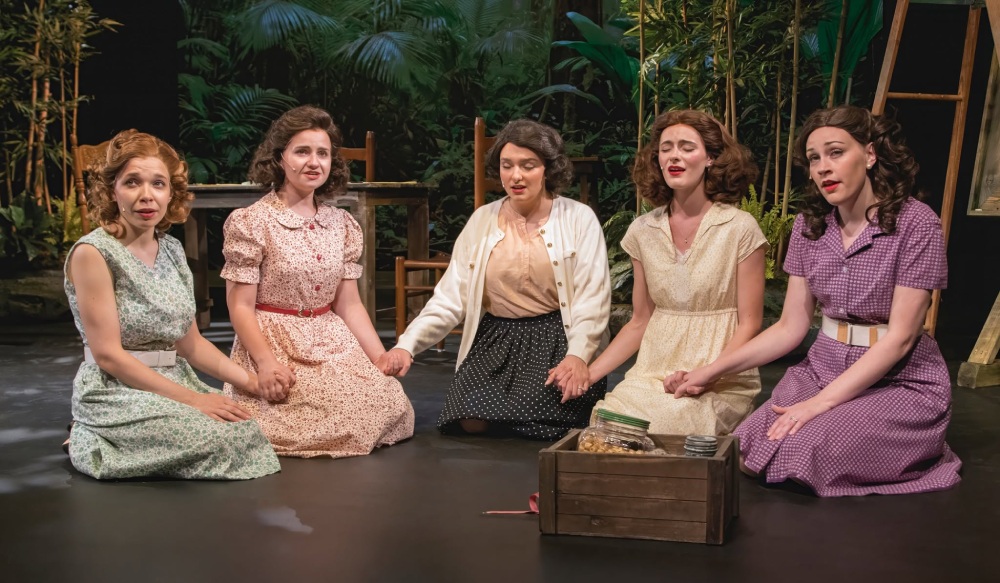
That operation truly begins in 1955 after Saint spots an isolated Indigenous community during one of his flights, a discovery that sets everything that follows into motion. The Huaorani tribe, known for both hostility and intense internal warfare that threatened their own survival, had a population of only about 500 when the missionaries first attempted contact. Their initial introduction came through gifts dropped from Saint’s plane, a cautious gesture meant to build trust from a distance.
Though Saint emerges as the central figure of the mission, Elliot’s influence is still woven throughout the narrative, especially in his declaration that he is God’s “flame of fire,” a metaphor for his calling to spread the gospel with absolute conviction. The play also incorporates several of Elliot’s writings, later collected by his wife Elisabeth after his death, including his well‑known line: “He is no fool who gives what he cannot keep to gain that which he cannot lose.” In the context of the story, the quote underscores Elliot’s belief that sacrificing one’s earthly life in service of faith is not a loss, but an exchange for something eternal - a sentiment that becomes hauntingly resonant as the mission unfolds.
Overshadowed’s ensemble brings sincerity and cohesion to Flame of Fire, with each missionary paired thoughtfully with the woman who shares his calling. Justin McHugh and Leah Johansen anchor much of the story as Jim and Elisabeth Elliot, while Jacob Starr and Emily Starr bring warmth and resolve to Nate and Marjorie Saint. Andrew Dille and Madelyn Jones portray Pete Fleming and Olive Ainslie with gentle conviction, and Alex Kretschmer and Olivia Orsag give Ed and Marilou McCully a grounded, earnest presence. Benjamin Nelson and Betsy Richman round out the group as Roger and Barbara Youderian, offering a steady, heartfelt partnership. Together, the cast forms a unified portrait of faith, devotion, and the human ties that shaped this historic mission.
Jacob Starr’s portrayal of Nate Saint is especially striking. From his first entrance, standing across the stage with the other missionaries, he flashes a wide, earnest smile that feels genuine, full of promise, and quietly selfless. Even though Saint is known as “the man who could fix anything” and often carries himself with a no‑nonsense, mission‑first focus, that smile keeps returning, reminding us of his deep excitement and unwavering joy in the work he feels called to do. And in the moments after his death, when he appears again among the group, the smile remains - a subtle, moving reassurance that he died doing exactly what he believed in most: sharing God’s work with those who had never heard it.
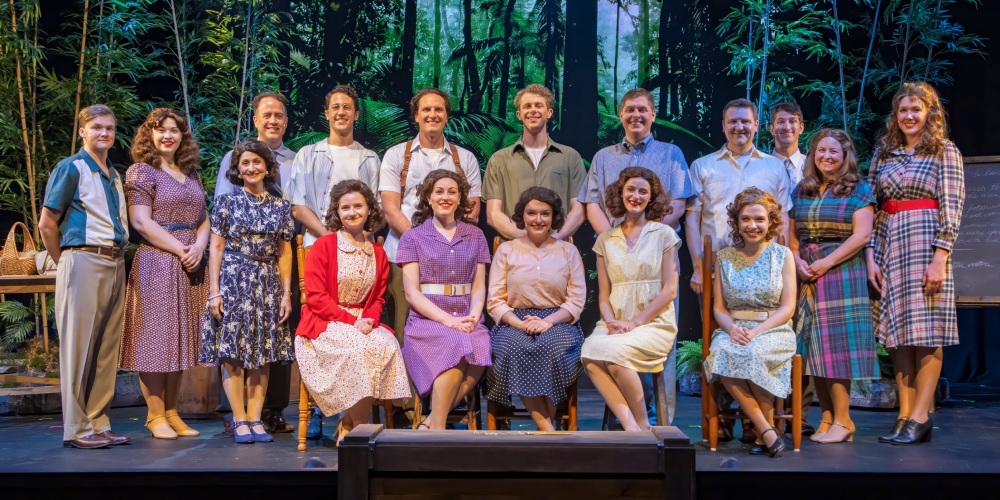
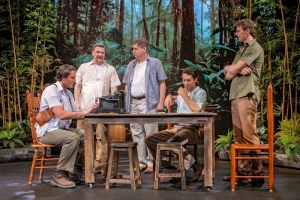
The cast of Flame of Fire by Reba Hervas by Overshadowed Theatrical Productions.
The set design, led by Scenic, Projection, and SFX Designer Yohannan Lee, adds an impressive layer of storytelling to Flame of Fire. Act I moves fluidly through key locations, beginning at Wheaton College where Jim and Elisabeth first meet, then shifting to other formative moments in the missionaries’ early lives. These transitions are made seamless by a massive video board at the rear of the stage, which Lee uses to create crisp, immersive backdrops that keep the narrative visually anchored. But it’s Act II that truly transports the audience: once the story reaches Ecuador, the stage blossoms into a lush rainforest environment. Towering exotic trees, dense shrubs, and textured greenery surround the missionaries’ campsite, blending physical foliage with atmospheric projection work to evoke the depth and isolation of the jungle. The result is a vivid, enveloping world that makes the shift from American college life to the Amazon feel both dramatic and authentic.
Though criticisms have been brought to light in recent years, particularly in cases where missionary work aligned with power, assimilation, or cultural disruption through colonial empires, governments, or corporations, Flame of Fire shows that another side of missionary history exists, revealing a contrasting perspective defined not by dominance but by unselfish people driven by a sincere passion to share the gospel and help communities in need. The missionaries in this story are portrayed as embracing and appreciating Huaorani culture rather than seeking to overwrite it. Their stated purpose, “We are not here to impose, but to show them a new way,” reflects a posture of humility rather than dominance. The production underscores the practical support they offered as well: medical care for infections and injuries, assistance with childbirth, treatment for illnesses, and help navigating crises that had long gone unaddressed. In this telling, their faith is expressed through service as much as through preaching, and their motives are framed as deeply personal rather than political.
The play also widens its scope to reveal the larger forces threatening the Huaorani people in the 1950s. The courage of the wives is made unmistakably clear, returning to the very people who speared their husbands to death with a resolve that feels almost unimaginable. Big oil companies, working with the Ecuadorian government, coveted Huaorani land for new oil fields and expected the tribe’s internal conflicts to wipe them out - and if not, planned to forcibly remove them. That trajectory changed when the missionaries’ wives returned after the killings, some choosing to live among the Huaorani. Their presence helped foster peace, reduce violence, and stabilize the community in ways the play presents as lifesaving. Anthropological research often confirms that the Waodani (the tribe’s self‑name) spearing feuds were unsustainable and that the tribe actively chose to end the killings once introduced to the concept of forgiveness. The population grew instead of disappearing. And in one of the story’s most powerful arcs, the very men who killed their husbands later became Christians themselves, forming lifelong bonds with the missionaries’ families, relationships depicted as genuine, mutual, and rooted in grace. In Flame of Fire, the positive motives of these missionaries are made unmistakably clear, offering a portrait of faith expressed through compassion, reconciliation, and enduring human connection.
Flame of Fire is a moving, meticulously crafted production that balances historical weight with heartfelt storytelling, offering audiences a rare look at the compassion, conviction, and humanity behind a famously tragic chapter of missionary history. Overshadowed Productions brings sincerity, artistry, and emotional clarity to every corner of the stage, creating a piece that resonates long after the final scene. This is a powerful, beautifully rendered play that deserves to be seen, discussed, and remembered. Flame of Fire runs through October 10th and can be experienced at Jubilee Bible Church in Medinah, and comes recommended.
- Overshadowed Theatrical Productions
- Flame of Fire
- Jim Elliott
- Elisabeth Elliott
- Nate Saint
- missionaries
- Operation Acua
- Reba Hervas
- Through Gates of Splendor
- Wheaton College
- Justin McHugh
- Leah Johansen
- Jacob Starr
- Emily Starr
- Andrew Dille
- Madelyn Jones
- Alex Kretschmer
- Olivia Orsag
- Benjamin Nelson
- Betsy Richman
- Medinah
- live theatre
- on stage
- Chicago events
- Jubilee Bible Church
- moving drama
- true life events
- Pete Fleming
- Ed McCully
- Roger Youderian
Kokandy Productions’ Jekyll & Hyde: A Fearless Reworking Elevated
Kokandy Productions’ Jekyll & Hyde, now presented by Broadway In Chicago at the Broadway Playhouse, arrives with the momentum of a bona fide Chicago phenomenon. After its run at Chopin Theatre was extended again and again - an almost unheard of feat for an intimate, homegrown musical - the show has now been picked up for a full commercial engagement, marking a major leap for the company and a testament to the production’s electric word of mouth. It is worth noting just how rare this is: Broadway In Chicago almost never transfers storefront productions, making this pickup one of the most significant Chicago theatre success stories in recent memory. Conceived for the stage by Steve Cuden and Frank Wildhorn, this staging proves how a storefront success can scale beautifully without losing its bite.
This reimagined take on The Strange Case of Dr. Jekyll and Mr. Hyde, drawn from Robert Louis Stevenson’s classic story, uses Leslie Bricusse’s book and lyrics to follow Dr. Jekyll, a brilliant yet splintering scientist whose compassion fuels his most dangerous ideas. He turns to self‑improvement experiments - attempting to isolate and remove the darker impulses that plague human behavior. Only after the town council votes down his proposal to move forward does Jekyll test his theories on himself, unleashing a violent alter ego - Mr. Hyde - that refuses to stay contained and seeks revenge on those who dismissed his ideas as reckless.
While Jekyll’s experiments drive the plot, the production grounds his unraveling in two sharply drawn relationships: his earnest, hopeful romance with Emma and his complicated, magnetic connection with Lucy. Emma represents the future he’s desperate to protect, while Lucy embodies the vulnerability and desire he can’t fully control. Together, they give the story its emotional spine, showing how Jekyll’s transformation fractures not just his identity, but the lives of the women who care for him.
Kokandy dives into the duality with sharp humor, vivid theatricality, and a pulsing score that turns the transformation into both a spectacle and a psychological spiral. As Jekyll’s world cracks - friends endangered, morality blurred, identity slipping - the production keeps the tension taut, balancing gothic thrills with a surprisingly human core.
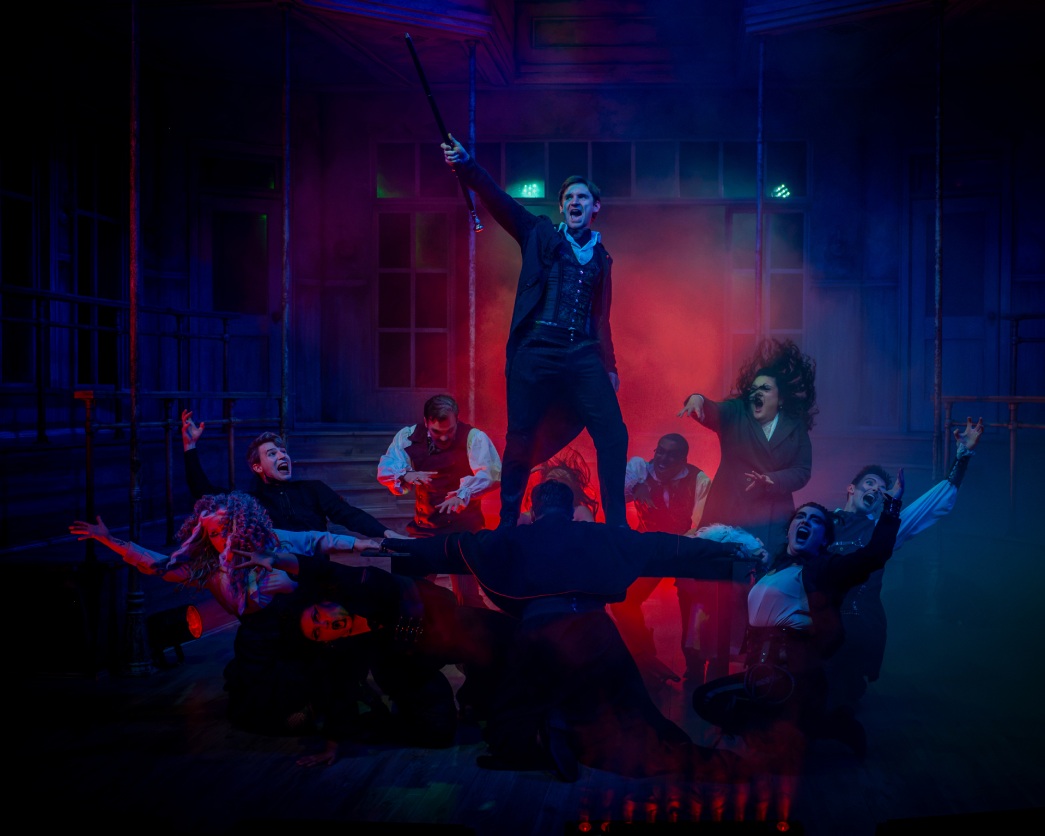
(center) David Moreland and the cast of Kokandy Productions’ production of Jekyll & Hyde.
What makes this staging stand out is its inventiveness: clever staging, bold physicality, and a cast that commits fully to the grotesque and the gorgeous – and, wow, can they sing. It’s no surprise audiences kept returning at Chopin, pushing the run far past its original closing date. That groundswell of audience demand is precisely what caught Broadway In Chicago’s attention - a level of traction strong enough to propel a storefront musical into a full commercial engagement. Seeing it now elevated to the Broadway Playhouse feels like the rare occasion when Chicago’s storefront originality gets the larger platform it deserves. In fact, upon entering, guests are handed stickers to mark how many times they’ve seen the show. Whether it’s their first visit or their seventh - the highest number I spotted - theatergoers wear it proudly, a small but telling sign of the cult‑like enthusiasm surrounding this production.
Directed by Producing Artistic Director Derek Van Barham, this production thrives on a razor‑sharp sense of style and drive. Van Barham shapes Jekyll & Hyde with the confidence of someone who knows exactly how to blend horror and heart into one seamless theatrical rhythm. A kinetic drive and deft wit run through the score thanks to Nick Sula’s music direction, ensuring crisp transitions and character‑focused vocal work. With a rare 15‑piece live orchestra on stage, the production’s musical power hits with a fullness and immediacy that elevates every passage. Brenda Didier’s choreography is the secret weapon — precise, playful, and radiating personality, it turns the show’s physicality into storytelling and amplifies the divide at the center of Jekyll’s collapse.
Kokandy’s ensemble fires on all cylinders, creating a production that feels both wickedly fun and sharply realized. David Moreland anchors the show with a riveting, shape‑shifting performance as Dr. Henry Jekyll and Mr. Edward Hyde, his vocal work and physical transformations giving the story its ferocious pulse. Moreland delivers a performance of remarkable physical and emotional intensity, one that stands out among the strongest I’ve seen. With visceral depth and vocal heat, Ava Lane Stovall shapes Lucy Harris into a woman suspended between danger and desire, her performance threading vulnerability through every moment of volatility. She makes Lucy’s internal tug of war feel immediate, giving the role a current that’s both seductive and unsettling. Meanwhile, Emily McCormick’s Emma Carew delivers a beautifully grounded counterbalance, her warm, expressive songs reinforcing the production’s moral center and offering the steadiness Jekyll’s world so desperately lacks.
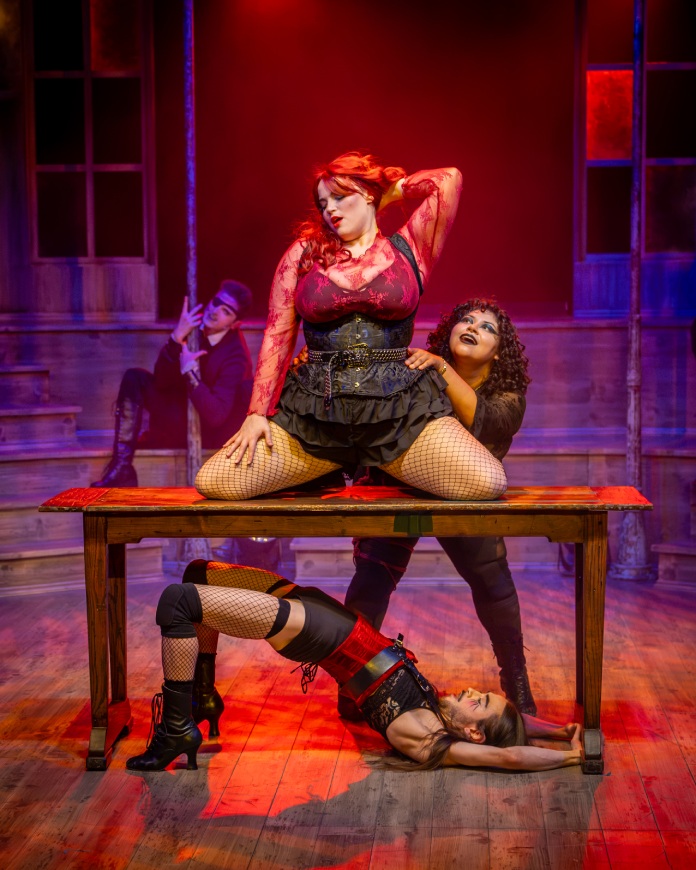
(center) Ava Lane Stovall with (left to right) Quinn Kelch and Ismael Garcia and (below) Quinn Simmons in Kokandy Productions’ production of Jekyll & Hyde.
As Simon Stride and Spider, Quinn Kech moves effortlessly between clipped propriety and feral swagger, pairing sharp character work with vocals that cut cleanly through the score. A steady moral throughline comes through in Kevin Webb’s Gabriel John Utterson, his warm baritone and grounded presence giving the story its emotional ballast. Nathan Calaranan brings a dignified, resonant authority to Sir Danvers Carew, shaping each turn with clarity and restraint. Around them, the ensemble meets the material with full‑throated commitment - singing with power, acting with specificity, and charging every scene with the kind of collective intensity that makes this production feel larger than its footprint. Led by Jeff Award winners Moreland, Stovall, and McCormick, the ensemble’s collective impact makes this Dr. Jekyll & Mr. Hyde feel vividly, thrillingly alive. The extended applause throughout the night were frequent and fully deserved.
The reimagined score is one of the production’s greatest triumphs, built on Frank Wildhorn’s music, yet reshaped into something leaner, sharper, and far more theatrical. Kim Scharnberg’s orchestrations give the music its dark, muscular edge, while Jason Howland’s arrangements sharpen its modern undercurrent. The orchestrations feel slyly contemporary and richly atmospheric, giving the story a sonic identity that matches Kokandy’s confident staging. Sula ensures every number lands with intention, whether it’s a brooding solo that tightens like a vice or an explosive ensemble sequence that floods the stage with adrenaline. And the vocal performances? They’re extraordinary – out of this world, presented with a clarity and force that elevate every musical moment.
The set evokes the grit and pressure of 1880s London without ever changing, a circular playing space with elevated risers that let the cast surround the action and heighten every moment of tension. Scenic designer Sotirios Livaditis, U.S.A., builds a world that’s intentionally fixed yet remarkably flexible, giving the ensemble multiple levels and angles to push the story forward. G. “Max” Maxin IV’s lighting and Matt Reich’s sound design sharpen that sense of immersion, shaping mood, focus, and dramatic impact from scene to scene. This talented design team gives us a unified environment that feels alive in its stillness - a single space that transforms through performance rather than mechanics.
Jekyll & Hyde comes highly recommended, not only for its inventive reworking but for the sheer theatrical command Kokandy brings to the Broadway Playhouse stage. Presented by Broadway In Chicago, the production (already extended) runs through November 8, 2026 at the Broadway Playhouse at Water Tower Place, with a runtime of 2 hours and 35 minutes including an intermission. It’s a bold, stylish, and wildly entertaining take on a classic tale - one that proves Kokandy’s storefront artistry can thrive beautifully on a commercial stage. I walked away from this production genuinely amazed, struck by how fully Kokandy has transformed a familiar title into something fresh, fearless, and alive. It’s a milestone not just for Kokandy, but for Chicago theatre itself - a reminder that the city’s most daring work can rise all the way to the downtown marquee.
- Jekyll Hyde
- Kokandy Productions
- Broadway Playhouse
- Robert Louis Stevenson
- Dr Jekyll Mr Hyde
- Derek Van Barham
- Nick Sula
- Brenda Didier
- David Moreland
- Ava Lane Stovall
- Emily McCormick
- Quinn Kech
- Nathan Calaranan
- Kevin Webb
- Musical theatre
- live theatre
- on stage
- Chicago events
- Broadway in Chicago
- classic
McHenry Outdoor Theater: Nostalgia With a Modern Heartbeat
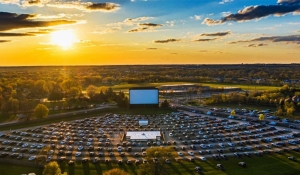
There was a particular kind of magic to seeing a movie outside when I was a kid in 1970s Chicago - a feeling that lived somewhere between summer air and pure possibility. Back then, drive-ins still dotted the map, and a couple sat right at the city’s edge: the Bel Air Drive-In in Cicero and the Harlem Outdoor Theater at Harlem and Irving in Norridge, each glowing like its own little universe. An evening at either of them felt bigger than the movie itself - the slow parade of cars, the metal speakers crackling to life, the giant screen lighting up the sky as if it were waking the stars. Those memories stayed with me long after drive-ins began to disappear nationwide, as owners sold their land for residential and commercial development, leaving only a small fraction of drive-in theaters still standing.
As the years went by, the drive‑ins of my childhood faded into a soft, far‑off memory, the kind that settles into the back of your mind and stays there untouched. So, when I visited the McHenry Outdoor Theater for the first time in 2017, I wasn’t chasing nostalgia so much as testing whether that old spark still existed. It did - and then some. The drive from Chicago isn’t terribly long, and it’s surprisingly scenic - the kind of easy stretch where you throw on your favorite true crime podcast, settle in, and enjoy the ride. We make regular weekend trips from Chicago to McHenry now, and every visit feels like a small gift. If you already live nearby, what a bonus - you’re even closer to one of the last places where that childhood wonder still flickers to life every time the projector starts to glow.
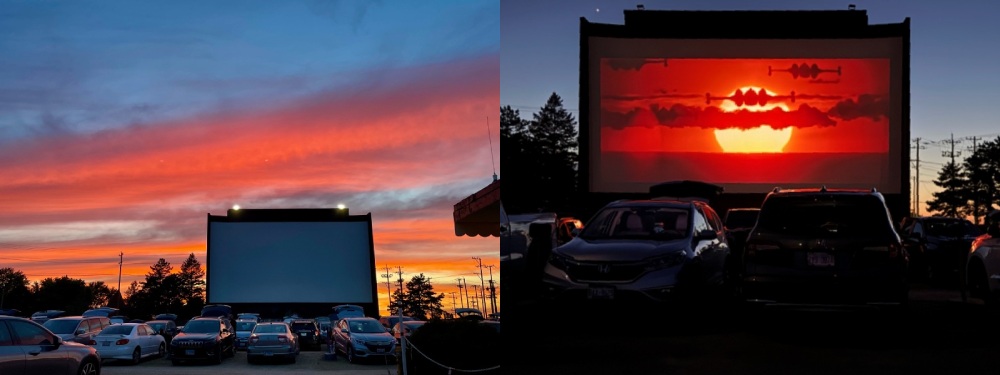
The sunset sets the stage, the screen takes it from there. Photos by Ken Payne.
Why Write About a Drive-In on a Theatre and Dance Site?
Even though McHenry Outdoor Theater sits outside the world of proscenium arches and sprung floor studios, it belongs in the same constellation of live, communal storytelling that theatre and dance celebrate. A drive-in may swap footlights for headlights and velvet seats for lawn chairs, but the heart of the experience is strikingly similar: people gathering in a shared space, settling in as dusk falls, and giving themselves over to a story unfolding on a giant stage. There’s ritual, anticipation, atmosphere - the same ingredients that make live performance feel alive. It’s another place where art meets audience in real time, where community forms in the dark, and where the night itself becomes part of the show.
The Fun Before the Movie Starts
Going to the McHenry Outdoor Theater isn’t just catching a movie - it’s giving yourself over to an entire summer evening. McHenry generally opens its gates about two hours before showtime, which means there’s plenty of room for the night to breathe and unfold. Families and friend groups spill into the grassy areas, tossing frisbees, batting birdies, kicking soccer balls, or setting up little picnic spots. Kids chase bubbles, play tag, or run around in that wide-open space that feels tailor-made for burning off energy. Solo guests wander the property, stretch out in camp chairs with a book, snap sunset photos, or just enjoy the easy rhythm of people arriving. Some folks grab dinner from the concession stand, others unpack coolers and fold-out tables, turning their parking spot into a tiny outdoor dining room. By the time the screen flickers to life, you’ve already had a full evening - the movie becomes the final chapter.
Double Features, Nostalgic Snacks, and Throwback Magic
McHenry keeps the classic drive-in rhythm alive with two features every night, separated by an intermission that always includes a throwback countdown cartoon - you know the one, with dancing popsicles and ice cream bars, hot dogs doing circus tricks, and cheerful little characters racing toward the concession doors every time the countdown number drops. It’s a charming time capsule that sets the countdown and taps straight into the old-school drive-in joy that’s defined summer nights for generations. The concession stand only adds to the retro charm, serving old-time candies, brats, burgers, pizza, chicken sandwiches, nachos, soft drinks, and what might honestly be the best popcorn around.
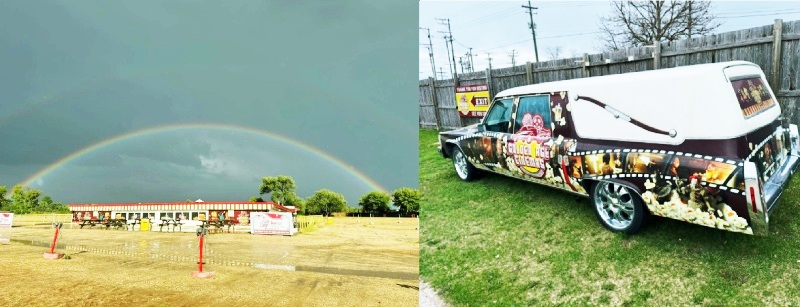
A rainbow beyong the vintage concession stand. Photo courtesy McHenry Outdoor Theater. The McHenry Outdoor Theater Hearse. Photo by Ken Payne.
Seven Days All Summer / Fridays & Saturdays in the Extended Season
McHenry is open seven days a week from Memorial Day through mid‑August, giving guests the freedom to enjoy the grounds whenever the mood strikes. They offer a season pass that covers one carload for the entire year - and includes a free bucket of popcorn every visit - for around $300. Depending on how many people you bring, it can pay for itself in just a handful of trips. During the full summer season, there’s also $15 carload night every Tuesday and Thursday, and $2 hot dog night every Sunday. And unlike most Midwest drive‑ins that shut down for half the year, McHenry opens its season in mid‑March or early April and keeps the movies going almost to Christmas. Outside of those peak summer months, the drive‑in remains a reliable weekend destination, operating on Fridays and Saturdays.
Merchandise and Keepsakes
Beyond the food and films, McHenry has built a small but thoughtful selection of drive-in merchandise that fans love to browse between features. Blankets, baseball hats, hoodies, and tees line the shelves, each one stamped with the McHenry Outdoor Theater logo - the kind of keepsakes that let people take a little piece of the night home with them. It’s all part of the atmosphere: a place where the movies, the memories, and even the merch feel like they belong to the same warm tradition.
Speakers, Sound, and Film Lineup
While the original external speakers on poles still stand throughout the lot, they’re mostly aesthetic now - a nostalgic nod to the past. Today, the theater uses powerful external speakers that radiate sound across the grounds, giving the whole place a warm, ambient audio bed. To actually pick up the movie’s soundtrack, you tune your car radio to the FM station or bring (or rent) wireless FM speakers for a cleaner, fuller boost. And the film lineup is its own kind of magic: a mix of new releases and beloved throwbacks like Jaws, Grease, The Goonies, American Graffiti, and Raiders of the Lost Ark. At McHenry, the movies fold into the atmosphere of the night.

Charlie Hustle - Drive-In dog extraordinaire. Summer fun (left) and cuddling up in the car during a winter feature. Photos by Ken Payne.
Bring the Dog - They’re Part of the Experience
Dogs aren’t just allowed at McHenry - they’re part of the charm. There’s nothing better than your pup curling up beside you as the sky darkens and the first feature flickers to life. And if your dog is more of an explorer, the wide-open lot becomes a world of new smells and friendly encounters. Many guests take their pups on a full lap around the perimeter of the grounds, a slow, easy tour that lets them sniff every corner and take in the night. Whether stretched out on a blanket or trotting around to explore, having your dog with you makes the night even better.
Choose Your Setup - Creativity Encouraged
There are countless ways to enjoy a movie at McHenry. You can watch the traditional way - parked head-on, windows down - or back into your spot, pop the hatch, and turn the rear of your vehicle into a cozy den. Over the years, many regulars have leveled up their setups into full outdoor living rooms: folding recliners, tables, FM speakers, tarps, mosquito-repellent candles, dog beds, and whatever comforts they dream up. Half the fun is seeing how everyone builds their own setup. You’ll spot inflatable mattresses in truck beds, swinging chairs, and clever canopy structures that stay low enough not to block anyone’s view. At McHenry, the movie is only part of the experience; the way people build their own little worlds for the night is also part of the adventure.
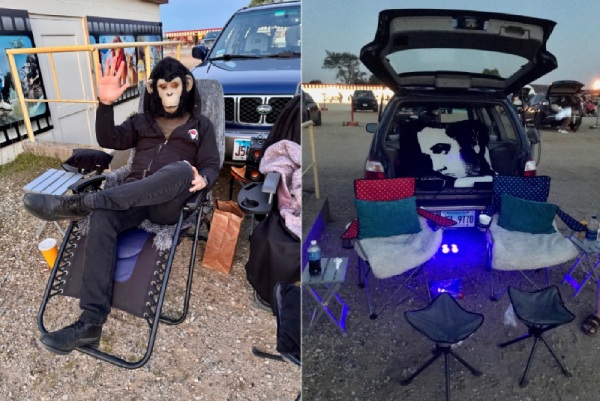
Chairs out, monkey mask on it’s Planet of the Apes time at the drive‑in. Photos by Ken Payne.
A Rare Survivor of a Fading American Tradition - 75 Years!
At their peak in the 1950s and 60s (then still named Sky Line Drive-In), the United States had more than 4,000 drive-ins. The numbers tell the story: thousands in the ’70s, fewer than a thousand by the end of the ’80s, and only around 300 left today. That’s part of what makes the McHenry Outdoor Theater - built in 1951 and now celebrating its 75th anniversary - feel so meaningful. It is a living piece of American moviegoing history, still doing what so many others couldn’t hold onto. And this season, they’re marking the milestone with all kinds of promotions, including a massive giveaway offering free movies for the next 75 years to some lucky fans (I'd only be 134 years old when it expires).
And can you imagine the wonderful cars from the late 1940s and early 1950s parked throughout the lot when it first opened? On a warm summer night, families spread out across the gravel just as generations before them did, and it’s easy to picture what those early evenings looked like: rows of gleaming Chevrolets, Studebakers, and Ford Fairlanes easing into their spots, chrome catching the last of the daylight. Windows were rolled down as the hum of summer drifted through the air, the smell of fresh-cut grass mixing with a faint hint of gasoline. Elvis Presley crackled through AM radios - maybe "Heartbreak Hotel" or "Hound Dog" - while kids in cuffed jeans and saddle shoes raced to the concession stand for popcorn and fountain sodas. The screen towered over it all like a beacon, pulling everyone into a story as fireflies blinked across the lot. Today, the cars and the music may be different - or sometimes the same - but we’re still out here doing what they did then, reliving yesterday in our own way.

McHenry Outdoor Theater owner Scott Dehn. Photo courtesy McHenry Outdoor Theater.
Scott Dehn’s Vision: Nostalgia with a Modern Touch
Owner Scott Dehn, now in his 26th year, has done far more than keep the grounds tidy and the towering six-story screen in pristine shape. He guided the theater through the costly transition from analog film to digital projection, refreshed the concession area, expanded food options, added powerful external speakers, introduced tiered parking from VIP to standard, updated the bathrooms, and even added a selection of alcoholic beverages. He’s also woven cinematic aesthetic touches throughout the property, deepening the atmosphere and honoring the theater’s history. As Scott likes to say, McHenry offers “nostalgia with a modern touch” - and he’s absolutely right.
Enter Joe Cicero: Marketing, Community, and Big Ideas
Scott expanded his vision by bringing in Joe Cicero, a beloved longtime radio personality with deep roots in McHenry County, to serve as Director of Promotion and Marketing. Together, they’ve turned the theater into a nonstop engine of creativity: family value packs, themed nights like the wildly popular John Hughes triple feature, Bring Your Dog Night (complete with adoptable pups), and movie-themed car photo ops. They’ve partnered with local businesses for specialty snacks, art, and clothing pop-ups, and they often spotlight local singers by inviting them to perform the National Anthem before showtime. On occasion, they even bring in hometown bands to play live sets before the movie, adding an extra layer of energy and connection to the night. They also support organizations like Lamb’s Farm by selling their baked goods. If you can dream it, Scott and Joe are probably already planning it.
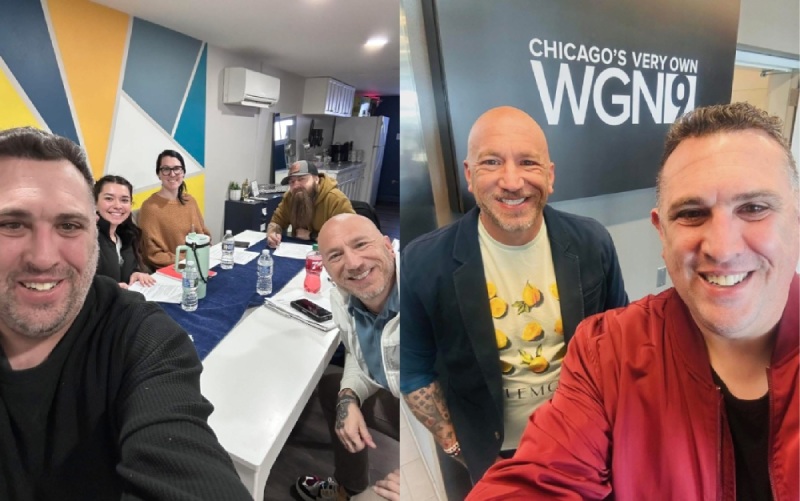
The team that makes it happen. Photo 1 (left to right) Joe Cicero, Director of Promotion and Marketing, Emily Knapik, General Manager, team members and Scott Dehn, Owner. Photo 2 (left to right) Scott Dehn and Joe Cicero. Photos courtesy McHenry Outdoor Theater.
Special Events, Themed Nights, and Seasonal Programming
McHenry Outdoor Theater celebrates its 75th anniversary with the kind of creativity and community spirit that has become its signature. All summer long, they’ve leaned into the milestone with special promotions and double features, including a partnership with Martin Chevrolet, who sponsored a one-day celebration where the first 75 cars were admitted completely free - a perfect nod to the drive-in’s 75 years of moviegoing history. On Fourth of July weekend, they hosted one of their biggest events ever when Major League Baseball selected McHenry as one of only four drive-ins nationwide for its America250 Summer Drive-In celebration. MLB rolled in a 43.6-foot-wide LED screen bright enough for daylight viewing, screened The Sandlot, hosted a live Cubs vs. Cardinals watch party, and capped the night with a full fireworks show over the grounds - a sellout event that felt like a love letter to American moviegoing. And the excitement isn’t ending with the anniversary year: McHenry plans to bring the MLB event back in 2027, keeping the momentum going into next season.
Themed nights remain a major draw, including this weekend's John Hughes Night with a triple feature of Ferris Bueller’s Day Off, The Breakfast Club, and Sixteen Candles, bringing fans back to the golden age of Chicago-made cinema and honoring the filmmaker whose stories defined a generation. Then, on August 28th and 29th, they’ll host Bring Your Dog Night with Scooby Doo and Beethoven, a crowd favorite that turns the lot into a tail-wagging celebration for movie lovers and their pups. The entire Back to the Future trilogy will follow on October 2nd and 3rd, a perfect fall throwback for longtime fans and a tribute to one of the most beloved time-travel stories ever put on film. And not long after, horror fans get their own treat with a full triple feature of A Nightmare on Elm Street, Friday the 13th, and Texas Chainsaw Massacre (all the originals) October 23rd and 24th, keeping the spooky season alive in true drive-in fashion.
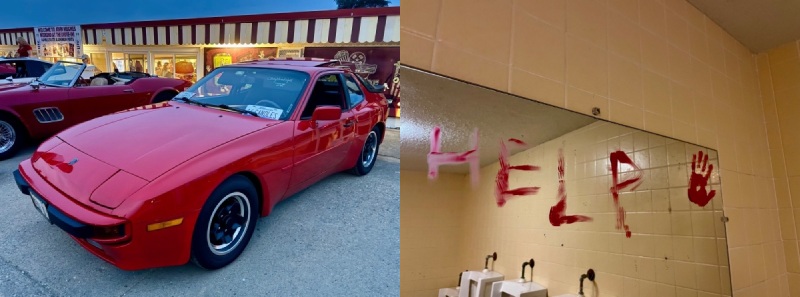
Theme nights are highly popular. Replica cars were displayed from Sixteen Candles and Ferris Beuller's Day Off for John Hughes Triple Feature Night 2025 (left). Horror nights are always fun at McHenry Outdoor Theater. Photos by Ken Payne.
As Halloween approaches, McHenry leans even further into the horror genre, scheduling classics like The Exorcist, Poltergeist, Halloween, and The Conjuring - a lineup that gives fans a chance to revisit some of the most iconic scares ever put on film. And while most drive-ins close for half the year, McHenry keeps the energy going almost to Christmas, transforming the lot into a cozy cold-weather movie haven. Winter brings visits with Santa Claus, a hot chocolate station with all the works, and chilly double-feature throwbacks where guests can bundle up under blankets and watch movies flicker against a winter sky. They plan to feature a Christmas throwback movie throughout November and December, screening it each Friday and Saturday, with admission set at just $15 per vehicle - one of the most affordable holiday outings around. With an off-season of only about three months or so, McHenry remains a year-round destination for classic drive-in spirit, community, and the kind of movie glow that keeps this place thriving decade after decade.
A Staff That Makes the Place Feel Like Home
Another part of what makes McHenry so welcoming is its staff, led in part by Emily Knapik, General Manager, whose friendly presence sets the tone for the entire team. They help with everything from stubborn headlights (tip: engaging the parking brake often works) to lowering hatches so no one’s view is blocked. They patrol the lot, assist with concessions, and even offer a jump-start service for anyone who drains their battery. But mostly, they’re there to assist patrons with whatever’s needed to make the evening smoother, more fun, and completely hassle-free. It’s the kind of attentive, good-natured support that makes the place feel like a community rather than just a venue.
On most nights, you’re likely to spot Scott, Joe, or Emily making their rounds - sometimes all three - always quick with a friendly wave or hello. They’re the steady heartbeat of the place, the folks who keep things running smoothly while making every guest feel like they belong, and they’re a big part of what makes McHenry feel so welcoming.
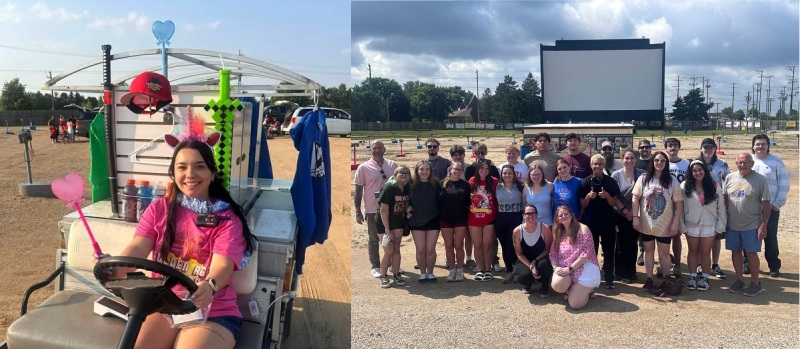
The staff is friendly and helpful. General Manager, Emily Kanpik covering the drive-in grounds (left). The outstanding staff of McHenry Outdoor Theater. Photos courtesy McHenry Outdoor Theater.
Stay Connected
For more information on upcoming films and promotions, visit www.goldenagecinemas.com - but the best way to stay up to date is by following them on Instagram at @mchenryoutdoor or on Facebook, where they post the latest news, unique events, and night-of surprises.
In the End
In the end, what makes the McHenry Outdoor Theater so special isn’t just the movies, the promotions, or even the history - it’s the feeling you get when the sky dims, the headlights fade, and a whole community settles in together under the stars. It’s a place where the past and present meet, where memories are made in real time, and where that old drive-in magic still lives and breathes. If you haven’t experienced it yet, you’re missing one of the pure joys of a Midwest summer evening. And in a world that moves faster every year, there’s something quietly remarkable about a place that invites you to slow down, look up, and enjoy a night that feels both timeless and entirely your own.
McHenry Outdoor Theater is located at 1510 N Chapel Hill Rd, McHenry, IL.
See ya at the drive in!
Otherworld Theatre Boldly Goes Again with Starship Edsel Season 4

Otherworld Theatre blasts back into the cosmos with Season 4 of Starship Edsel: An Improvised Star Trek Parody, the latest chapter in its long-running improvised Star Trek satire. Now in its fourth outing, the misfit crew of the USS Edsel once again shows why the production remains a reliably funny fixture in Chicago’s sci-fi comedy landscape: sharp improvisers, affectionate genre parody, and the kind of starship energy you’d never find in the Federation’s official logs.
This season sends the Edsel crew tumbling through new temporal and interstellar absurdities, driven by the fast-paced, character-focused humor that has defined the show from the start. The ensemble dives into the joyful dysfunction of a starship seemingly held together by duct tape and questionable decisions, mixing Trek lore nods with gleeful irreverence and the lived-in chemistry that makes every malfunction and misunderstanding feel inevitable. That energy takes shape in an entirely new crisis: after stumbling through the early Star Trek timeline, the Edsel is abruptly flung centuries forward into the 32nd century, a future shaped by Star Trek: Discovery. Suddenly the galaxy looks unfamiliar, the rules have changed, and the crew finds themselves surrounded by Starfleet Academy cadets who seem barely old enough to pilot a shuttle, let alone judge the Edsel’s competence. I’m not sure whether the mission changes from performance to performance, but in this “episode” their assignment was deceptively simple – secure a peace‑extension treaty with the Blavakians (I hope I got that right) – and what should have been a straightforward diplomatic task stretched into an endlessly delayed ordeal, derailed by hilarious temporal hiccups, cultural misunderstandings, and the Edsel’s trademark ability to complicate even the calmest negotiations.
Directed by Second City alum Anthony LeBlanc, Chicago’s premier sci-fi theatre company brings its hit improvised Star Trek parody to Second City’s De Maat Theatre for its fourth season. Running from August 9 through September 13, the show lands every Sunday at 6 p.m., continuing Otherworld Theatre’s tradition of blending sharp improv, affectionate Trek satire, and the unpredictable charm of the galaxy’s most questionable starship.
The cultural whiplash is immediate: advanced tech they have never seen, protocols they do not understand, and a timeline that expects far more professionalism than the Edsel has ever demonstrated. With a brand-new captain stepping aboard, their six-week mission quickly spirals into new complications, leadership challenges, and the unscripted deep space mayhem that has carried the show through all four seasons.
One of the strongest comedic through lines comes from Wanjiku Kairu Oliver, who steps in as Captain Reitanna Troi and delivers a sharply tuned, consistently funny performance. She begins as an overly supportive, everyone-is-my-friend, besties-with-everyone captain desperate to be liked, then after a well-intentioned nudge from Admiral Jean Pierre Baptiste (played with dry precision and understated comic bite by Edward Neequaye) swings far too hard into stern, over-the-top authority, hilariously misreading his call for a middle ground he clearly thought was obvious.
Season 4’s comic energy is driven by a nimble ensemble that thrives on the Edsel’s brand of barely functional spacefaring misadventure. While the lineup can shift from week to week, in the performance I saw many of the standout laughs came from Matt Kawa as Lt. T’Pang Gah (what's better than a delightfully anachronistic Vulcan?); Carlos Rivera as Chief Counselor J’Errrs’Q, a Klingon with impeccable comedic timing; and Mike Mazzella’s Lt. Cmdr. James Buchanan. Together with the rest of the performers, the crew embraces bold physical comedy and sharp genre parody, making the Edsel’s catastrophes feel both inevitable and irresistible.
What makes the show genuinely entertaining is the cast’s ability to improvise on the spot with razor-precise timing. The performers take every unexpected turn, audience suggestion, and self-inflicted disaster and heighten it with quick pivots, smart character choices, and a shared instinct for building jokes together. The comedy never feels forced or manufactured; it grows organically from the crew’s chemistry and their collective willingness to commit fully to whatever absurdity the Edsel throws at them. The improvisation feels both effortless and impressively precise.
Starship Edsel makes clever use of multimedia to introduce and deepen its characters, with video briefings, ship diagnostics, and on-screen prompts that instantly ground the audience in its improvised sci-fi universe. The set, though minimal, somehow conjures the impression of a functioning starship interior – just enough structure to suggest the Edsel’s corridors and consoles while leaving the performers room to build the world through play. Before the episode begins, Admiral Jean Pierre Baptiste invites the audience to help repair the ship’s failing systems by answering a pair of questions; in this performance, the strangest gift ever received (a skunk) and the oddest motivational tactic from a boss (a magic trick) became key inputs. This talented ensemble wove both suggestions into the narrative with seamless, absurd precision, turning offhand audience answers into some of the night’s funniest running gags.
Created from a live-action role-playing framework written by Brandon Brylawski, the show uses that narrative backbone to fuel an ever-shifting roster of characters and cosmic complications. Each week’s cast builds on that structure with their own improvised twists, expanding the Edsel’s universe in ways that feel both unpredictable and perfectly in tune with the ship’s legacy. The result is a mission that always feels alive, flexible, and primed for fresh absurdity.
You do not need to be a die-hard Trekkie to enjoy Starship Edsel – far from it. While longtime fans will catch the deeper nods to Trek lore, the show’s comedy lands just as well for anyone walking in cold. I say that as someone who grew up religiously watching the original series (TOS) and The Next Generation, and who never fully made the jump to the sprawling lineup of later shows beyond the films. Even with my old-school Trek background, the Edsel’s improvised storytelling, character-driven humor, and affectionate parody make the experience completely accessible and endlessly entertaining.
If you are looking for a night of comedy that goes boldly where no starship should ever go, the Edsel is absolutely the disaster you want to beam aboard.
Run Dates: Opening – Sunday August 9 at 6 p.m., Closing towards the end of October - check site for updated info.
Location: Second City’s De Maat Theatre, 1608 N Wells, Chicago, IL 60614
Running Time: 60-75 minutes with no intermission
Tickets: $25 general admission
Direct Ticket Link: https://www.secondcity.com/shows/chicago/starship-edsel-an-improvised-star-trek-satire-chi
Theatre Company Link: https://www.otherworldtheatre.org/starshipedsel
- Otherworld Theatre
- Starship Edsel An Improvised Star Trek Parody
- Star Trek
- Starship Edsel
- second city
- Wanjiku Kairu Oliver
- Edward Neequaye
- Matt Kawa
- Carlos Rivera
- Mike Mazzella
- Anthony LeBlanc
- Brandon Brylawski
- Parody
- Satire
- Camp
- Improv
- live theatre
- on stage
- Chicago events
- chicago theatre
- De Maat Theatre
- Trekkie
From Subway Cars to Chicago Stages: Marcus Monroe at The Comedy Bar
Sometimes the best way to find a comedian who’s new to you is by stumbling onto a clip that stops your scroll cold. That’s exactly how I first encountered Marcus Monroe: a burst of chaotic silliness on Instagram that made me immediately wonder what his full stand-up looked like beyond the quick-hit reels. As I have with both up-and-coming comedians, and even more established ones I haven’t really explored, I first discovered Monroe online by chance. Outside of a good handful of snippets - mostly from his Stand Up on the Subway series that I’ll get to shortly - I had very little to go on in terms of what his actual live stand-up would be like. In his case, I couldn’t stop watching the run of hilarious reels: quick, character-driven, highly silly bursts of comedy that immediately stood out for their timing and playful absurdity. Those clips ended up being a solid introduction to Monroe’s live show, which delivers a smart, engaging blend of his signature comedy. And yes - he’s genuinely funny.
I finally saw him live at The Comedy Bar in downtown Chicago, and it was the perfect venue to experience his style up close. The night was packed with laughs. Opener Brett Druck was outstanding, delivering sharp, tightly crafted jokes with a calm confidence that immediately locked the room in. His humor leans clever and observational, the kind of writing that sneaks up on you and lands with a clean, satisfying snap, perfectly setting the stage for headliner Marcus Monroe.
Monroe’s current tour highlights the style he’s become known for: sharp, in-your-face comedic banter paired with fast-paced variety performance. Born and raised in Milwaukee, Wisconsin, and now residing in New York City, Monroe brings a Midwest-friendly looseness to his delivery, even as he leans into the nonconformist energy that has defined his career. He’s a past recipient of the Andy Kaufman Award, given annually to a performer whose originality and creative spirit echo Kaufman’s own. His résumé spans television appearances, cruise line entertainment, and major comedy festivals, and he’s been seen by millions, including performances on The Late Show with David Letterman and America’s Got Talent.
Onstage, he delivers a tight, energetic set that mixes storytelling, improvisation, and physical comedy in a way that feels both polished and spontaneous. His crowd work delivers some of his best moments - he’s genuinely comfortable interacting with the audience, slipping into quick riffs and playful exchanges that feel effortless and keep the room locked in. His material ranges widely, from the chaos of travel and performing on the road, to the odd realities of being somewhat of a “variety act” in a stand-up world, to the strange encounters that come with doing comedy in unconventional spaces. He also dives into his relationship with his wife, who’s fifteen years older and has been with him for over a decade. They never signed a prenup, but he’s unfazed - as he jokes, everything’s hers anyway. In fact, most of her belongings came from a divorce settlement with her ex-husband, so should they ever split, Monroe figures he’d walk away with half of Steve’s stuff. And toward the end of the show, he folds in his juggling - often with sharp knives - not as a gimmick, but as a comedic tool he uses for timing, misdirection, and playful escalation, giving his set a physical dimension most stand-ups don’t attempt. And this is the same guy who has juggled flaming torches while riding a sky-high unicycle, so the physicality isn’t just a flourish - it’s part of his comedic DNA.
A major part of Monroe’s growing national profile comes from his Stand Up on the Subway series, the viral project that helped expand his audience far beyond traditional comedy venues. For more than two years, he’s been performing fully costumed bits on New York City trains, transforming everyday commutes into pop-up comedy sets. The punchlines in these subway bits, while some downright goofy, are often purposefully so bad in a brilliant way - beyond dad-joke territory and deep into gleeful absurdity - that they loop back around into being hilarious. It’s part of what makes the series addictive, and I’ve become hooked on watching each new character drop into a train car with that “what’s he going to do next?” unpredictability. His Stand Up on the Subway series has now surpassed 100 million views and even features cameos from Bowling for Soup, Train, Bobby Moynihan, BBMak, Ryan Cabrera, and more, adding an extra layer of delightful unpredictability to the chaos. His roster of subway personas is part of the fun: Michael Jackson, Marty McFly, Ozzy Osbourne, the Grinch, Ronald McDonald, Freddie Mercury, a watermelon, a foot, Uncle Sam, an emo kid, and an endless supply of other characters pulled from whatever corner of his imagination he’s exploring that day. He’s even created a Chicago version on the EL train, suiting up as a Bears player for a local twist. The reactions - amused, confused, delighted, or occasionally baffled - become part of the show, and the series has become a defining piece of his creative identity.
Taken together, the tour, the reels, and the Stand Up on the Subway series reveal a performer who thrives on unpredictability, connection, and inventive silliness. Monroe isn’t trying to reinvent comedy so much as he’s carving out his own lane within it, one built on enthusiasm, oddball charm, and a willingness to commit fully to the bit. It’s a combination that works, and his stand-up is highly recommended. For upcoming tour dates, videos, and more of his character work, visit www.marcusmonroe.com.
A Legendary Transformation: John Mulaney’s Historic Night at Wrigley Field
John Mulaney didn’t just perform at Wrigley Field. He made history there. In a venue synonymous with baseball legends, rock icons, and century-old Chicago lore, Mulaney became the first comedian ever to headline a full stand-up show at Wrigley Field, and, depending on which version of the truth you prefer, possibly the largest live audience for a comedian in history. Whether or not the record is airtight, the scale of the night was undeniable. Chicago turned out in force for one of its own.
A New Chapter: The Mister Whatever Tour
Mulaney’s Mister Whatever tour marks a tonal shift from the raw confessionals of Baby J. Where that show dissected his intervention, addiction, and the wreckage of his personal life, Mister Whatever leans into the absurdity of middle age, fatherhood, and domestic unpredictability. The storytelling remains fast, sharp, and unmistakably Mulaney, but now filtered through the lens of a man navigating toddlers, in-laws, and the strange mundanity of being a grown-up with a past.
Family Life and Fatherhood: Comedy in the Trenches
Mulaney’s material about family life is some of his richest yet, especially when he dives into the sprawling constellation of his new in-laws. Marrying into Olivia Munn’s Vietnamese-Chinese family gives him endless fodder, and he mines it with precision: overbearing relatives, cultural misunderstandings, and the kind of familial chaos that feels both universal and deeply specific. He even slips into a Vietnamese accent, a move he preemptively defends by insisting he has “earned the right” because they are his actual family now. It’s classic Mulaney: self-aware, slightly provocative, and delivered with a wink.
His bits about raising two toddlers are equally sharp. He compares dealing with a three-year-old to working in a toxic workplace, complete with unreasonable demands, emotional volatility, and a boss who has no concept of time. The late-night meltdowns, the negotiations over snacks, the existential exhaustion of parenting: he turns it all into a comedic autopsy of modern fatherhood.
And then there is the “wallet allowance,” a running gag about his post-rehab financial oversight. According to Mulaney, his wife and even bank cashiers treat him like a teenager with limited privileges. It’s a sly, self-deprecating way of acknowledging his past without dwelling in it.
Absurd Observations and Pop Culture: Mulaney’s Sweet Spot
Where Mulaney truly thrives is in the absurdity of everyday grievances, and his extended rant about modern $1,000 drying machines is a highlight of the night. He builds an entire comedic architecture around the decline of appliance quality: how dryers now seem designed to not dry clothes, how they beep like needy robots, how they offer dozens of settings but none that actually work. It’s the kind of bit only Mulaney can stretch into a full routine, turning a mundane annoyance into operatic frustration.
His pop culture and political impressions land just as hard. His RFK Jr. impression is a showstopper: wild, unhinged, and delivered with a kind of manic sincerity that had the stadium roaring. He skewers billionaires, public figures, and the bizarre circus of current events with the same blend of sharpness and silliness that has always defined his best work.
And then comes one of the night’s funniest detours. His bit about being possessed by Satan, specifically how Satan always does it the exact same way, with someone jolting upright in bed and unleashing a string of profanity, becomes one of the night’s sharpest and most ridiculous highlights. It’s pure Mulaney: theatrical, absurd, and delivered with the timing of a performer who knows exactly how long to let a joke breathe before landing it.
A Chicago Homecoming with Legendary Guests
What made the night feel truly monumental were the surprise guests, each adding their own flavor to the celebration.
Buddy Guy, Chicago blues royalty, took the stage and tore into a couple of songs, including a blistering rendition of “Sweet Home Chicago.” Seeing Buddy Guy at Wrigley Field would be a thrill on its own. Seeing him as part of a John Mulaney comedy show felt like a surreal Chicago fever dream.
Fred Armisen followed with a brilliantly odd set that blended music and comedy. Switching between guitar and drums, he delivered the kind of deadpan, musically infused humor that only Armisen can pull off. It was weird, delightful, and perfectly calibrated for a stadium crowd.
Richard Kind served as a sort of comedic emcee, popping in with jokes, introductions, and the warm, slightly bewildered charm that makes him such a beloved character actor. His presence added a theatrical looseness to the night.
And then, in a moment that felt like a benediction, David Letterman stepped out to introduce Mulaney. Letterman may be from Indiana, but in Chicago terms, that is close enough. His dry, understated introduction gave the night a sense of occasion, like a passing of the comedic torch from one generation to the next.
A Night That Felt Bigger Than Comedy
What made Mulaney’s Wrigley Field show remarkable wasn’t just the scale, or the guests, or the historic firsts. It was the sense of homecoming. Mulaney performed with the confidence of someone who knows the city in his bones: its rhythms, its humor, its contradictions. The stadium setting didn’t dilute his intimacy. It amplified it. His storytelling reached throughout the Friendly Confines without losing its specificity.
In a venue built for legends, Mulaney delivered a night worthy of the space.
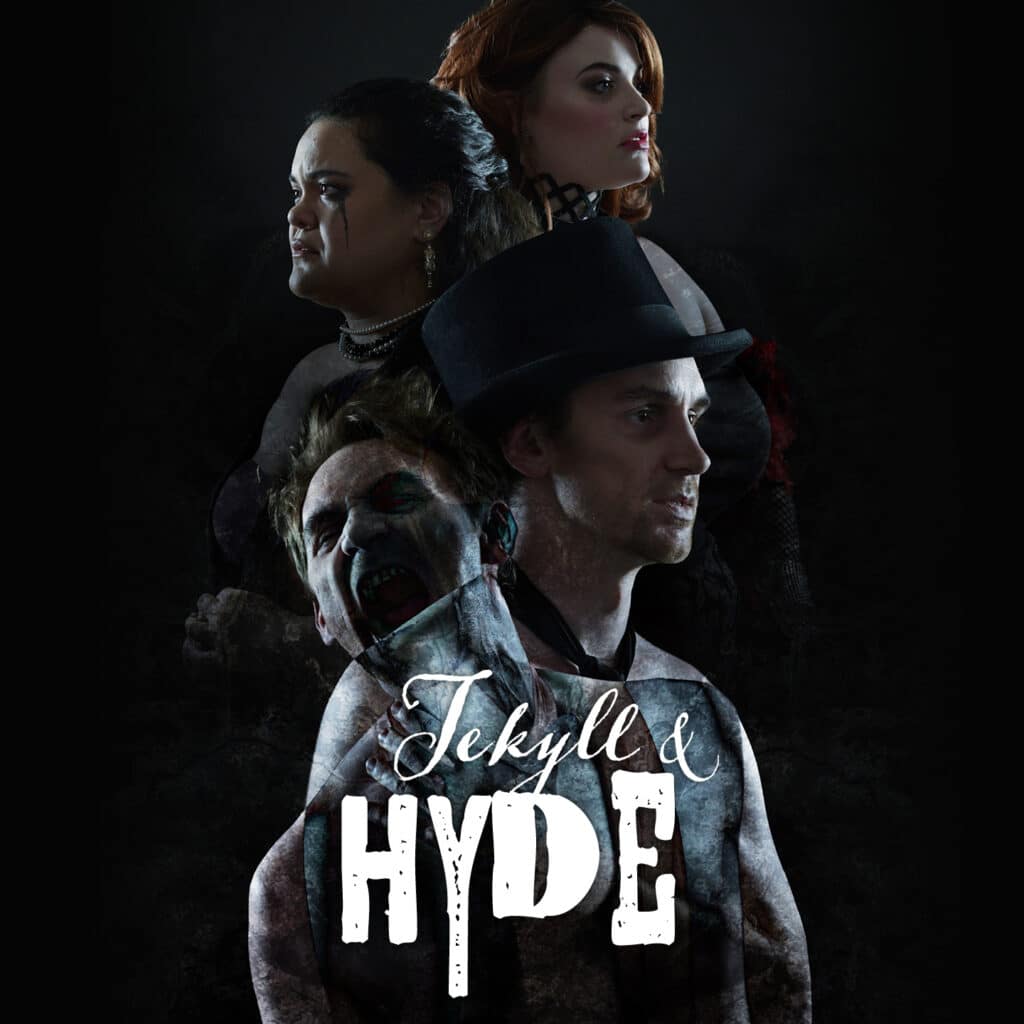



Latest Articles
-
 “A Strange Loop” Lets the Intrusive Thoughts Win at Raven Theatre in partnership with About Face Theatre
Written by John AccroccoA musical, but it’s just the voices in your head. Sounds just crazy enough to win the 2020 Pulitzer for Drama. “A Strange Loop” by Michael R. Jackson finally makes its Chicago premiere at Raven Theatre in a co-production with…
“A Strange Loop” Lets the Intrusive Thoughts Win at Raven Theatre in partnership with About Face Theatre
Written by John AccroccoA musical, but it’s just the voices in your head. Sounds just crazy enough to win the 2020 Pulitzer for Drama. “A Strange Loop” by Michael R. Jackson finally makes its Chicago premiere at Raven Theatre in a co-production with… -
 Announcing Goodman's 22nd New Stages 2026 Festival Line-Up
Written by Buzz Center StageFrom a "Kung Fu rom-com" to a witchy new musical, The Goodman's popular New Stages Festival in its 22nd year continues to offer a first glimpse at the latest works by a handful of the hottest contemporary playwrights. This year's four-play…
Announcing Goodman's 22nd New Stages 2026 Festival Line-Up
Written by Buzz Center StageFrom a "Kung Fu rom-com" to a witchy new musical, The Goodman's popular New Stages Festival in its 22nd year continues to offer a first glimpse at the latest works by a handful of the hottest contemporary playwrights. This year's four-play… -
Chicago Danztheatre Ensemble Announces 2026-2027 Season
Written by Buzz Center StageChicago Danztheatre Ensemble (CDE) is pleased to announce its 2026 - 2027 season. CDE will open this artistic season with Copestic Vibrations: A Music Festival, Friday, Nov. 13 and Saturday, Nov. 14, followed by a fully staged production of For…
-
Eos Theatre Company Announces Second Production with The Thin Place
Written by Buzz Center StageEos Theatre Company is pleased to announce their second production with Lucas Hnath's horror play The Thin Place, directed by JC Clementz (Steppenwolf's Director of Casting and Artistic Operations), playing February 5 - 28, 2027 in Bramble Arts Loft's Beatrice Theater, 5545 N…
Does your theatre company want to connect with Buzz Center Stage or would you like to reach out and say "hello"? Message us through facebook or shoot us an email at This email address is being protected from spambots. You need JavaScript enabled to view it..
*This disclaimer informs readers that the views, thoughts, and opinions expressed in the text belong solely to the author, and not necessarily to Buzz Center Stage. Buzz Center Stage is a non-profit, volunteer-based platform that enables, and encourages, staff members to post their own honest thoughts on a particular production.