

Bill Esler
Standing Room Only Crowd for Chicago’s Leading Theater Artistic Directors
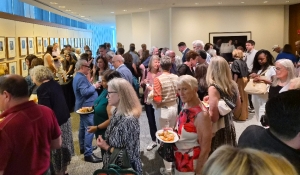
It must have been heavenly for the creative leaders of Goodman, Steppenwolf, Chicago Shakespeare and Court, Chicago’s top regional theaters, to be greeted by a standing room only crowd. But there they were, on a panel moderated by the eminent Chicago Tribune theater critic Chris Jones. The program was introduced by Marla Mendelson, MD, then by her daughter, Tova Wolff, who also happens to be artistic director at Refracted Theatre Company.
Held on the 6th floor of the airy University of Chicago Gleacher Center overlooking the Columbus Drive bridge at the Chicago River, the event was part of the Evening Inquiry Series founded by Mendelson and her husband Stephen Wolff, and arriving on the heels of a landmark report from the Arts Alliance Illinois that shows the creative sector is the sixth largest business sector in the state. In Chicago, where nearly half (47.5%) of the overall state’s direct creative economy output takes place, the sector supports 212,875 jobs, generates $50 billion in output, and generates $5.7 billion in tax revenue. It is Chicago’s 3rd largest industry (11.3%), larger than educational services (10.2%), retail (8.3%), and manufacturing (7.9%).
Citing that as a backdrop, moderator Chris Jones led the panelists through the discussion.
Also referencing the report, Edward Hall, artistic director at Chicago Shakespeare Theater noted, “This city has a very powerful, strong cultural economy as well, which I think feeds social and cultural life, but also it's an economic driver. And you haven't even begun to count the trickle-down effect of people's secondary spending when they fly into town and see Iceboy, or they see Lord of the Rings, whatever they come and see. They're taking cabs. They're going to hotels. They're spending money.”
Jones's questions led to the perhaps surprising revelation: subscriptions to theaters have dwindled. Audrey Francis, artistic director for Steppenwolf, said that at its height, Steppenwolf had 25,000 season subscription holders. “And now we have 5,000,” she said, which was the number when she started her tenure at the theater.
“It's challenged me as an artist to say, ‘Okay, this is the game,’” said Francis. “And it's not about, for us, necessarily what's popular. It's about how are we being our best to make sure that when you come dance with us, we're the best dance partner you have.” According to Francis, “Being challenged to evolve and to keep up and to say, ‘Okay, we can't keep doing the same thing. The rules are changing, and everybody's getting better, and how do we keep up?’”
Budget-wise, ticket revenue overall covers just half the operations of any of these theaters.What that means for theater operators is audience preferences and marketability to individual ticket buyers is a key driving force in the creative selection of scripts to be produced at larger Chicago theaters. Given that, how do artistic directors determine the roster of shows for each season?
What came up in the course of the panel is that there is serious tension (as might be expected) between including the established “canon” of playwrights—Eugene O’Neil, Ibsen, Chekov, Shakespeare, Shaw, etc.—and new works from rising talents around the country. Over recent years new works have risen in prominence, while the number of scripts from the old guard have diminished.
The event was preceded with an open bar reception and generous array of hor d'oeuvres, during which the audience mingled. There were actors, creatives from theater companies, and the regulars who attend these Evening Inquiries sessions at the University of Chicago’s Gleacher Center. As a theater critic for Buzz Center Stage, I recognized a number of publicists from theatrical groups and agencies that specialize in communications for this marketplace.
One woman I spoke to was the spouse of an actor. I also met a man who was a retired professor of drama from Bates College in Lewiston, ME, who complained heartily of the numerous new works in seasons just announced by the panelists’ theaters, to the exclusion of Shaw and other traditional canonical works. “What’s the best thing you’ve seen in the last year?” he asked me, his voice ripe with challenge. I answered unequivocally: “The Devil Comes to Town at Trap Door Theater.” (It was adapted and directed by Jeremy Ohringer who is also on the faculty at DePaul University.)
This was a perfect lead-in to the discussion of seasons filled with newer works, discovered through careful dramaturgy of who and what is trending around the country, which may be unfamiliar to Chicago audiences. There is risk attached to trying such unknown works as part of a mission for exposing audiences to what the theaters think they might or should like.
“If you go back to that origin statement about serious, mission-driven work, fully fifty percent of your annual income is box office dependent,” said Susan Booth, artistic director at Goodman Theatre. Producers can no longer rely on subscription ticket holders to weather through whatever they’re given in a season. “That box office number is a reality in our day-to-day life,” Booth said. “And I would love to hear from my colleagues on the panel about the challenge of selling mission-driven work versus selling popular work.”
Chicago Shakespeare’s Hall noted that theater lives in a perpetual recession. “There has never been a moment when I've heard any of my colleagues say, ‘What do we do with all this excess money?’ And theater has always been striving to do mission-driven work. And the idea that if you go popular, it's easy,” Hall said, “it's a lie, actually.” (Though the exception proving the rule perhaps are the lavish productions at Paramount Theatre in Aurora, generously underwritten by its neighboring casino profits.)
Avery Hoffman, who was named artistic director just last November at Court Theatre at the University of Chicago, described her theater’s audiences as many layered: the students and faculty on campus, individuals throughout the surrounding Hyde Park area, and the entire south side of Chicago, the city at large and the region. “This knowledge of your audiences is really, really important to that collective thinking, certainly to my collective thinking,” Hoffman said. “It means that our seasons maybe take a little bit longer to come to fruition. But then at the end of the day, you have a collective agreement about what your mission is, what shows that you're doing that serve that mission, and an audience that knows that mission and is there to support [it].”
A lengthy discussion covered the shifting role of these big regional theater companies from gatekeepers of what should be seen by audiences, to collaborative facilitators of what audiences want—even if that means bringing them unfamiliar scripts that meet their latent interests. Francis noted that the ensemble-powered company of Steppenwolf has long meant that the establishment of each season's offerings is the product of intense creative conflict, in the best sense of those words.
Best Question of the Night
After 30 minutes, Jones entertained a few questions from the audience, and the first out-of-the-gate came from a long-haired young man who cited the recent transfer of the a cappella musical Octet from Raven Theatre’s space on Clark St. to extend its run at the Goodman’s Owen Theater for three weeks this summer.
Goodman’s Booth responded that she had an immediate reaction when she saw Octet at Raven: “I thought the ceilings are just too low for these great voices.” And so it happened, but that is a rarity in Chicago. “The big theaters are often dark,” the questioner pointed out, and these successful storefront shows need to be able to get to bigger venues in order to extend their runs, rather than simply close to accommodate a subsequent planned production from their own season. "All of us are keenly aware that we benefit from the ecosystem," Booth said, referring to Chicago's many storefront and small theaters.
Of course, this is the natural ecosystem in New York, where Off Off Broadway shows frequently transfer to Off Broadway and sometimes on to Broadway—usually driven by proven audience demand. Why couldn’t that happen more frequently in Chicago? This led to an intriguing proposition from Chicago Shakespeare's Hall for a separate non-profit theatrical entity that might serve as a development center for co-producing shows, lef by Chicago's regional theaters.
Three cheers to University of Chicago and Mendelson's Evening Inquiry series for putting this remarkable discussion of theater on stage.
‘Anatomy of a Suicide’ Is Hard to Watch, But Not Because of the Subject
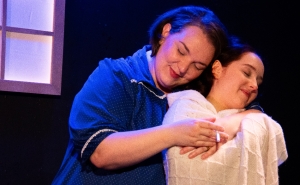
Perhaps surprisingly, Anatomy of a Suicide is not an overwhelmingly emotionally gripping play, nor is it horrifying. Instead, it vividly portrays the slow drip of suffering for Carol, a woman in the grip of depression, living always with suicidal tendencies. It also presents the impact of an intergenerational transference of Carol’s condition on her daughter and granddaughter. Written by British playwright Alice Birch and ably directed by Alex Mallory, it features Tatiana Pavela in the role of Carol, Taigé Lauren as her young adult daughter Anna, and Isabel Lee Roden as her granddaughter Bonnie.
Anatomy of a Suicide is hard to watch because of the design Birch has chosen for it. The central stories of these three women are performed simultaneously for two hours with one fifteen minute intermission. These focal storylines are in three different time frames, years apart. And some characters carry their roles between the timeframes. In other words, it is difficult to follow. A number of actors play multiple roles as numerous ancillary characters, adding to the challenge.
The program is helpful, but audience members are given just a barcode then told to silence their phones, so there is nothing to guide us as we watch. As a consequence, it is only by reading the program afterward, then studying the Wikipedia page for the play, that I could understand more of the details of what I witnessed.
Still, the broad lines of Anatomy of a Suicide on stage are clear enough to appreciate the heart of the story. All three actors are stunning in their roles. Pavela as Carol, whose life revealed, we are told spans the time frame of 1967-1985, registers the emotions that accompany what we now recognize as post-partum depression. We see every nuance of her internal strife as she struggles to meet societal expectations as homemaker and mother in that window of time when expectations of a woman’s place were unquestioned.
For those of us around then, it is an accurate portrayal of the menial roles women were expected to play in family life. And it puts in the spotlight how that period militated against women having an inner life, especially one that ran counter to the foreordained narrative line. Those who were depressed by childrearing or housekeeping bore the brunt of social opprobrium. And if their condition persisted, they might be subjected to brutal mental illness treatments, including shock therapy.
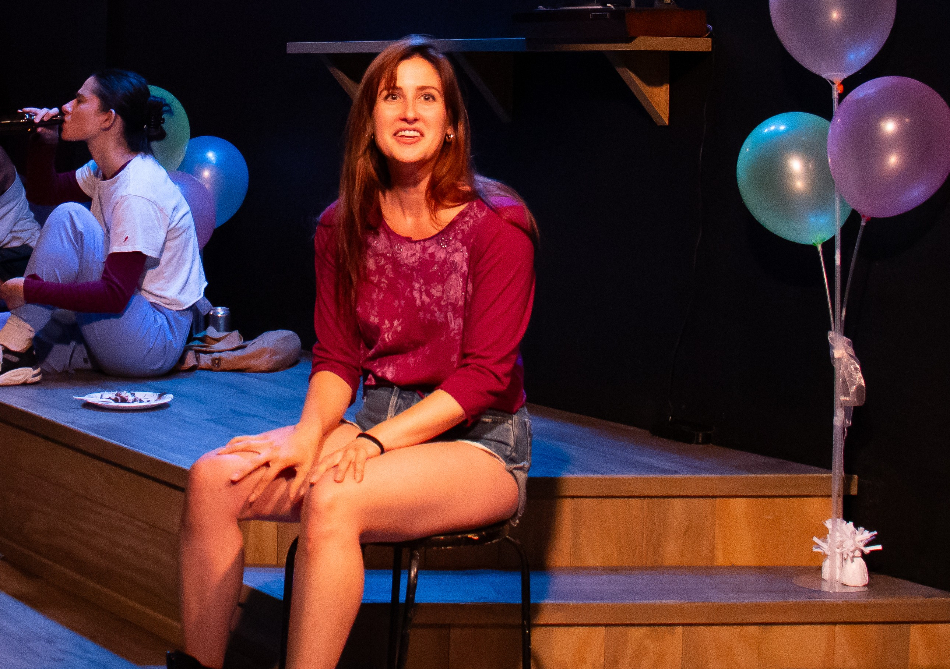
Isabel Lee Roden (left) as Bonnie and Taigé Lauren as Anna in Anatomy of a Suicide.
When we first see Anna, Carol’s daughter, portrayed in the window of 1994-1999 and in her twenties, she is being retrieved by her father, John (Josh Razavi) from a hospital where she was placed following a drug binge. The juxtaposition of these two characters, though in separate unconnected scenes, suggests a link between her mother Carol’s condition and Anna’s drug dependency. Anna emerges from her situation, finds her true love Jamie (Raúl Alonso) marries, and eventually bears a daughter, Bonnie.
We gather the pregnancy and birth are triggering emotionally for Anna. But most of her timeline on stage seems happy. She is a vibrant person. Her wedding day is full of joy; her father embraces her. Taigé Lauren's performance is full, rich and vibrant and it is a pleasure to see her on stage. Another actor, Laila Malak, plays a youthful version of Anna, and it seems that later, during Malak's tenure on stage, she and her father are nearby during a picnic at the moment of Carol’s suicide. This happens later in the play’s sequence, and explains retroactively why Carol was not at Anna’s wedding.
We meet Carol’s granddaughter, Bonnie, who seems to be on the spectrum of some neurodivergent condition. Isabel Lee Roden reflects an inertness in Bonnie, her lack of affect in engaging others. But in climactic moments, Roden leaps from reticence to full-throated dramatic presentation, a great performance that bides its time in deference to the character, but is always there.
To my mind, this is an actor’s play, one for theater professionals, but not something the average ticket buyer would want to see. The play is also burdened with a difficult to market title - Anatomy of a Murder or Anatomy of a Fall have worked, but Anatomy of a Suicide is an unlikely draw. With just 32 seats in the theater, I’m guessing co-producers JunkHeart and The Metal Shop Performance Lab do not have high expectations for revenue. Anatomy of a Suicide runs through August 30, 2026 at Redtwist Theatre in Chicago.
Mike Bartlett’s ‘An Intervention’ Zings in Chicago Premiere

A new company, Heart of Gold Theatre, is presenting the Chicago premiere of Mike Barlett’s An Intervention. Bartlett is a noted British playwright, whose future-conjectural work Charles III received five Tony nominations in 2016, including Best New Play. Bartlett’s Cock (2009) and its companion work Bull (2013) played to accolades off-Broadway in New York.
Directed by Aaron Henrickson and just 75 minutes long in five acts, An Intervention is played against a velvet curtain with no set, intended by Bartlett to resemble a vaudeville comedy act. There we see two 30-something friends: character A is played by a sparkling Amanda Egle and B is played more circumspectly by Taylor Adams. They are caught in the middle of an energized, fast-paced repartee that when we first see them has been reduced to single-word declamations and terse phrases (“Oh.” “Yeah.” ‘You - “ “Yup.”)
Their tone conveys a dispute of some kind, but the audience doesn’t yet know what it’s about. “I don’t believe it,” says A; “Well it’s true,” B retorts. Context soon reveals it is over the matter of a military intervention in a Middle East war.
First performed in 2014, it was a period that saw the rise of ISIS, the Gaza War by Israel against Palestine, and the entry of the U.S.-led coalition into Iraq, among other conflicts. But the timeliness (and unfortunate timelessness) of the setting makes An Intervention very much of-the-moment.
The character A, we learn, has just come back from a protest against the intervention, only to learn that B, whom she counts as a trusted friend, supports it. He even encourages it to happen. She is crestfallen, and the argument moves on to the nature of their friendship.
Stepping down from the stage with one foot, B gives us his take on A in a lengthy aside. Later A will do likewise about B. So the argument is no longer centered on the politics or justice of the impending military action, but about how these two feel about each other.
What we see are two friends whose friendship is based on loving to argue. Well, actually, it’s a bit more than that. Because they love to argue about politics, for example, their regular argumentative battlegrounds form a vehicle for intimacy.
Subsequent acts—here are five in this tightly wound show—reveal more about their lives at large. Periodically the two reach through the curtains for props - a harmonica, wine glasses, and lots of liquor. The two also take issue with each other's personal lives. B charges A with being an alcoholic (another type of intervention), while A argues against B’s romance with a “harridan” and soon their friendship reaches a breaking point.
Many months later, in the last act, the threads are tied together in such a satisfying resolution that the continuously puzzling nature of that opening scene is successfully explained.
Adams, the founder and artistic director of Heart of Gold and (full disclosure) a personal friend, has brought us a play for the moment. When we argue, as Adams tells us in the program, aren’t we asking, “Why aren’t you the person I want you to be? Why can’t you be … less like that?”
Bartlett has written a “thinking” play in An Intervention, in which the dramatic tensions are equally “characters” in the work. So producer and co-star Adams has given us a deft bit of dramaturgy in bringing it to Chicago audiences.
The play examines the timely matter of how human beings can engage each other while bearing deeply held convictions that conflict. Nothing could be more important to our civic life than to seek guidance and clarity on this issue, which vexes us continuously. This is what theater is for.
The production also resurrects to the Chicago theater scene Pierce Hall in the landmark Chicago Temple Building. Pierce, fittingly, was home for the Silk Road Theatre Project, formed after 9/11 to address the challenges of backlash facing Asian, Middle Eastern, and North African communities.
Finally, because I know this producer and actor well, I have watched most of the steps along the way in development of the performance you will see. The passion a single individual must muster to licence a worthy script from a noted author, to secure a stage, to field a corps of able actors, director, lighting, costumes, and then to publicize and market ticket sales - well as the thousands working in this field in Chicago well know - it’s not an enterprise for the faint of heart. The inevitable rise and fall of the fortunes of a single production are familiar territory for this city’s theater producers. We in the audience are spared the sturm und drang. The lights come up and a polished presentation appears, as if by magic.Though magical, a stage show takes hard hard work.
Recommended, An Intervention runs through August 9, 2026 at 7:30 pm at Pierce Hall, the lower level theater in the Temple Building, 77 W. Washington Blvd., Chicago.
Absurdist Satire ‘Do You Feel Anger?’ Captures Toxicity in Workplace Today

Set in a debt collection call center, Do You Feel Anger? captures how a toxic workplace manifests itself in today’s theoretically more “enlightened” world. Much of that toxicity, at least in this 2019 script by Mara Nelson-Greenberg, is propelled by male bonding and power.
But it’s not an oppressive tale. The artfully drawn script approaches this office from hell by showing what characters would be like if they are allowed to express emotional impulses with no filters whatsoever, and they do so to the max, without the slightest bit of empathy for their targets. The sorry state of affairs that results becomes a reduction to the absurd, with a pack of males hitting relentlessly on women both literally and figuratively.
With first-rate performances across the board and well directed by Kady Nordstrom for Here’s the Exit Theatre Co., the production (I saw the final performance June 28) was set in a site-specific location - an actual shared office space near Ravenswood and Montrose in Chicago was used for the performances.
At the opening Sofia (Dina Monk), recently hired as an empathy coach at a debt collection agency as a measure to fend off hundreds of lawsuits, clearly has her work cut out for when she begins to lead them through exercises intended to develop compassion for others. Though we never see them actually engaged in their debt collection work, one can only imagine how strong arming debtors makes for a noxious workday.

Joe Metcalfe as Jon in Do You Feel Anger?
The audience is introduced to Jon (Joe Metcalfe) first, already in character before the show begins, as he looks across our faces with a power-mongering smile, issuing blunt directives, at odds with his sinister grin, that we must turn off electronic devices and refrain from photos. This is our first warning of how it will go.
To Jon, Sophia’s training is a meaningless exercise. His oft-stated aim is to get her to sign off quickly on a document affirming the staff has successfully completed the course. He expects this effort to be over in two or three days. No, Sophia warns him, it will take four or five weeks. We learn that Jon is not just a boss, but an erstwhile participant in much of this bad behavior.
The very first of the workers to address Sophia is Eva (Laila Rodriguez), who lets slip that she is mugged daily (it is an absurdist work, after all), usually in the break room, by a masked marauder. After years of enduring this, Eva has given up hope, and fashioned what defenses she can. After Sophia begins to encounter lewd remarks from the males, Sophia offers her advice: her successful defense against relentless sexual approaches by the men is to have a boyfriend, which seems to suspend the advances. When Eva discovered her boyfriend was a murderer, she reluctantly dropped him, knowing what she would face back at work as an “unspoken for” woman.
We soon meet Eva’s co-workers: always-angry Howie (Hudson Therriault) barely constraining himself from running amok with a bat when his bile rises; then Howie’s co-worker and bro, Jordan (Makari Robinson-McNeese), a sweet and gentle soul who goes along to get along - further enabling the bad behavior, then joining in.
We watch Sophie struggle to generate empathy in the workplace, but everything we see suggests that Jon has given implicit permission to his workers to disregard it. But Sophie is effective and makes a small amount of headway. We see Eva build some trust as Sophie assures her she will have her back.
These office dynamics take a toll on Sophie, and gradually she also compromises. “Give me one more week,” she pleads with Jon, who works against her efforts, even adopting the woke language. “If you expect them to accommodate other people’s feelings, then their feelings should be accepted, too,” he argues. “I’d let these guys keep some of their customs.” Among them are entreaties to Eva for oral sex and jokes about piss charts.
This isn’t a play that delivers a hopeful resolution. Sophie joins in one of the men’s not-suitable-for-work jokes, and eventually conjures up her own imaginary boyfriend to keep the men at bay. Compromises aside, she carries on and makes some headway with the employees, including Jon. Nelson-Greenberg’s script suggests why the workplace might be better today than it was in the era of the 1960s Mad Men, but there are no guarantees of safety for women. What we really see is the shapeshifting nature of toxic masculinity in the office, now dressed up in new terminology, but still the same as ever.
Do You Feel Anger had its Chicago premiere at A Red Orchid Theatre’s stage in 2020 This site-specific revival at the Platform Coworking loft near Ravenswood and Montrose had some pluses, but minuses as well that detracted a bit. Seating was not on risers, so lots of craning your head to see the action. The loft was a plus for immersion in a realistic environment, but acoustics were less than perfect, as was lighting, and the occasional CTA train arrived at sometimes inopportune moments. But the play is so good it didn’t matter much to us in the audience. Here's the Exit Theatre Company, founded in fall of 2024, is worth keeping an eye on.
Funny, Incisive 'Southern Rapture' Skewers All Parties in 'Angels in America' Fracas

“Southern Rapture” quickly elicits loud guffaws from the audience, a heartening circumstancve, as it means playwright Eric Coble’s script is doing its job. Billed as a satire, it recounts the tumultuous week in real life leading up to the 1996 opening night of Tony Kushner's celebrated AIDS play, “Angels in America” in Charlotte, NC. But what might have been a tragic recount of small-minded efforts at artistic repression gets turned on its head, a potential tragedy mined for comedy, with an ending that is at once affirming and exhilarating.
This show at Theater Wit, produced by three-year-old Tin Drum Theatre Company, is loaded with broad humor, and is something of a backstage comedy as well. For purposes of the script, Charlotte becomes a generic southern city, and Kushner becomes Anton Finewitz, and his vaunted work is transformed into “Rapture in America.”
The show parodies not just the reactionary forces that sought unsuccessfully to keep “Angels in America” from the stage of a rising southern metropolis. It also takes aim at the theater company, its governing board, local government, and the national media that spun the controversy into the unnuanced, dualistic divisiveness that seems to have solidified as a way of American life today.

Andrew Bosworth as Reverend Dupree and Jenny Hoppes as Laverne Jackson protest the opening of "Rapture in America."
As “Rapture in America” barrels toward dress rehearsal, a big supratitle flashes the daily countdown to its local premiere. In an opening monolog to the audience, Marjorie Hooper proudly tells us, “The play’s won the Pulitzer, Tony, Drama Desk Award, an Evening Standard Award, the Rainbow Excellence Award and an ASPCA citation (that last one is a laugh line)—We’re one of only six theaters in the nation to get the rights to do the show outside of New York!” Indeed!
When word gets around there will be full frontal male nudity in the show, the gears of progress run unevenly, and almost grind to a halt. Company director Marjorie Winthrop (Shannon Leigh Webber) attempts to insulate her performers from the backlash, which comes in the form of Reverend Dupree (Andrew Bosworth) and a town gadfly Lavern Jackson (Jenny Hoppes). Jackson has read the script and counted the number of mentions of “cocksucker” and other notable perversions to the Charlotte Town Council. (In a content warning to the audience, Jackson’s list includes “one penis,” which indeed appears in the second act at Theatre Wit.)

Theater critic Simon Larisher (Jordon Gleaves, left) conspires to promote "Rapture in America" with production director Donald Sherman (Michael Stejskal).
Charlotte Mayor Winston Paxton (Teddy Boone), ever even-tempered, tries to stay above the fray. His aspirations for transforming this growing city into a world-class metropolis have netted a symphony orchestra, a national sports franchise, and now, an important regional theater company, about to move into the big leagues. But the mayor is beginning to feel unsettled, praising the season’s opener, "The Odd Couple," and encouraging Marjorie to do something other than “Rapture.”
“There’s still gonna be plenty of art!,” the Mayor argues. “It’s just art we can all appreciate. Because that ‘Odd Couple’ was one of the goddam funniest things I ever saw in my life.” But Marjorie will have none of that, declaring the play "epic."
It even dares to cut through the slavish devotion accorded "Angels in America" and Kushner himself, asking a if this two-part six-hour "epic" work might be too much in a town that likes to get home in time to catch Jay Leno.
"'“Epic' meaning?" asks the mayor. "Three hours, two intermissions," Marjorie tells him. "And that’s just Part I. Part II is three hours too."
"Good lord, is this a play or a telethon?" asks the mayor, and the playwright punctures the unquestioned aura that seems to envelop Kushner and his fans.
Amid the brewing ontroversey, Marjorie conjures up a “bubble” for the players, a send up of that too precious psychobabble affectation that performers may have seen once or twice:
Marjorie: We’re in the bubble, say it with me.
Players: We’re in the bubble.
Marjorie: And what do we do in the bubble?
Players: We make art in the bubble.
Even theater reviewers get skewered in the no-holds-barred script:
“When I have something to say,” says beleaguered Mayor Paxton, “I’ll talk to a real reporter.”
“I am a journalist,” Simon Larisher (Jordon Gleaves) retorts, to which the mayor replies, no, “You’re a theater critic!” Ouch! Larisher helps raise the profile of the imminent production in concert with the publicity-hungry production director Donald Sherman (Michael Stejskal).
The playwright specifies just seven actors should play the 16 roles, and director Jason Palmer and the high-caliber cast carry this off wonderfully. Casting credits go to Teddy Boone. Particularly notable is Andrew Bosworth as the protesting preacher Reverend Dupree, and two of his nemeses: the playwright who has flown from New York into the fray, and company member Mickey Steadman, who will deliver the full monty. Bosworth plays the roles distinctively and we have no confusion.
Even more so for Mary Ann Bowman as the theater company board chair, the district attorney, and the over-the-top Nyla-Jean Geisy, a winged creature essential to the play within this play. Likewise for Gleaves, who carries off very well with the support of a good script four roles, including the TV host of “Night Line” and Franklin McManus, a highly effective lawyer given to flowery South Carolina colloquialisms.
Beyond its funny rendition of what it must have been like in Charlotte in 1996, “Southern Rapture” does something more. For me, it’s a reminder that we can recover from our seemingly intractable current state of social affairs. After all, we’ve done it numerous times in the last three decades, and even following the darkest of times in the 1950s with McCarthyism and the blacklisting of creatives.
Back in the real Charlotte, “Angels in America” opened to record ticket sales, and the protests withered in the face of ticket-buyer preferences. Though the theater company that produced it saw its funding cut in retribution, a successor there commissioned this very funny “Rapture in America,” which feels cathartic all in all.
Now “Angels in America” is the stuff of celebrated revivals, and no one blinks an eye. So we do make it through these times of darkness, the forces of Steven Miller, Trad Wives and Andrew Tate notwithstanding. And we will recover from our current predicament too.
Even with some clunkers among its running gags and jokes, “Southern Rapture” is highly recommended. It runs at Theater Wit through June 28, 2026.
This review is proudly shared with our friends at www.TheatreInChicago.com.
Inside a Real ‘Fire House’ You Are Immersed in Phantasmic Lives of Firefighters

Set in Chicago’s oldest fire station (now Firehouse Art Studio) the immersive play "Fire House” is only loosely tethered to a realistic portrayal of what fire fighters do. What it conveys is an impressionistic vision of the experience that fire fighters may undergo.
Produced by Chicago Shpatz, an experimental theater company created by Chicago artists Matthew Schlerf and Sivan Spector, just 25 audience members are led through each performance of the immersive experience "Fire House." After a trek up the 19th century staircase, director Spector guides us to a locker room, where a dispatcher (Nu A.M.), cigarette dangling from their lips, jumps between a squawking radio box and a Chicago map on the wall.
As a mix of sounds slowly gains meaning—other dispatchers voices, radio news fire reports, etc.—a number of firefighters are gathered around the table. It becomes clear that one is a recent arrival, perhaps a cadet graduate of the fire academy—the Newbie (Steven Hou) asking questions. Inquiring into the cause of a possible arson that Newbie asks earns a gruff answer: “Our only job is to stop fires.”
The Chief (Matthew Schlerf) establishes himself as the authority, barking terse directives. A card game is dealt by the Martyr (Capri Gared-O’Connell), the best actor of the lot, who is fully in character and delivers lines as we imagine a hustling fire fighter would.
Then Newbie loses a hand, and becomes subject to hazing —abashedly accepting a pink thong he is to wear. The Chief departs and later reappears wrapped in a towel, wet from the shower. “Has anyone seen my clothes?” the Chief bellows. Then he drops the towel, revealing he is wearing the thong. A joke that short circuits the Newbie’s hazing and conveys the camaraderie of the men. Other character types of fire fighters are present, The Muscle (Margo O’Connell), the Sage (Jarais Musgrove), dispensing wisdom. Bad blood between the Martyr and the Muscle ends up in slammed locker doors.
This site-establishing scene segues to another room, where the fire fighters move in unison, then silently take off at break-neck speed when an alarm sounds. Windows sometimes flicker red, suggesting flaming structures. Characters appear, seemingly residents caught in unexpected moments doing private things who have been caught off guard as fire fighters barge in. Another room features a model house, presumably for strategic firefighting planning. Another scene finds a dozing Chief disturbed as the Newbie flicks water droplets on his sleepy face.
The show evolves into other rooms, one that becomes a dance floor with a DJ, where some audience members splayed on the floor to have arms and legs manipulated by bystanders. Clearly we’ve moved into another dimension of “Fire House.” A motto is shone on a wall: “For a better world something may need to burn.” A wraith in white beckons us into an alcove where we are to write out an answer to “What are we willing to allow to be burned” and throw it into a raffle ticket roller cage. Later an audience member brings me the answer I entered: “My Books.”
And so it goes, mysterious, other worldly, experiential but unwieldy for those who want a clearly defined storyline. Just an hour, and we are returned to the lobby for post show chats and conviviality at the refreshment area. “Fire House” is a valiant step into immersive theater, perhaps less successful on the ground charted so well by the now-defunct Windy City Playhouse, or Rough House Theater’s quirky annual “House of the Exquisite Corpse.” Nevertheless “Fire House” is recommended for the venturesome enough to opt out of standard theater seating. "Fire House" runs through May 30 at Fire House Art Studio, 1123 W. Roosevelt Rd in Chicago.
This review is proudly shared with our friends at www.TheatreInChicago.com.
No Dialog, Yet Strongly Affecting, Trap Door's 'Le Bal' Is Like Nothing You've Seen

Can you have a play run 90 minutes with no dialog? Indubitably, as Trap Door Theatre demonstrates with its new production, “Le Bal.”
Adapted to the stage by Stephen Buescher, it is inspired by a 1983 French film of the same title. Of the absence of dialog, one Trap Door company member told me “Actors love it.” With no lines to memorize, the audience gets to see more clearly all the other things actors do to bring characters and scenes to life—and that is amazing to witness. Like the film, sans dialog scenes in “Le Bal” on stage are set against a backdrop of sound and music that captures the sweep of history, each reflecting those moments in time.
The film follows 50 years in the life of a Parisian dance hall, and the characters are drawn entirely from the patrons and employees as it evolves from from the 1930s through the war years, German occupation, into present day. Trap Door’s version which was commissioned to the playwright, Buescher (he also directs), shows a longer sweep of time—nearlya century—and we move in reverse chronological order from the current times back to the 1930s.
A pastiche of skits reflects the period of the music, and evokes not just the passage of time, but the feel and spirit of those moments. Unlike the film, which sticks with dancing, Buescher gives us dynamic vivant tableaus, opening with music, drugs and sex then coursing backward through powerful settings expressing post-war grief, or the shocking onslaught of COVID. As corpses are shrouded by masked nurses, I was moved and the melancholy that enveloped us in those days arose for me. And the unvisited sorrow at the deaths.

We witness the incredulity and unchained anger of younger generations as the Black Lives Matter movement sweeps the nation. In this, Buescher allows for a departure, as the cast gasps George Floyd's words: “I can’t breathe!” We see the tumult of the 1960s political revolt against Viet Nam, the 1950s housewives awaiting their men’s return from the Korean War, and back and back through WWII and the formalized grief that met millions of deaths. Then through the pre-WWII Depression accompanied by a Franklin Roosevelt inaugural address. And back further to the bursting bubble of speculation that brought on the Great Depression, with its breadlines, soup kitchens, and hard times. All of it shown, including the thundering oppressiveness of the factory lines that fueled the riches, with risky working conditions that could be dangerous, even deadly, and that spawned the sometimes violent labor movement.
Two recurring themes Buescher brings forth are the fragmentation of social frameworks, and the recurring response of Americans to unite and demonstrate for justice and a better life. In insightful Dramaturgy Notes, these listings of recurring unrest and mass demonstrations have touched so many areas: that labor unrest of the 1930s, through demands for racial equality arising in the 1950s, the political and anti-war unrest of the 1960s (though it’s not called out in the notes I detected it on the stage), ACTUP’s demand for support during the AIDs crisis, Occupy Wall St. in the early 2000s, then Black Lives Matter, rising Gay Pride visiblity, MAGA rallies, women’s and immigrants rights marches, and much more.
It is not just music accompanying the major timeframes on stage, but sounds - Dany Rockett, sound technician, does a remarkable job working in real-time with the cast. The costumes designed by Rachel Sypniewski, are just enough to create the impressions needed, from sailor suits, to poodle skirts. Quick changes, usually onstage, are handled with minimal fuss, as the scenes of epochs elide one to another.
Buescher's vision for "Le Bal," and the work of the amazing cast at Trap Door—Dan Cobbler, Genevieve Corkery, Cat Evans, Emily Nichelson, Gius Thomas, Jasz Ward and Carl Wisniewski—stretch the bounds of what theater can be.
“Le Bal,” adapted and designed by Steven Buescher comes recommended; a unique theatre experience and another example of why Trap Door is a treasure. “Le Bal” runs through June 20, 2026 at Trap Door Theatre 1655 W. Cortland in Chicago.
This review is proudly shared with our friends at www.TheatreInChicago.com.
Alone Together: Three Guys Fishing for Love in Stellar 'Eelpout!'

Shattered Globe’s world premiere of the delightful comedy “Eelpout!” delivers its punches with deceivingly understated skillfulness. Written by Paul W. Kruse, who calls it a fantasia, it is beautifully conceived and directed for the stage at Theater Wit by Jeremy Ohringer, whose “A Devil Comes To Town” at Trap Door has made me a big fan of his stage work.
“Eelpout!” examines the less frequently visited territory of the emotional relationship between two men in this tale of a stag party set in an ice fishing hut in Minnesota. We meet Ole Olsen (Carl Hallberg is terrific)—soon to marry Lena (Lydia Moss’s brief appearance is a knockout)—as he and his best buddy Sven Svensen (Jeff Rodriguez in a nuanced performance) trek across the frozen water in the pre-dawn darkness aiming to fish and drink.
Gradually we gather that Ole is more vested in the manly pursuits like ice fishing, while Sven is a more sensitive reflective soul. Their overlap, the safe area in which male intimacy is expressed, is in spectator sports, and chugging booze. Ritualistic beer and shots action is called upon whenever the conversation veers toward honest male intimacy. Likewise for a terse memetic conversation, almost totemic in its value and repeated throughout the play by multiple characters, runs like this:
You catch that game yesterday?
Nail biter.
Sure was.
Down to the buzzer.
These devices substitute for emotional connection, or defer it, for the men.
As the play opens on icy Lake Mille Lac (a real place), Sven pauses to take in the magnificent starry night and beckons Ole to join him and drink in the beauty. The language they have to express their feelings is terse, constrained by male convention, and even more so by their monosyllabic vernacular, which the playwright wields with amazing versatility. (There is a plethora of unusual nouns that I had to Google, only to find that they are real words, at least in Minnesota.)
SVEN: Ole. Just look!
OLE: Oh
SVEN: Worth it.
OLE: How about that.
SVEN: Prettiest right before the sun comes up.
Ole: Yessir
Sven tells Ole, “You ever think about how looking at the milky way is looking sideways through a pancake of stars?” Perhaps touched by the moment, Ole is moved to share a confidence with Sven: that he and Lena will name their first born after him. Now Ole is disappointed that Sven is less than enthusiastic. "You're supposed to be happy,” complains Ole. Sven deflects. “I wanna fish,” But their true feelings spill out in the course of the play, when Sven predicts to Ole that after he is married to Lena, their friendship will suffer and their offspring will take centerstage.
This conversation comes soon after Sven has an accidental dunk into a frigid spear fishing hole during the starlit walk. There he meets the magical Eelpout (Jesús Barajas is absolutely enchanting), a sentient fish in glistening red sequined body stocking. Eelpout engages Sven, nibbling at him in magical fish-like exploration. Barajas is so good in his role, both fishlike, and an alien personality almost from another dimension. It’s a remarkable performance, so good that even one of his stylish exits earned applause!
I suspect the playwright has given us an altogether new personality type - vaguely, a bit Sheldon Cooper-ish from Big Bang theory, maybe Jake Gyllenhaal in "Buzz Saw," with that dash of a very restrained yet overtly gay sensibility. Eelpout as a type seems a rare but familiar character in real life, but I don’t think I’ve seen it on a stage or film.
A third-wheel character arrives in the shape of Lars (Dina Berkeley) with gender bending affect - just one of the guys, but there’s just something you can’t put your finger on. Lars is a well-intentioned dolt and a schmuck, and also affords the playwright an opportunity to caricature the ungainly social behavior of the male suffering deep-seated insecurity and feelings of inadequacy.
In addition to the fantasia style of this play, conjuring visions of great bodies of swirling, writhing, spawning aggregations of fish, the playwright also incorporates classically funny physical comedy and comedy of errors skits: Ole and Sven in skivvies under a blanket, warding off hypothermia and trying unsuccessfully not to get hard; a mistaken identity in which not one, but two stag party strippers (Taigé Lauren as Heidi and Rebecca Jordan as Holly) appear in the ice hut to shock and humorous surprise. It’s a lot of fun.
Particularly notable are the production values, which use very little to great effect. Kudos to Delena Bradley (costume designer), Sierra Walker (lighting designer), Saskia Bakker (props designer), and particularly Eleanor Kahn (set) for the ice house and platform.
All’s well that ends well in a play like this. “Eelpout!” is a precise evocation of the many styles and languages of the varieties of love that dare not speak their name, or perhaps, may not even have a name. Highly recommended, Shattered Globe’s “Eelpout!” runs through May 30, 2026 at Theater Wit in Chicago.
This review is proudly shared with our friends at www.TheatreInChicago.com.
At Writers Theatre, a Tech “Job” Too Toxic Shatters an Employee

A psychotherapist is held hostage by a gun-toting patient demanding he certify her as stable enough to return to work. That inherently conflictual demand is the core of Max Wolf Friedlich’s “Job” at Writers Theater.
It is an intriguing work. Directed by David Esbjomson it has a slow-burn of reveal in which details might easily turn into spoilers, so be forewarned. In the course of the session both patient and therapist reveal themselves in lengthy discourse, but intermittently scenes flash by that are revelations.
These momentary glimpses during “Job” are impeccable, powerful, rapid-fire, split seconds that are core to the evolving action. High praise is due for lighting design by James F. Ingalls with interwoven sound scapes by co-sound designers Willow James and Christopher Koz and one instantaneous horrifying mask change that feels like a gut punch. Costumes are by Jessica Pabst, and scenic design is by Jack Magaw. “Job” also represents a deft bit of dramaturgy (credit Erin Shea Brady) that this play has been brought to Chicago so soon after gaining considerable buzz in New York.
Opening in a series of flash scenes, at the outset no explanation or context is offered, just a young woman brandishing a gun at an older gentleman in sweater, tie and glasses. The exact scene is presented repeatedly in stroboscopic rapidity, and we are able to see it’s in an office setting, perhaps an academic and a student? A settee dominates the room.
As the play progresses, we are periodically treated again to such scenes repeating themselves. And we in the audience slowly divine that we are witnessing the varying perceptions through the eyes of the patient Jane (Rae Gray is remarkable). She has been sent by her employer to the office of Loyd (Christopher Donahue is excellent), a psychotherapist, for evaluation. The reason? She had a screaming desktop meltdown at work, and was placed on leave until Jane’s sanity can be affirmed by Loyd. That settee is a psychotherapist's couch.
For 85 minutes, the two joust back and forth. Jane has no belief in the efficacy of psychotherapy, and is an unwilling patient. Loyd specializes in tough cases. The playwright records Jane’s unintentional revelations of her deep-seated issues that led to the meltdown, which was shared on social media and went viral, damaging to her and to her employer’s reputation, to say the least.
Under force, Jane has taken the therapist hostage, and argues ardently against his entreaties and skillful non-directive therapeutic efforts to lead her to insights about herself.
"I hate talking about myself," says Jane. "It never seems to get me anywhere."
Despite her best intentions, Jane goes deeper and deeper into her worldview, and also the concrete job-related causes of her meltdown.
And though Loyd is held under force in this session, it is the attraction of their argument about therapy that keeps them there. and the playwright Friedlich provides an excellent recount of the circuitous techniques of an effective therapist that lead patients to self-understanding, and healing.
But not Jane. She is what they call in the psych game “highly defended.” She never experiences an “aha” moment under Lloyd’s guidance. And when one approach fails, Loyd pulls out of his bag other tools, including an extremely direct analysis of Jane delivered point blank to her face. This depiction of the psychotherapy process is a great accomplishment.
Jane is compelling in her intransigence, and offers strong and dismissive arguments against Loyd’s efforts and disses psychoanalysis overall.
"When everything is connected, nothing is," she says.
During this back and forth we find ourselves moved to ally with the arguments of one side or the other. As the action rises to its climax, Jane nearly nails her therapist to his vulnerability. It is the tension between the two that is intended to make “Job” gripping, but it didn’t quite capture me in that way.
An important subtext lies in Jane’s work. She desperately needs to be at her desk to make her feel grounded and keep her world aligned. But the work is toxic - she flags and removes horrifying and illegal visual content from the web. The continuous encounter with such heinous content, which Jane describes at length, has certainly affected her mental health. But rather than return to it, as Jane desperately desires, maybe she should file a workers comp claim and call it a day.
One problem with the play is that it seems a bit too “literary,” in the story-telling sense of the word. As Jane relates anecdotal elements of her experience at work or her love life, the passages sometimes go on ad nauseum. Show, don’t tell is the maxim on stage. The effect is to deflate the tension between the characters, and I found my attention and interest flagging. I also felt that Jane’s sometimes lengthy discourses weren’t convincingly those of a woman, but maybe that’s just me. Some time is spent on the generational and cultural divides between boomers like Loyd and younger generations represented by Jane. This seemed to detract from the thrust of the drama.
Still, “Job” is recommended for the great performances, and the excellent production. "Job" runs through June 14, 2026 at Writers Theatre in Glencoe, IL.
*Extended through July 3rd
This review is proudly shared with our friends at www.TheatreInChicago.com.
Intriguing ‘The Sugar Wife’ Is Well Produced, But Its Restraint Is Limiting

The Artistic Home’s U.S. premiere of this 2024 revival by Dublin’s Abbey Theatre, “The Sugar Wife” is intellectually engaging but rather unemotional given its subject lines: marital infidelity, slavery, sexploitation, hypocrisy. Perhaps that goes with its Quaker storyline, a denomination known for an ascetic simplicity and rigorous moral discernment before engaging in action.
Set in 1850, the 2006 script by Elizabeth Kuti revolves around the internal moral struggles of Hannah Tewkley (Annie Hogan), who has married the wealthy Samuel Tewkley (Todd Wojcik), a merchant whose fortune is in sugar and tea. The sugar trade, in Hannah’s view, is contaminated by its reliance on slave labor for production. So in their marriage pact, Hannah has required that Samuel source sugar cane only from “ethical” sources not involving slavery.
Hannah is a morally upstanding Quaker, who now has the wherewithal to fund charities, visit the poor and offer assistance for their betterment, tutoring in reading, for example. But the poor starving Irish (the famine was at its height) really just want food and money. This sentiment is embodied by Martha Ryan (Kristin Collins is the liveliest performer on stage).

From left: Ashayla Calvin, Kristin Collins and Annie Hogan
Ill and wrapped in a blanket on her cot, Ryan rises to challenge Hannah for something more useful than moral improvement, like cash. This scene presents the conflict inherent in dispensing one’s own vision of benefit to parties seeking something more essential to their lives. Ryan gives Collins the insolence and quick Irish wit of which we wish there were more on stage.
The plot, what there is of it, thickens with the arrival of Alfred Darby (John LaFlamboy), a British philanthropist, accompanying Sarah Worth (Ashayla Calvin), a former slave who is on a speaking tour relating the evils of the slave trade. But we learn along the way Alfred has been disinherited from his family’s wealth, and now relies on Sarah’s speaking fees. Alfred takes public credit for buying Sarah’s freedom, but she has entered a different kind of enslavement as the breadwinner for the duo, who reside with the Tewkley’s during this speaking stint.
In a notably precise dive into Quaker matters, Alfred challenges Hannah about the small fortune she spent remodeling the mansion she inhabits with Samuel. She has stripped out all the moulding and embellishments, including a gilded mirror, in the interest in creating a more spare interior, in keeping with her Quaker values. But such an action can be frowned upon in Quaker circles, looking more like virtue signalling since that money might have been used for a social good.
Samuel meanwhile confesses to Alfred, man to man, that he has been untrue, and that, occasionally, he must buy sugar cane from slaveholders to keep his mills operating. He keeps these matters quiet from Hannah. Eventually this and more dirty laundry surfaces among the players, each of them, including Sarah, with something untoward to confess. Despite skillful direction and scenic design by Kevin Hagan, and truly great costumes by Rachel Lambert, it's a slow grind through what is essentially a melodrama, to get to the bottom of it all. At which point we see the light, but with very little heat.
“The Sugar Wife” is recommended, if only because The Artistic Home deserves support for its ordinarily better script selection. “The Sugar Wife” runs through May 3, 2026 at Chicago’s Theater Wit.
This review is proudly shared with our friends at www.TheatreInChicago.com.

Standing Room Only Crowd for Chicago’s Leading Theater Artistic Directors
04 September 2026 in Theatre BuzzIt must have been heavenly for the creative leaders of Goodman, Steppenwolf, Chicago Shakespeare and Court, Chicago’s top regional theaters,…
The Best of Us: Marriott Theatre’s Come From Away
03 September 2026 in Theatre in ReviewCome From Away begins from a place of deep uncertainty, yet what emerges is a story grounded in the steady,…

Steppenwolf Theatre Presents Revival of TOPDOG/UNDERDOG September 17 – November 1 / Rehearsals Underway
02 September 2026 in Upcoming TheatreSteppenwolf Theatre Company, the nation's premier ensemble theater company, is pleased to launch its 51st Season with Suzan-Lori Parks' Pulitzer Prize-winning drama Topdog/Underdog, helmed by Tony Award-winning…

Chicago Black Dance Legacy Project Gala: Radiant & Sumptuous at the Harris
01 September 2026 in Dance in ReviewThe first thing you notice about the meticulously curated Black dance performance held at the Harris Theater over the weekend…

Vape! The Grease Parody Is High-Energy Fluff
01 September 2026 in Theatre in ReviewVape! The Grease Parody, currently running at Chicago’s Apollo Theater through January, takes a satirical swing at the iconic 1978…

BrightSide Theatre Announces "Monte Carlo Night" 15th Anniversary Gala and Fundraiser on September 25
01 September 2026 in Theatre BuzzBrightSide Theatre will celebrate its 15th anniversary with "Monte Carlo Night," a gala and fundraiser, on Friday, September 25, 2026,…

GDC Hosts 19th Anniversary “Dancing With The Giordano Stars” Ballroom Dance Competition October 8th
01 September 2026 in Upcoming DanceGiordano Dance Chicago (GDC) hosts its highly anticipated 19th Anniversary "Dancing With The Giordano Stars" ballroom dance competition 7-11 p.m. Thursday, Oct. 8…
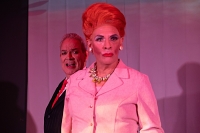
A Loving, Delight‑Packed Celebration: Joan Crawford Goes to Hell Marks 25 Years of Handbag
31 August 2026 in Theatre in ReviewHell in a Handbag Productions celebrates its 25th year with a revival of Joan Crawford Goes to Hell, a sharp,…

An Immersive Sunday in the Park with George at Kokandy Productions
31 August 2026 in Theatre in ReviewComposition, tension, balance, light, and harmony come together seamlessly in Kokandy Productions’ revival of Sondheim’s opus, ‘Sunday in the Park…

Robert Falls to Direct the World Premiere of FLYING MONKEYS, by L.C. Bernadine, at Redtwist Theatre, Dec 6 - Jan 17
31 August 2026 in Upcoming TheatreAward-winning Redtwist Theatre, launching its 22nd season with Prayer Circle, September 17 - November 8, by Erik Gernand and directed by Executive Artistic Director Dusty Brown, announces today…

Buffalo Theatre Ensemble Names Daniel Millhouse as New Managing Artistic Director
31 August 2026 in Theatre BuzzBuffalo Theatre Ensemble (BTE), the professional theater company in residence at the McAninch Arts Center (MAC), is pleased to announce that, in keeping…

Promethean Theatre Ensemble to offer talkbacks after selected performances BLOOD OF THE LAMB, opening September 5 and 6
31 August 2026 in Upcoming TheatrePromethean Theatre Ensemble announced today it will offer post-show audience talkbacks following two performances of their Chicago premiere of BLOOD OF…

City Lit’s Shane Saddles Up a Classic Western With Fresh Heart
30 August 2026 in Theatre in ReviewCity Lit Theatre’s world premiere of Shane, adapted for the stage and directed by Mark Pracht, brings a fresh, nostalgic…

In Sisters, Barrie Turns an AI Fable into an Impressive Character Study
29 August 2026 in Theatre in ReviewThe rise of artificial intelligence raises many questions about its effect on humanity. What does it mean if we become…

Buddy Holly’s Brilliance, Reawakened on the Drury Lane Stage
27 August 2026 in Theatre in ReviewDrury Lane Theatre opens its latest musical with a warm jolt of rock ’n’ roll energy as Buddy – The…

Kokandy's JEKYLL & HYDE Extended by Popular Demand
26 August 2026 in Upcoming TheatreBroadway In Chicago is pleased to announce a darkly delicious Halloween surprise: Kokandy Productions’ critically acclaimed revival of JEKYLL & HYDE will be extended…

Following Obama Center premiere, Manual Cinema's acclaimed productions return to Chicago's Studebaker Theater
26 August 2026 in Upcoming TheatreChicago-based Emmy Award-winning performance collective and film/video production company Manual Cinema premiered two new hand-animated films at the Obama Presidential Center Museum…

Playmakers Lab’s That’s Weird Grandma’s 25th Birthday is a fine place to giggle
25 August 2026 in Theatre in ReviewIf you need an energy boost, skip the can of Monster and get yourself, plus loved ones of any age,…

Victory Gardens Theater presents the World Premiere of Zayd Ayers Dohrn's The Humanities September 10 through October 4
25 August 2026 in Upcoming TheatreVictory Gardens Theater (2433 N. Lincoln Avenue), an historic incubator for new play development, proudly announces the World Premiere staging of The…

Lookingglass Kowalski starring Johnny Galecki and Jacob Moskovitz September 15 through October 25
25 August 2026 in Upcoming TheatreJoining the previously announced stars of Kowalski Johnny Galecki ("The Big Bang Theory," "The Little Dog Laughed") as Tennessee Williams and Jacob Moskovitz ("Elle") as Marlon…

Shattered Globe Theatre Opens 36th Season with Midwest Premiere of VLADIMIR October 2 – November 14 at Theater Wit
25 August 2026 in Upcoming TheatreShattered Globe Theatre is pleased to open its 36th Season with the Midwest premiere of Erika Sheffer's Vladimir, an unflinching drama of resistance directed by Ensemble Member Lou Contey*,…

TICKETS FOR A 20 RETURNS WITH SPECIALLY PRICED $20 TICKETS FROM HOT TIX AUGUST 27-SEPTEMBER 14, 2026
24 August 2026 in Theatre BuzzThe League of Chicago Theatres announces the return of Tickets for a 20. From Thursday, August 27 through Monday, September 14, 2026, theatregoers can…

Babes With Blades's announces William Shakespeare's KING LEAR, October 15 - November 21
24 August 2026 in Upcoming TheatreBabes With Blades Theatre Company’s (BWBTC), now presenting the world premiere of yo ho. through August 29 at The Edge Off-Broadway, shares the…

BrightSide Theatre announces THE ADDAMS FAMILY MUSICAL, to play October 2 - 18
24 August 2026 in Upcoming TheatreBrightSide Theatre has announced cast and crew for THE ADDAMS FAMILY MUSICAL - the kickoff production of BrightSide's 15th Anniversary season.…

35th Annual Dance for Life Saturated with Excellence
23 August 2026 in Dance in ReviewFrom its beginning in 1992 on the tiny stage of a modest theater, Dance for Life (DFL) has grown and…

Chicago Shakespeare Theater announces Two Shakespeare Productions in Repertory beginning October 13 - January 3
21 August 2026 in Upcoming TheatreChicago Shakespeare Theater (CST) announces the cast and creative team for the company's fall Shakespeare Repertory productions, an unforgettable theatrical event at the heart…

Rising star Jacob Moskovitz to play Marlon Brando in the Chicago presentation of Kowalski at Lookingglass Theatre
20 August 2026 in Theatre in ReviewRising star Jacob Moskovitz ("Elle") has joined the cast of Kowalski as Marlon Brando, alongside previously announced Chicago theater veteran Johnny Galecki ("The Big Bang Theory," "The Little…

McHenry Outdoor Theater: Nostalgia With a Modern Heartbeat
20 August 2026 in Theatre BuzzThere was a particular kind of magic to seeing a movie outside when I was a kid in 1970s Chicago…

‘Anatomy of a Suicide’ Is Hard to Watch, But Not Because of the Subject
18 August 2026 in Theatre in ReviewPerhaps surprisingly, Anatomy of a Suicide is not an overwhelmingly emotionally gripping play, nor is it horrifying. Instead, it vividly…

Gwydion Theatre Company presents The Chicago Premiere of Por’ Knockers at the Greenhouse Theater’s Studio 44 September 10 - October 4
18 August 2026 in Upcoming TheatreThis narrative tracks five individuals within the "People’s Diasporatic Party"—outfitted in corporate attire—as they take refuge in a desolate East…



Latest Articles
-
Standing Room Only Crowd for Chicago’s Leading Theater Artistic Directors
Written by Bill EslerIt must have been heavenly for the creative leaders of Goodman, Steppenwolf, Chicago Shakespeare and Court, Chicago’s top regional theaters, to be greeted by a standing room only crowd. But there they were, on a panel moderated by the eminent…
-
 The Best of Us: Marriott Theatre’s Come From Away
Written by Kimberly KatzCome From Away begins from a place of deep uncertainty, yet what emerges is a story grounded in the steady, everyday kindness people offer when they have nothing else to give. Rather than revisiting the events of September 11 themselves,…
The Best of Us: Marriott Theatre’s Come From Away
Written by Kimberly KatzCome From Away begins from a place of deep uncertainty, yet what emerges is a story grounded in the steady, everyday kindness people offer when they have nothing else to give. Rather than revisiting the events of September 11 themselves,… -
 Steppenwolf Theatre Presents Revival of TOPDOG/UNDERDOG September 17 – November 1 / Rehearsals Underway
Written by Buzz Center StageSteppenwolf Theatre Company, the nation's premier ensemble theater company, is pleased to launch its 51st Season with Suzan-Lori Parks' Pulitzer Prize-winning drama Topdog/Underdog, helmed by Tony Award-winning director Kenny Leon, who returns to Steppenwolf following his hit production of King James. Ensemble members Glenn Davis (Windfall, Purpose–Chicago/Broadway, King James) and Namir Smallwood (Windfall, The Book of…
Steppenwolf Theatre Presents Revival of TOPDOG/UNDERDOG September 17 – November 1 / Rehearsals Underway
Written by Buzz Center StageSteppenwolf Theatre Company, the nation's premier ensemble theater company, is pleased to launch its 51st Season with Suzan-Lori Parks' Pulitzer Prize-winning drama Topdog/Underdog, helmed by Tony Award-winning director Kenny Leon, who returns to Steppenwolf following his hit production of King James. Ensemble members Glenn Davis (Windfall, Purpose–Chicago/Broadway, King James) and Namir Smallwood (Windfall, The Book of… -
 Chicago Black Dance Legacy Project Gala: Radiant & Sumptuous at the Harris
Written by Mitchell OldhamThe first thing you notice about the meticulously curated Black dance performance held at the Harris Theater over the weekend is language. The eloquence and weight of the words used to explain why the Chicago Black Dance Legacy Project (CBDLP)…
Chicago Black Dance Legacy Project Gala: Radiant & Sumptuous at the Harris
Written by Mitchell OldhamThe first thing you notice about the meticulously curated Black dance performance held at the Harris Theater over the weekend is language. The eloquence and weight of the words used to explain why the Chicago Black Dance Legacy Project (CBDLP)…


Does your theatre company want to connect with Buzz Center Stage or would you like to reach out and say "hello"? Message us through facebook or shoot us an email at This email address is being protected from spambots. You need JavaScript enabled to view it..
*This disclaimer informs readers that the views, thoughts, and opinions expressed in the text belong solely to the author, and not necessarily to Buzz Center Stage. Buzz Center Stage is a non-profit, volunteer-based platform that enables, and encourages, staff members to post their own honest thoughts on a particular production.